

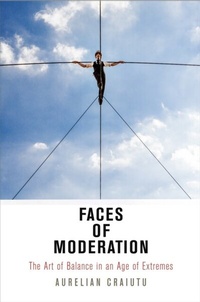
Faces of Moderation
The Art of Balance in an Age of Extremes
1st Edition
Published on 29. November 2016
304 pages
978-0-8122-9351-7 (ISBN)
Description

Aristotle listed moderation as one of the moral virtues. He also defined virtue as the mean between extremes, implying that moderation plays a vital role in all forms of moral excellence. But moderation's protean character-its vague and ill-defined omnipresence in judgment and action-makes it exceedingly difficult to grasp theoretically. At the same time, moderation seems to be the foundation of many contemporary democratic political regimes, because the competition between parties cannot properly function without compromise and bargaining. The success of representative government and its institutions depends to a great extent on the virtue of moderation, yet the latter persists in being absent from both the conceptual discourse of many political philosophers and the campaign speeches of politicians fearful of losing elections if they are perceived as moderates.
Aurelian Craiutu aims to resolve this paradox. Examining the writings of prominent twentieth-century thinkers such as Raymond Aron, Isaiah Berlin, Norberto Bobbio, Michael Oakeshott, and Adam Michnik, he addresses the following questions: What does it mean to be a moderate voice in political and public life? What are the virtues and limits of moderation? Can moderation be the foundation for a successful platform or party? Though critics maintain that moderation is merely a matter of background and personal temperament, Craiutu finds several basic norms that have consistently appeared in different national and political contexts. The authors studied in this book defended pluralism of ideas, interests, and social forces, and sought to achieve a sound balance between them through political trimming. They shared a preoccupation with political evil and human dignity, but refused to see the world in Manichaean terms that divide it neatly into the forces of light and those of darkness. Faces of Moderation argues that moderation remains crucial for today's encounters with new forms of extremism and fundamentalism across the world.
Aurelian Craiutu aims to resolve this paradox. Examining the writings of prominent twentieth-century thinkers such as Raymond Aron, Isaiah Berlin, Norberto Bobbio, Michael Oakeshott, and Adam Michnik, he addresses the following questions: What does it mean to be a moderate voice in political and public life? What are the virtues and limits of moderation? Can moderation be the foundation for a successful platform or party? Though critics maintain that moderation is merely a matter of background and personal temperament, Craiutu finds several basic norms that have consistently appeared in different national and political contexts. The authors studied in this book defended pluralism of ideas, interests, and social forces, and sought to achieve a sound balance between them through political trimming. They shared a preoccupation with political evil and human dignity, but refused to see the world in Manichaean terms that divide it neatly into the forces of light and those of darkness. Faces of Moderation argues that moderation remains crucial for today's encounters with new forms of extremism and fundamentalism across the world.
Reviews / Votes
"Superb and timely." (Peter Wehner, New York Times) "I've been inspired by Aurelian Craiutu's great book Faces of Moderation." (David Brooks, New York Times) "[Craiutu] has written a work that challenges readers to consider the complexity of moderation, raising interesting questions about its effects and contexts, and has thereby enriched the discussion. In the spirit of the moderates, may the conversation continue so this virtue and others are better appreciated." (Society) "Stimulating and learned, Faces of Moderation displays the virtue of moderation in the very act of highlighting exemplary cases of the virtue in action from throughout the twentieth-century, granting readers a grounded understanding of its uses and limits. Aurelian Craiutu's conclusion, with its call for moderation in a hyperpartisan age, is intellectually moving and lyrically written." (Samuel Moyn, Yale University) "Aurelian Craiutu is devoted to rehabilitating what he believes to be, correctly in my view, the forgotten virtue of moderation. He demonstrates a considerable mastery of the topic and his knowledge of the central figures is impeccable." (Steven Smith, Yale University)More details
Series
Language
English
Place of publication
Pennsylvania
United States
Target group
College/higher education
File size
0,80 MB
ISBN-13
978-0-8122-9351-7 (9780812293517)
Copyright in bibliographic data and cover images is held by Nielsen Book Services Limited or by the publishers or by their respective licensors: all rights reserved.
Schweitzer Classification
Other editions
Additional editions
Book
03/2018
University of Pennsylvania Press
€33.00
Shipment within 10-20 days
Book
01/2017
University of Pennsylvania Press
€97.50
Shipment within 10-20 days
Person
Aurelian Craiutu is Professor of Political Science at Indiana University, Bloomington. He is author and editor of several books on French political thought, most recently A Virtue for Courageous Minds: Moderation in French Political Thought, 1748-1830.
Content
Prologue. In Search of an Elusive Virtue
Chapter 1. The Ethos of Moderation
Chapter 2. The Lucidity of Moderation: Raymond Aron as a "Committed Observer"
Chapter 3. Moderation as an Antidote to Monism: Isaiah Berlin's Cold War Liberalism
Chapter 4. Meekness as a Face of Moderation: Norberto Bobbio's Politics of Dialogue
Chapter 5. Moderation and Trimming: Michael Oakeshott's Politics of Skepticism
Chapter 6. Radical Moderation and the Search for Moral Clarity: Adam Michnik's Lesson
Epilogue. Beyond the Golden Mean
Notes
Bibliography
Index
Acknowledgments
Chapter 1. The Ethos of Moderation
Chapter 2. The Lucidity of Moderation: Raymond Aron as a "Committed Observer"
Chapter 3. Moderation as an Antidote to Monism: Isaiah Berlin's Cold War Liberalism
Chapter 4. Meekness as a Face of Moderation: Norberto Bobbio's Politics of Dialogue
Chapter 5. Moderation and Trimming: Michael Oakeshott's Politics of Skepticism
Chapter 6. Radical Moderation and the Search for Moral Clarity: Adam Michnik's Lesson
Epilogue. Beyond the Golden Mean
Notes
Bibliography
Index
Acknowledgments
