

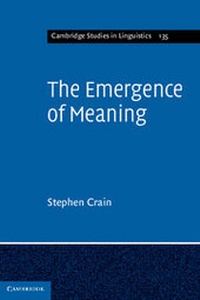
The Emergence of Meaning
1st Edition
Published on 11. September 2012
201 pages
978-1-139-55784-9 (ISBN)
Description

Over the past forty years, scientists have developed models of human reasoning based on the principle that human languages and classical logic involve fundamentally different concepts and different methods of interpretation. In The Emergence of Meaning Stephen Crain challenges this view, arguing that a common logical nativism underpins human language and logical reasoning. The approach which Crain takes is twofold. Firstly, he uncovers the underlying meanings of logical expressions and logical principles that appear in typologically different languages - English and Mandarin Chinese - and he demonstrates that these meanings and principles directly correspond to the expressions and structures of classical logic. Secondly he reports the findings of new experimental studies which investigate how children acquire the logical concepts of these languages. A step-by-step introduction to logic and a comprehensive review of the literature on child language acquisition make this work accessible to those unfamiliar with either field.
Reviews / Votes
'This careful and sophisticated study provides powerful empirical evidence, from many sources, for logical nativism, the thesis that human languages make use of the logical concepts and laws of classical logic, and that these are contingent facts that are not learned and not required for a rational creature. It extends the conclusion to other aspects of natural language, its acquisition and use. The conclusions are compelling, and of great import for linguistics, philosophical logic, and psychology of language and mind quite generally.' Noam Chomsky, Massachusetts Institute of Technology 'In this lucid study of how children understand logical vocabulary, Crain makes a powerful case for a substantive form of logical nativism. Using tools from classical logic and generative grammar, he unifies a range of individually impressive experimental results, thereby illustrating his fruitful method for investigating how semantic and logical competences are related.' Paul M. Pietroski, University of Maryland 'New and deep ideas are a rarity in the study of language acquisition, and Stephen Crain's The Emergence of Meaning has plenty of both. This is likely to be considered one of the most important books in language acquisition in years.' Steven Pinker, Harvard College Professor of Psychology, Harvard University, and author of The Language Instinct and The Stuff of ThoughtMore details
Series
Language
English
Place of publication
Cambridge
United Kingdom
Publishing group
Cambridge University Press
Target group
Professional and scholarly
Illustrations
16 Halftones, unspecified; 13 Line drawings, unspecified
File size
4426,09 MB
ISBN-13
978-1-139-55784-9 (9781139557849)
Copyright in bibliographic data and cover images is held by Nielsen Book Services Limited or by the publishers or by their respective licensors: all rights reserved.
Schweitzer Classification
Other editions
Additional editions
Stephen Crain
The Emergence of Meaning
Book
08/2012
Cambridge University Press
€136.20
Shipment within 15-20 days
Stephen Crain
The Emergence of Meaning
Book
08/2012
Cambridge University Press
€47.40
Shipment within 15-20 days
Person
Stephen Crain is a Distinguished Professor at Macquarie University and a fellow of the Academy of Social Sciences in Australia. He is also Director of the Australian Research Council Centre of Excellence in Cognition and its Disorders.
Content
1. Logic and human languages; 2. Competing approaches to language and logic; 3. The case for logical nativism; 4. Scope parameters; 5. How something can be both positive and negative; 6. Two logical operators for the price of one.
