

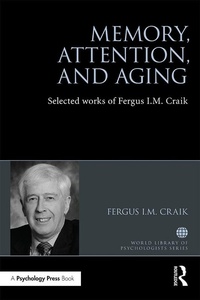
Memory, Attention, and Aging
Selected Works of Fergus I. M. Craik
Published on 26. October 2016
340 pages
978-1-315-44043-9 (ISBN)
Description

Memory, Attention, and Aging is a collection of some of the most influential journal articles previously published by Fergus Craik and his collaborators, with new introductory material unifying the research of this noted cognitive psychologist. The reprinted articles are grouped into six sections reflecting Craik's various research interests across his career.
The first section on short-term memory focuses on research concerns Craik uncovered in the 1970s, but are still valid today. They comprise theoretical suggestions and data on the nature of STM, including the notion that working memory may be defined as attention paid to features of items held in conscious awareness. The second section on levels of processing contains the very influential articles by Craik & Lockhart and by Craik & Tulving on memory research, in addition to a later article in which Craik gives a critical account of the LOP work. Craik's third interest is in cognitive aging. The section contains two articles from the 1980s in which Craik lays out his ideas on age-related changes in memory, plus a more recent article addressing lifespan changes in cognition. The fourth section on attention and memory has two articles that report on the effects of divided attention on subsequent memory, and differences between implicit and explicit memory processes. The fifth section on cognitive neuroscience includes an early PET study probing neural correlates of LOP, and a study searching for the neural correlates of the "self" concept. Finally, the sixth section contains an article on bilingualism that explores age-related differences in executive functions as a consequence of bilingualism, and a study showing that bilingualism postpones the onset of Alzheimer's disease.
Grouping the most highly cited and groundbreaking articles of Fergus Craik in one volume, this book will be of interest to a wide spectrum of students and professional researchers.
The first section on short-term memory focuses on research concerns Craik uncovered in the 1970s, but are still valid today. They comprise theoretical suggestions and data on the nature of STM, including the notion that working memory may be defined as attention paid to features of items held in conscious awareness. The second section on levels of processing contains the very influential articles by Craik & Lockhart and by Craik & Tulving on memory research, in addition to a later article in which Craik gives a critical account of the LOP work. Craik's third interest is in cognitive aging. The section contains two articles from the 1980s in which Craik lays out his ideas on age-related changes in memory, plus a more recent article addressing lifespan changes in cognition. The fourth section on attention and memory has two articles that report on the effects of divided attention on subsequent memory, and differences between implicit and explicit memory processes. The fifth section on cognitive neuroscience includes an early PET study probing neural correlates of LOP, and a study searching for the neural correlates of the "self" concept. Finally, the sixth section contains an article on bilingualism that explores age-related differences in executive functions as a consequence of bilingualism, and a study showing that bilingualism postpones the onset of Alzheimer's disease.
Grouping the most highly cited and groundbreaking articles of Fergus Craik in one volume, this book will be of interest to a wide spectrum of students and professional researchers.
More details
Series
Language
English
Place of publication
London
United Kingdom
Publishing group
Taylor & Francis Ltd
Target group
College/higher education
Illustrations
29 Tables, black and white; 33 Line drawings, black and white
File size
2,60 MB
ISBN-13
978-1-315-44043-9 (9781315440439)
Copyright in bibliographic data and cover images is held by Nielsen Book Services Limited or by the publishers or by their respective licensors: all rights reserved.
Schweitzer Classification
Other editions
Additional editions
Book
01/2023
1st Edition
Routledge
€72.06
Shipment within 10-20 days
Book
11/2016
1st Edition
Routledge
€232.40
Shipment within 10-20 days
Person
Fergus I. M. Craik is a cognitive psychologist whose research interests include human memory and cognitive aging. He is a Senior Scientist at the Rotman Research Institute in Toronto, and a University Professor Emeritus at the University of Toronto.
Content
Introduction
Part 1: Short-term or "Primary Memory"
Primary Memory (Craik 1971)
The Fate of Primary Memory Items in Free Recall (Craik 1970)
The Role of Rehearsal in Short-Term Memory (Craik & Watkins 1973)
Part 2: Levels of Processing
Levels of Processing: A Framework for Memory Research (Craik & Lockhart 1972)
Depth of Processing and the Retention of Words in Episodic Memory (Craik & Tulving 1975)
Levels of Processing: Past, Present...and Future? (Craik 2002)
Part 3: Studies of Cognitive Aging
Aging and Cognitive Deficits: The Role of Attentional Resources (Craik & Byrd 1982)
A Functional Account of Age Differences in Memory (Craik 1986)
Cognition through the Lifespan: Mechanisms of Change (Craik & Bialystok 2006)
Part 4: Attention and Memory
The Effects of Divided Attention on Encoding and Retrieval Processes in Human Memory (Craik et al 1996)
Contributions of Surface and Conceptual Information to Performance on Implicit and Explicit Memory Tasks (Craik, Moscovitch, & McDowd 1994)
Part 5: Cognitive Neuroscience
Neuroanatomical Correlates of Encoding in Episodic Memory: Levels of Processing Effect (Kapur et al 1994)
In Search of the Self: A Positron Emission Tomography Study (Craik et al 1999)
Part 6: Bilingual Studies
Cognitive Control and Lexical Access in Younger and Older Bilinguals (Bialystok, Craik, & Luk 2008)
Delaying the Onset of Alzheimer's Disease: Bilingualism as a Form of Cognitive Reserve (Craik, Bialystok, & Freedman 2010)
Part 1: Short-term or "Primary Memory"
Primary Memory (Craik 1971)
The Fate of Primary Memory Items in Free Recall (Craik 1970)
The Role of Rehearsal in Short-Term Memory (Craik & Watkins 1973)
Part 2: Levels of Processing
Levels of Processing: A Framework for Memory Research (Craik & Lockhart 1972)
Depth of Processing and the Retention of Words in Episodic Memory (Craik & Tulving 1975)
Levels of Processing: Past, Present...and Future? (Craik 2002)
Part 3: Studies of Cognitive Aging
Aging and Cognitive Deficits: The Role of Attentional Resources (Craik & Byrd 1982)
A Functional Account of Age Differences in Memory (Craik 1986)
Cognition through the Lifespan: Mechanisms of Change (Craik & Bialystok 2006)
Part 4: Attention and Memory
The Effects of Divided Attention on Encoding and Retrieval Processes in Human Memory (Craik et al 1996)
Contributions of Surface and Conceptual Information to Performance on Implicit and Explicit Memory Tasks (Craik, Moscovitch, & McDowd 1994)
Part 5: Cognitive Neuroscience
Neuroanatomical Correlates of Encoding in Episodic Memory: Levels of Processing Effect (Kapur et al 1994)
In Search of the Self: A Positron Emission Tomography Study (Craik et al 1999)
Part 6: Bilingual Studies
Cognitive Control and Lexical Access in Younger and Older Bilinguals (Bialystok, Craik, & Luk 2008)
Delaying the Onset of Alzheimer's Disease: Bilingualism as a Form of Cognitive Reserve (Craik, Bialystok, & Freedman 2010)
