

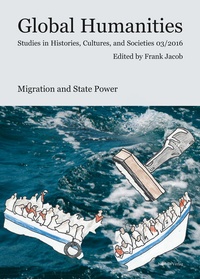
Migration and State Power
Description

The current situation in Europe seems to emphasize that our modern society is still not ready to accept migration as an important part of human history. Instead of welcoming immigrants and refugees with open arms, state power is trying to restrict asylum for those who are in need. The reasons, why people leave their home countries are different: human trafficking, prosecution, war, or just the hope for a better future. Despite the ethical and moral perspective and the duty of a modern democratic state to support those in need, restrictions and limitations of civil rights often seem to be the sole answer. While the members of the European Union are accusing each other, a solution for the problem of refugee migration is far away.
The relationship between migration and state power has always been difficult. To highlight its history the third volume of Global Humanities deals with the philosophy and the history of this interrelationship as well as its reception in popular media. It analyzes the difficulties with regard to migration and state power from Huguenot France to Korea and Taiwan after 1945. Furthermore, by providing historical case studies, it shows that the problems of migration movements are not new at all and that there have always been similarities with regard to the reaction to those movements, which more than resembles the actual situation in Europe and other parts of the world.
More details
Other editions
Additional editions
Persons
Frank Jacob (Dr. phil.) ist Assistant Professor für Welt- und Globalgeschichte an der City University of New York (QCC). Er hat in Würzburg und Osaka Geschichte und Japanologie studiert und wurde 2012 mit einer Arbeit zu Geheimgesellschaften in Deutschland und Japan promoviert. Seitdem beschäftigt er sich mit verschiedenen komparativ-historischen Projekten, vor allem im Bereich der Kulturgeschichte. Zu seinen Forschungsschwerpunkten zählen die moderne Geschichte Japans, die deutsche Geschichte des 19. und 20. Jahrhunderts sowie Globalgeschichte in vergleichender Perspektive. Er ist unter anderem Herausgeber der Reihe Wissen über Waren - Historische Studien zu Nahrungs- und Genussmitteln (Nomos) und arbeitet aktuell an einer Untersuchung der Internationalisierung des Tabakhandels im 16. und 17. Jahrhundert.
Content
- Cover
- Half Title
- Title Page
- Colophon
- Table of Contents
- Editorial
- Migration, State Power, and Philosophy
- Risse: The Sovereign and the Individual
- Migration, State Power, and History
- Douglas: Nîmes and the Huguenot Cross
- Craig: Punishment, Forced Migration and Political Power in the Early Modern British Atlantic, 1660-1730
- Kachina: From Russia to America
- Kachina: "Nothing Can Keep Me in This Country Any Longer"
- Jacob: The End of an Empire, the Beginning of Migration, and the Fate of Settler Colonialists
- Rabenschlag: Negotiating Anti-Racism
- Migration, State Power, and Popular Media
- Wallenbrock: Clandestine Boat Immigration in French Film
- Reviews
- Table of Figures
