

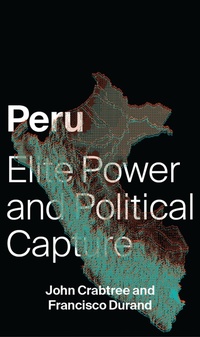
Peru
Elite Power and Political Capture
1st Edition
Published on 15. May 2017
256 pages
978-1-78360-906-2 (ISBN)
Description

While leftist governments have been elected across Latin America, this 'Pink Tide' has so far failed to reach Peru. Instead, the corporate elite remains firmly entrenched, and the left continues to be marginalised. Peru therefore represents a particularly stark example of 'state capture', in which an extreme concentration of wealth in the hands of a few corporations and pro-market technocrats has resulted in a monopoly on political power.
Post the 2016 elections, John Crabtree and Francisco Durand look at the ways in which these elites have been able to consolidate their position at the expense of genuine democracy, with a particular focus on the role of mining and other extractive industries, where extensive privatization and deregulation has contributed to extreme disparities in wealth and power.
In the process, Crabtree and Durand provide a unique case study of state development, by revealing the mechanisms used by elites to dominate political discussion and marginalize their opponents, as well as the role played by external actors such as international financial institutions and foreign investors. The significance of Crabtree's findings therefore extends far beyond Peru, and illuminates the wider issue of why mineral-rich countries so often struggle to attain meaningful democracy.
Post the 2016 elections, John Crabtree and Francisco Durand look at the ways in which these elites have been able to consolidate their position at the expense of genuine democracy, with a particular focus on the role of mining and other extractive industries, where extensive privatization and deregulation has contributed to extreme disparities in wealth and power.
In the process, Crabtree and Durand provide a unique case study of state development, by revealing the mechanisms used by elites to dominate political discussion and marginalize their opponents, as well as the role played by external actors such as international financial institutions and foreign investors. The significance of Crabtree's findings therefore extends far beyond Peru, and illuminates the wider issue of why mineral-rich countries so often struggle to attain meaningful democracy.
Reviews / Votes
An ambitious attempt to tackle a long-standing puzzle: what stopped Peru from joining the 'Left turn' in recent Latin American history? * Journal of Latin American Studies * In this learned, elegant and very readable study of Peru, Crabtree and Durand interrogate the scholarship on political capture as well as addressing the power of corporate interests, the machinations of the governing class and the relative weakness of civil society. * Barrie Axford, Oxford Brookes University * Through cutting-edge research and rich insights, the authors explain how business elites have ensured that free-market economic policies stay on autopilot through successive governments. A must read for those seeking to understand the deep inequities that plague Peru today. * Coletta Youngers, Senior Fellow, Washington Office on Latin America * The breadth and depth of this book are stunning. Crabtree and Durand are two of the world's leading authorities on Peru's political economy. In this book, they brilliantly analyze how, amid an atomized civil society, economic elites have controlled policy-making in Peru from independence through 2016. * Cynthia McClintock, George Washington University * A timely, thorough and original volume. Their examination of why Peru has been a notable exception to Latin America's move to the center-left and their insistence on what they term "elite capture" as a necessary explanation make it required reading. * Henry Dietz, University of Texas at Austin (Emeritus) * A comprehensive, historically-grounded, and theoretically sophisticated interpretation of Peru. At a time when Peru's political establishment is being rocked by the Odebrecht scandal, this book is essential reading. * Maxwell Cameron, University of British Columbia * An insightful and empirically rich work that makes sense of the Peruvian puzzle of economic growth contrasted with popular disaffection. This is a valuable resource for anybody interested in understanding how economic elites subvert democratic institutions in the region. * Peter Kingstone, King's College London *More details
Edition
1. Auflage
Language
English
Place of publication
United Kingdom
Publishing group
Bloomsbury Publishing PLC
Target group
College/higher education
ISBN-13
978-1-78360-906-2 (9781783609062)
Copyright in bibliographic data and cover images is held by Nielsen Book Services Limited or by the publishers or by their respective licensors: all rights reserved.
Schweitzer Classification
Other editions
Additional editions
Book
05/2017
Zed Books Ltd
€117.20
Shipment within 3-4 weeks
Persons
John Crabtree is a Research Associate at the Latin American Studies Centre, University of Oxford, a Senior Member of Saint Antony's College, Oxford, and (currently) a Visiting Researcher at Oxford Brookes University, Oxford. His most recent published books are Bolivia: Processes of Change co-authored with Ann Chaplin (Zed 2013), and Fractured Politics: Peruvian Democracy Past and Present (2011).
Francisco Durand is a Research Associate at DESCO-Centro de Estudios de Promocion del Desarrollo and Professor of Politics at the Catholic University of Peru (PUCP). His books in English include Business and Politics in Peru (1993), and Organized Business, Democracy and Economic Change (1996).
Francisco Durand is a Research Associate at DESCO-Centro de Estudios de Promocion del Desarrollo and Professor of Politics at the Catholic University of Peru (PUCP). His books in English include Business and Politics in Peru (1993), and Organized Business, Democracy and Economic Change (1996).
Content
Introduction
1. A Conceptual and Historical Introduction to Political Capture
2. Development of the Peruvian State since Independence
3. State Autonomy and Peruvian Elites
4. The Birth of the Neoliberal State
5. The Power of the New Elites
6. Problems of Distribution, Poverty and Decentralisation
7. The Deficiencies of a Disconnected State
8. Conclusions
Bibliography
Index
1. A Conceptual and Historical Introduction to Political Capture
2. Development of the Peruvian State since Independence
3. State Autonomy and Peruvian Elites
4. The Birth of the Neoliberal State
5. The Power of the New Elites
6. Problems of Distribution, Poverty and Decentralisation
7. The Deficiencies of a Disconnected State
8. Conclusions
Bibliography
Index
