

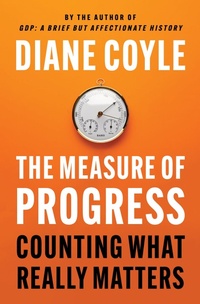
The Measure of Progress
Counting What Really Matters
1st Edition
Published on 18. February 2025
320 pages
978-0-691-27128-6 (ISBN)
Description

Why do we use eighty-year-old metrics to understand today's economy?
The ways that statisticians and governments measure the economy were developed in the 1940s, when the urgent economic problems were entirely different from those of today. In The Measure of Progress, Diane Coyle argues that the framework underpinning today's economic statistics is so outdated that it functions as a distorting lens, or even a set of blinkers. When policymakers rely on such an antiquated conceptual tool, how can they measure, understand, and respond with any precision to what is happening in today's digital economy? Coyle makes the case for a new framework, one that takes into consideration current economic realities.
Coyle explains why economic statistics matter. They are essential for guiding better economic policies; they involve questions of freedom, justice, life, and death. Governments use statistics that affect people's lives in ways large and small. The metrics for economic growth were developed when a lack of physical rather than natural capital was the binding constraint on growth, intangible value was less important, and the pressing economic policy challenge was managing demand rather than supply. Today's challenges are different. Growth in living standards in rich economies has slowed, despite remarkable innovation, particularly in digital technologies. As a result, politics is contentious and democracy strained.
Coyle argues that to understand the current economy, we need different data collected in a different framework of categories and definitions, and she offers some suggestions about what this would entail. Only with a new approach to measurement will we be able to achieve the right kind of growth for the benefit of all.
The ways that statisticians and governments measure the economy were developed in the 1940s, when the urgent economic problems were entirely different from those of today. In The Measure of Progress, Diane Coyle argues that the framework underpinning today's economic statistics is so outdated that it functions as a distorting lens, or even a set of blinkers. When policymakers rely on such an antiquated conceptual tool, how can they measure, understand, and respond with any precision to what is happening in today's digital economy? Coyle makes the case for a new framework, one that takes into consideration current economic realities.
Coyle explains why economic statistics matter. They are essential for guiding better economic policies; they involve questions of freedom, justice, life, and death. Governments use statistics that affect people's lives in ways large and small. The metrics for economic growth were developed when a lack of physical rather than natural capital was the binding constraint on growth, intangible value was less important, and the pressing economic policy challenge was managing demand rather than supply. Today's challenges are different. Growth in living standards in rich economies has slowed, despite remarkable innovation, particularly in digital technologies. As a result, politics is contentious and democracy strained.
Coyle argues that to understand the current economy, we need different data collected in a different framework of categories and definitions, and she offers some suggestions about what this would entail. Only with a new approach to measurement will we be able to achieve the right kind of growth for the benefit of all.
More details
Other editions
Additional editions
Book
approx. 09/2026
Princeton University Press
€24.00
Not yet published
Book
04/2025
Princeton University Press
€28.50
Shipment within 10-20 days
Person
Diane Coyle is the Bennett Professor of Public Policy at the University of Cambridge. She is the author of Cogs and Monsters: What Economics Is and What It Should Be, GDP: A Brief but Affectionate History (both Princeton), and many other books.
