

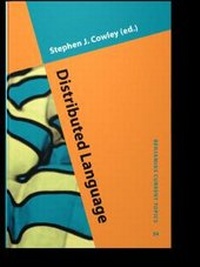
Distributed Language
1st Edition
Published on 5. October 2011
IX, 220 pages
978-90-272-8415-0 (ISBN)
Description

The volume presents language as fully integrated with human existence. On this view, language is not essentially 'symbolic', not represented inside minds or brains, and most certainly not determined by micro-social rules and norms. Rather, language is part of our ecology. It emerges when bodies co-ordinate vocal and visible gesture to integrate events with different histories. Enacting feeling, expression and wordings, language permeates the collective, individual and affective life of living beings. It is a profoundly distributed, multi-centric activity that binds people together as they go about their lives. Distributed Language pursues this perspective both theoretically and in relation to empirical work. Empirically, it reports studies on the anticipatory dynamics of reading, its socio-cognitive consequences, Shakespearean theatre, what images evoke (in brain and word), and solving insight problems. Theoretically, the volume challenges linguistic autonomy from overlapping theoretical positions. First, it is argued that language exploits a species specific form of semiotic cognition. Second, it is suggested that the central function of language lies in realizing values that derive from our ecosystemic existence. Third, this is ascribed to how cultural and biological symbols co-regulate the dynamics that shape human activity. Fourth, it is argued that language, far from being organism-centred, gives us an extended ecology in which our co-ordination is saturated by values and norms that are derived from our sociocultural environment. The contributions to this volume expand on those originally published in Pragmatics & Cognition 17:3 (2009).
More details
Other editions
Additional editions
Stephen J. Cowley
Distributed Language
Book
10/2011
John Benjamins Publishing Co
€90.10
Shipment within 10-15 days
Person
Content
- Distributed Language
- Editorial page
- Title page
- LCC data
- Table of contents
- About the Authors
- Distributed language
- 1. Beyond symbol processing
- 2. The distributed perspective
- 3. The Distributed Language Movement: Prehistory
- 4. Language: ecological, dialogical and non-local
- 5. Investigating the glue of cognition
- 6. Imbumba: doing things together
- 7. Future Prospects
- Notes
- References
- The role of anticipation in reading
- 1. Introduction
- 2. Information processing or anticipation?
- 3. Fixation-speech interval (FSI) as a measure of temporal dynamics in reading
- 3.1 FSI and type of text
- 3.2 FSI in relation to articulation, sentence structure, and reading experience
- 3.3 FSI: Implications for reading
- 4. Anticipatory dynamics in reading
- 4.1 The concept of anticipation
- 4.2 Neural models of anticipation
- 5. Reading as generation of meaning
- 5.1 The unit of meaning in reading
- 5.2 Silent and oral reading
- Notes
- References
- The experiential basis of speech and writing as different cognitive domains
- 1. Speech, text, and dynamics
- 2. The linguist's view of literacy
- 3. Languaging and experience
- 4. The cognitive domain of written marks
- 5. Beyond code models of language
- 6. Conclusion
- Notes
- References
- Insightful thinking
- 1. Prelude
- 2. Insight in internalist tradition
- 2.1 Information-processing models
- 3. Externalist extensions
- 4. The cheap necklace problem
- 4.1 Experiment 1: Paper and pen versus concretized versions
- 4.2 Experiment 2: The open links experiment
- 5. The experiments in theoretical context
- 5.1 Beyond internalism
- 5.2 Extended mind or distributed cognition?
- 5.3 The parallel with language
- 6. Insight spreads
- Notes
- References
- Actualizing semiotic affordances in a material world
- 1.0 Introduction
- 2.0 The recognition and comprehension of material signals
- 2.1. The experiments
- 3.0 Data analysis
- 3.1 Results of coding procedure I
- 3.2 Coding procedure II: Semiotic strategies
- 4.0 Discussion
- 5.0 Conclusion
- Acknowledgements
- Notes
- References
- Languaging in Shakespeare's theatre
- 1. Written language bias and the code view of language
- 2. Background: The conditions of playing in the early modern theatre
- 3. Plays in action
- 4. Multimodal dynamics on stage
- 5. "Authority" and the dynamics of performance
- 6. Action and accent: The gestural dimensions of the plays
- 7. The limits of languaging: The writer and the clown
- 8. Conclusion
- Notes
- References
- Semiotic cognition and the logic of culture
- 1. Cognition and representation
- 2. Difference
- 3. Cultural evolution
- 4. Self-consciousness
- 5. Conclusion
- Notes
- References
- Ecological pragmatics
- 1. Beyond rules
- 2. Ecological perception and action: Realizing values in driving and conversing
- 3. Dialogical arrays: Conversing as a perceptual system
- 4. The complexity of fractal dynamics: Conversing as an action-system
- 5. Realizing values through affordances: Conversing as a caring system
- 6. Attunement and alienation: Consciousness, suffering, and hope
- Note
- References
- Symbols as constraints
- 1. Introduction
- 1.1 Language without symbols?
- 2. Pattee's framework: Meaning, symbols, and rules
- 2.1 Symbols of natural language: Constraints on dynamics in multiple time-scales
- 2.2 The interplay of dynamics
- 2.3 Syntactic rules describe emergent patterns
- 3. Identifying dynamics: Examples from computer modeling
- 4. Communication: Meaning mapping or coordination?
- 5. Units of linguistic structure
- 6. Conclusion: The specificity of natural language
- Notes
- References
- Beyond mind
- Introduction
- 1. Language beyond the language system
- 2. From language to languaging
- 3. The social dimension of languaging as human niche construction
- 4. Ecologically extended cognition
- 5. Ecologically extended cognition
- 7. Conclusion: If you want to learn about language, forget about language!
- Notes
- References
- Subject Index
- Name Index
