

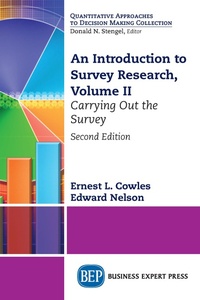
An Introduction to Survey Research, Volume II
Description

Survey research is a powerful tool to help understand how and why individuals behave the way they do. Properly conducted, surveys can provide accurate insights into areas such as attitudes, opinions, motivations, and values, which serve as the drivers of individual behavior.
This two-volume book is intended to introduce fundamentals of good survey research to students and practitioners of the survey process as well as end-users of survey information. This second volume focuses on carrying out a survey- including how to formulate survey questions, steps that researchers must use when conducting the survey, and impacts of rapidly changing technology on survey design and execution. The authors conclude with an important, but often neglected aspect of surveys-the presentation of results in different formats appropriate to different audiences.
More details
Other editions
Additional editions
Persons
Content
- Cover
- An Introduction to Survey Research, Volume II: Carrying Out the Survey
- Contents
- Preface
- Acknowledgments
- CHAPTER 1: Introduction
- Research Design
- Questioning (Interviewing) as a Social Process
- Book Overview
- Annotated Bibliography
- Research Design
- Questioning (Interviewing) as a Social Process
- CHAPTER 2: Writing Good Questions
- Begin at the Beginning
- Validity and Reliability in Survey Questions
- Willingness to Answer Questions
- Key Elements of Good Questions
- Specificity, Clarity, and Brevity
- Avoiding Common Question Pitfalls
- Question Types and Formats
- Open-Ended Questions
- Closed-Ended Questions
- Example 1
- Example 2
- Example 3
- Example 4
- Example 5
- Example 6
- Example 7
- Example 8
- Example 9
- Summary
- Annotated Bibliography
- General
- Characteristics of Good Questions
- Reliability and Validity
- Question Type and Structuring Questions on a Survey
- CHAPTER 3: Carrying Out the Survey
- Developing the Survey
- Looking at Other Surveys
- Focus Groups
- Cognitive Interviews
- Behavior Coding and Interviewer Debriefing
- Asking Experts to Review the Survey
- Pretesting the Survey
- Administering the Survey-Using Probe Questions
- Probing in Web Surveys
- Probing in Mailed Surveys
- Administering the Survey-Record Keeping
- Administering the Survey-Linking to Other Information
- Processing the Data
- Coding
- Editing the Data
- Data Entry
- Data Analysis
- Writing the Report
- Making the Data Available to Other Social Scientists
- Listening
- Interviewer Training
- Providing Documentation
- Practice Interviews
- Survey Participation
- Summary
- Annotated Bibliography
- CHAPTER 4: Changing Technology and Survey Research
- The Force of Modern Computing
- The Move to Wireless Telephones
- Internet Access and Survey Mobility
- Survey Panels
- Probability-based Panels
- Opt-in Panels
- Big Data and Probability Surveys
- Summary
- Annotated Bibliography
- Survey Sampling and Technology
- Online Surveys
- Survey Panels
- Big Data and Probability Sampling
- CHAPTER 5: Presenting Survey Results
- The Audience
- Knowing Your Audience
- The Hidden Lack of Understanding by the Audience
- Types of Audiences
- The Content
- Executive Summaries
- Privacy, Confidentiality, and Proprietary Information
- The Expression
- Presenting Data
- Text, Graphs, and Tables
- Summary
- Annotated Bibliography
- General
- Audience Considerations
- Presentation Elements
- Narrative, Charts, Graphs, and Tables
- Notes
- References
- About the Author
- Index
- Ad Page
- Back Cover
