

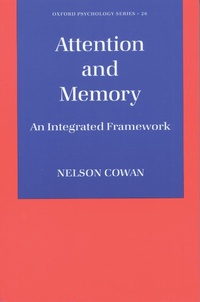
Attention and Memory
An Integrated Framework
Published on 15. January 1998
338 pages
978-0-19-534425-7 (ISBN)
Description

More details
Other editions
Additional editions
Book
02/1998
Oxford University Press Inc
€81.70
Shipment within 15-20 days
Content
- Intro
- Contents
- Preface
- 1. INTRODUCTION: MODELING MEMORY AND ATTENTION
- 1.1 The fundamental relation between memory and attention
- 1.2 The emergence of memory and attention in modern psychology
- 1.2.1 Behaviorist movement
- 1.2.2 Gestalt movement
- 1.2.3 Empirical observations of capacity limits
- 1.3 Modeling the processing of information
- 1.3.1 Broadbent's 1958 model
- 1.3.2 Modifications of Broadbent's (1958) model
- 1.3.3 Abandonment of Broadbent's (1958) model
- 1.3.4 A reconsideration of approaches to modeling: what is being modeled?
- 1.3.5 On the role of models in scientific progress
- 1.4 The model of Cowan (1988)
- 1.4.1 The article and the book
- 1.4.2 Background of the modeling framework
- 1.4.3 Cowan's (1988) formulation
- 1.5 A comparison of Cowan (1988) with other modeling approaches
- 1.5.1 Alternative graphic representations of the assumptions of Cowan (1988)
- 1.5.2 More explicit theories of memory and attention
- 1.5.3 More extensive unified theories of cognition
- 1.5.4 Partial-system models
- 1.5.5 Alternative arrangements of components
- 1.5.6 Strong modularity
- 1.5.7 Summary remarks on model comparisons
- 1.6 Key issues regarding memory and attention
- 1.6.1 Chapter 2: sensory memory
- 1.6.2 Chapter 3: short-term storage
- 1.6.3 Chapter 4: "virtual" short-term memory mechanisms
- 1.6.4 Chapter 5: habituation and dishabituation of orienting
- 1.6.5 Chapter 6: attention and long-term memory
- 1.6.6 Chapter 7: attention and awareness
- 1.6.7 Chapter 8: summary discussion including neurophysiological underpinnings of memory and attention
- 1.6.8 Strategies for reading this book
- PART I: TRANSIENT-MEMORY PHENOMENA
- 2. SENSORY MEMORY PERSISTENCE
- 2.1 Sensory memory in current cognitive psychology
- 2.2 Definition and distinguishing features of sensory memory
- 2.3 Types of sensory memory and their durations
- 2.4 Uses of sensory memory
- 2.5 Neural representation of sensory memory
- 2.6 Challenges to the concept of sensory memory
- 3. MEMORY ACTIVATION AND ATTENTIONAL FOCUSING
- 3.1 A brief history of short-term memory concepts
- 3.2 Short-term memory limits according to cognitive psychology
- 3.3 Cowan's (1988) conception of short-term memory
- 3.4 Some unresolved issues in the Cowan (1988) approach
- 3.5 Neurophysiology of short-term memory
- 4. ACTUAL VERSUS "VIRTUAL" SHORT-TERM MEMORY PHENOMENA
- 4.1 A challenge to multiple-store accounts
- 4.2 Arguments against the monistic view
- 4.3 Where do we search for short-term memory?
- 4.4 Refrain: what is short-term memory?
- PART II: SELECTIVE ATTENTION PHENOMENA
- 5. ATTENTION FILTERING AND ORIENTING
- 5.1 The problem of attentional filtering
- 5.2 Habituation of orienting as a selective filter
- 5.3 Evidence linking orienting and selective attention
- 5.4 Some unresolved issues related to the habituation hypothesis
- 6. ATTENTION AND LONG-TERM MEMORY
- 6.1 Dissociations between direct and indirect memory measures
- 6.2 The importance of attention for long-term memory
- 6.3 Dissociation of automatic and attention-related factors
- 6.4 Separate or embedded memory processes?
- 6.5 Specific mechanisms of attention in memory storage and retrieval
- 6.6 Automaticity, attention, and long-term memory
- 6.7 A reassessment of attention and memory in Cowan's (1988) model
- 7. ATTENTIONAL FOCUS AND CONSCIOUS AWARENESS
- 7.1 The concept of a unitary focus of attention
- 7.2 The challenge from cognitive science: multiple resources
- 7.3 The challenge from psychology at large: dissociated states and awareness
- 7.4 The challenge from philosophy of mind: multiple percepual drafts
- 7.5 Response to challenges to a unified view of attention and awareness: a summary
- 8. CONCLUDING OBSERVATIONS, WITH STEPS TOWARD NEUROSCIENCE
- 8.1 Relationships between memory and attention
- 8.2 Some directions for further work
- 8.3 Toward a neuroscience of memory and attention
- 8.4 Some observations about the future: on the changing relation between brain research and cognition
- References
- Author Index
- A
- B
- C
- D
- E
- F
- G
- H
- I
- J
- K
- L
- M
- N
- O
- P
- R
- S
- T
- U
- V
- W
- Y
- Z
- Subject Index
- A
- B
- C
- D
- E
- F
- G
- H
- I
- L
- M
- N
- O
- P
- R
- S
- T
- U
- V
- W
