

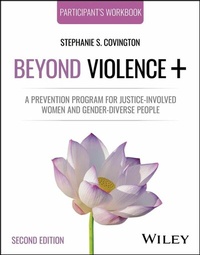
Beyond Violence+
Description

A gender-responsive, trauma-informed path forward for incarcerated women
Beyond Violence: A Prevention Program for Criminal Justice-Involved Women is a comprehensive, evidence-based program specifically designed to meet the unique needs of women in correctional settings who have committed a violent crime. In 20 carefully designed sessions, it identifies personal factors correlated with violence, examines the importance of relationships, and explores how violence can manifest in various settings. This package includes both a step-by-step Facilitator Guide and a Participant Workbook. Beyond Violence encourages active participation, leading women to a deeper understanding of violence and of themselves.
Author Stephanie Covington is nationally recognized for her expertise in creating, implementing, and facilitating women's treatment programs. In Beyond Violence, she offers counselors, mental health professionals, and program administrators the tools they need to implement this respected program within the criminal justice system. Participants will:
- Understand the relationships between thoughts, feelings, and behaviors-with a focus on anger and violence
- Learn new skills, including communication, conflict resolution, decision making, and calming soothing techniques
- Discover the effects of our families, our relationships, communities, and the larger society on our lives
- Become part of a group of women working to create a less violent world.
The Facilitator's Guide contains the theory, structure, and content needed to run effective groups. The Participant's Workbook is designed so that women can process, record, and refer back to their therapeutic experience.
More details
Other editions
Additional editions
Content
Orientation Session 1
Introduction to the Program 1
Overview of the Program 3
Your Workbook 3
Group Introductions 4
Topics Covered in This Program 5
Group Agreements 5
Our Group Agreements 6
Triggers and Coping Tools 7
Five Senses 8
Breathing and Exhaling 8
Statistics on Violence in the United States 9
Definition of Violence 12
The Social- Ecological Model (People in the Environment) 13
Creating a Container 18
My Container 19
Discovering Your Anger Style 20
Anger Survey 23
Between- Sessions Activity 24
Self- Soothing Activity: Palms Down, Palms Up 25
Part A: Self
Session One: Thinking Our Thoughts 29
The Spirals of Violence and Nonviolence 30
Thinking, Feeling, and Substance Use 31
Automatic Thoughts 31
Cognitive Distortion 32
My Typical Distorted Thinking 34
Feelings Inside and Outside 36
The DVD of What I Want My Words To Do To You 37
Understanding Keila 37
Understanding Me 40
Between- Sessions Activities 42
Session Two: Feeling Our Feelings 43
Identifying Feelings 44
Beliefs About Feelings 47
My Faulty Belief 48
Feelings as Clues 48
Intensity of Feelings 49
Emotional Wellness 53
Five Steps to Emotional Wellness 53
Feelings and the Body 54
When Feelings Threaten to Overwhelm You 55
The Observer Self 56
Between- Sessions Activities 58
Session Three: Violence and Trauma in Our Lives 59
Violence in Relationships 60
Types of Abuse 60
The Process of Trauma 61
Calming Strategies 63
Two Calming Activities 64
Mindful Breathing 64
Ten- Point Body Scan 64
Between- Sessions Activities 65
Session Four: The Effects of Trauma 69
Adverse Childhood Experiences Survey 70
The Adverse Childhood Experiences Study 72
The Effects of Trauma and Substance Use on the Brain 74
Risk Factors for Addiction 75
Personal Experiences with Substances 76
Triggers or Activators and the Body 77
Yoga Poses and the Mind- Body Connection 80
Between- Sessions Activities 81
Session Five: Anger and Me 83
Anger 84
Words for Anger 85
Meeting a Feeling 86
The Anger Funnel 89
Anger Triggers 92
Anger- Management Strategies 93
Anger Dos and Don'ts 95
Hidden Anger 97
Self- Inflicted Violence 98
Between- Sessions Activities 99
Session Six: The Risk of Suicide in Prison 101
DVD of What I Want My Words To Do To You 102
The Iceberg 104
My Iceberg 106
Making Life Livable 107
Between- Sessions Activities 109
Session Seven: Fostering Connection, Hope, and Meaning in Prison 111
My Hope- Practice Plan 112
My Safety Plan 113
Letter to My Future Self 116
Between- Sessions Activities 117
Session Eight: Understanding Ourselves 119
DVD of What I Want My Words To Do To You 120
Understanding Keila 120
Understanding My Crime 122
Understanding My Behavior 124
Becoming Whole 126
Between- Sessions Activities 128
Part B: Relationships
Session Nine: Our Families 131
Self- Soothing Activity: Deep Breathing 132
Risk Factors 133
Family Sculpture 134
The Cost of Violence 135
Feelings and the Family 136
Unspoken Rules 136
The Anger Questionnaire 137
Wheel of Nurturing Children 140
Between- Sessions Activities 143
Session Ten: Communication 145
Communication Styles 146
Nonverbal Communication 147
Communicating Emotions 148
Group Discussion Questions 149
Strategies for Creating Connection Through Communication 150
Responses to Stress 151
Between- Sessions Activities 153
Session Eleven: Power and Control 155
The Power and Control Wheel 156
Differences Between Women and Men in the Use of Force in Relationships 160
Types of Abuse in Relationships 161
The Violence Continuum 164
Escalation and De- escalation 166
Violence in Prison 168
Using the Time 169
Between- Sessions Activities 170
Session Twelve: Conflict Resolution 173
Fair Fighting 174
Guidelines for Fair Fighting 175
Words, Words, Words 176
Words That Escalate and Words That Help 176
Impulse Control 177
Tips for Impulse Control 178
The Equality Wheel 180
Between- Sessions Activities 183
Session Thirteen: Our Children 185
Nurturing Children in Our Lives 186
Messages About Nurturing and Raising Children 186
Abuse of Children Wheel 187
Patterns of Abuse with Children 189
Our Nurturing Legacies and What We Pass Along 190
Between- Sessions Activities 191
Session Fourteen: Nurturing in Action 193
Parenting and Caregiving Triggers 194
Drawing Our Family Dynamics 196
My Family Dynamics 197
Discipline, Consequences, and Punishment 198
Caregiving Checklist 199
Creating Connection 200
Nurturing in Action 201
Between- Sessions Activities 202
Session Fifteen: Caregiving over Time and with Others 203
Parenting from Prison 204
Our Villages 205
My Village 206
Caregiver Triggers 207
Power and Control and Caregivers 208
Caregivers and Communication 209
Caregiving Chapters 210
Between- Sessions Activities 211
Session Sixteen: Relationships in Prison 213
Relationship Roles 214
Sources of Joy, Connection, and Conflict 215
Power and Control Wheel 218
Creating a Power and Control Wheel 219
Equality Wheel 220
Creating an Equality Wheel 221
Between- Sessions Activities 222
Session Seventeen: Everyday Actions in Our Relationships 223
Common Relationship Situations 224
Relationship Decisions 227
Between- Sessions Activities 229
Session Eighteen: Creating Our Relationships 231
Falling in Love 232
Love and Addiction 233
Contrasting Intimate Relationships and Addictive Relationships 234
How To End a Relationship 235
Between- Sessions Activities 236
Part C: Community
Session Nineteen: Our Communities 239
Self- Soothing Activity: Progressive Muscle Relaxation 240
Our Communities 242
Visualization 243
Friendship 248
Between- Sessions Activities 249
Session Twenty: The Importance of Safety 253
Safety in the Community 254
The Four Kinds of Safety 256
Environment and Behavior 260
Safe and Unsafe Environments 262
Safety and the Body 263
Community Maps- Past, Present, and Future 264
Between- Sessions Activities 269
Session Twenty-One: Creating Community 271
DVD of What I Want My Words To Do To You 272
Crossroads 274
Making Good Decisions 276
Between- Sessions Activities 277
Session Twenty-Two: The Power of Community 281
DVD of What I Want My Words To Do To You 282
Activity: Writing About a Kind Act 284
Between- Sessions Activity 285
Part D: Society
Session Twenty-Three: Society and Violence 289
Self- Soothing Activity: Breathing in the Positive 290
Reviewing the Risks for Violence 291
The Culture Wheel 292
Institutional and Cultural Supports for Domestic Violence 294
Working To End Violence 296
National and International Organizations 297
Local Organizations 299
Art as an Expression of the Levels of Violence 300
Transgender, Gender Nonconforming, and Nonbinary Art 301
Between- Sessions Activities 302
Session Twenty-Four: Creating Change 305
Health, Harmony, and Wholeness 306
The Spirals of Transformation 308
Between- Sessions Activity 310
Session Twenty-Five: Transforming Our Lives 311
Visualization 312
The Role of Remorse in Transformation 314
The Process of Transformation 315
Making Amends 317
Forgiveness 318
Between- Sessions Activities 319
Session Twenty-Six: Honoring Ourselves and Our Community 321
The Relational Wheel 322
Respect, Mutuality, and Compassion 323
Are You Becoming the Person You Want To Be? 324
Orid 325
Appreciation 327
Appendix 1: Yoga Poses 329
Appendix 2: About the Women in the What I Want My Words To Do To You DVD 335
About the Author 341
About the Cover 343
Orientation Session
Introduction to the Program
Beyond Violence+: A Prevention Program for Justice-Involved Women and Gender-Diverse People is designed to help you look at the effects of violence in your life and to create an opportunity for you to make changes to prevent violence in the future. The program is divided into four parts: Self, Relationships, Community, and Society. These four content areas will guide you in understanding important issues relating to violence in the lives of many women and gender-diverse people both inside and outside your program group.
During this program, you will attend this orientation session and 26 additional sessions with the members of your group. With them, you will have new experiences and learn new ways of looking at the world. The facilitator conducting the sessions has experience working with those who have reacted with force toward others and understands the issues.
Taking part in this group will allow you to explore how seeing and experiencing violence in your life has affected you and the decisions you have made. You will find support from others in your group. As you explore important issues together, you will learn new ways to cope and better ways to make decisions. You will experience a greater sense of power, inner strength, and peace.
Although this program is designed for use in a group, it is also possible to do the work individually if there is not a group available for you. As you begin this session, take a minute or two to give yourself time to unwind, relax, and focus on where you are now. Just get settled in the way that feels best for you. Allow yourself to notice how you're breathing and then inhale gently and exhale fully. Repeat the breathing exercise two more times.
Please note: There also are yoga poses that you can do on your own. See the pictures and instructions at the back of this workbook. These are very good tools for stress reduction and relaxation. Enjoy!
Overview of the Program
The Beyond Violence+ program aims:
- To provide a place for you to reflect and learn more about yourself
- To provide information to help you to better understand the relationships between your thoughts, feelings, and behaviors
- To help you to understand the effects of your family, your relationships, your community, and the larger society on your life
- To help you understand more about the roles of anger and violence in your life
- To provide an opportunity for you to learn new skills, including skills in communication, conflict resolution, decision-making, and calming or self-soothing techniques
- To help you become part of a group of people working to create a less violent world
Your Workbook
This workbook is a place for you to record your experiences during the journey that you are about to begin in the Beyond Violence+ program. Using this workbook will help you to remember what you learn, think, and feel. The workbook contains:
- Some of the activities you will do during the group sessions
- Summaries of information that you will receive in the group sessions
- Questions and activities for you to do after each session
The activities will help you to examine many parts of your life. There are no right or wrong answers, and your responses will not be checked. You may be asked to share some of your responses in the group sessions, but this is voluntary, and other group members will be sharing as well. You do not need to worry about your handwriting or spelling. This workbook is a tool to help you with your growth and recovery.
You will keep your workbook to use between sessions. It is your responsibility to remember to bring your workbook to each group session.
If you are concerned about confidentiality by keeping your workbook with you, please discuss this with the group facilitator.
Group Introductions
The following are questions you can answer as a way to introduce yourself to the group. This introduction allows you and the other group members to begin to get to know one another. This program is created for women and gender-diverse people. We invite you to share your pronouns when you introduce yourselves.
If you are using this workbook on your own, read the questions and think about how you would introduce yourself to others.
My name: ________________________________________________________________
When and where I was born: ________________________________________________
__________________________________________________________________________
__________________________________________________________________________
__________________________________________________________________________
How I identify myself (including culture, ethnicity, race, and your pronouns if you want to include them): _____________________________________________________
__________________________________________________________________________
__________________________________________________________________________
__________________________________________________________________________
__________________________________________________________________________
The people in my family (can include a spouse or partner, children, parent(s), sibling(s), or whomever you consider your immediate family): __________________
__________________________________________________________________________
__________________________________________________________________________
__________________________________________________________________________
__________________________________________________________________________
If you are currently living in prison and have been here for a very long time, you may want to identify which persons you consider your family or best friends in the facility to be: __________________________________________________
__________________________________________________________________________
__________________________________________________________________________
__________________________________________________________________________
One thing I like about myself or a special gift that I have: _______________________
__________________________________________________________________________
__________________________________________________________________________
__________________________________________________________________________
Topics Covered in This Program
- How our thoughts and feelings affect our behaviors
- How to better manage our feelings, especially the powerful and painful ones
- The effects of families and relationships on our lives
- Information about abusive and healthy relationships
- The role of anger in our lives
- The effects of our communities on our lives, including support for violence in our communities
- Making amends and restitution
- Envisioning a more peaceful world
Group Agreements
Your facilitator explained the purpose of group agreements. These describe behaviors that will help the group to be a safe, respectful, and supportive space for each group member. Please write down the agreements from your group on the next page. When doing this alone, you may want to think about the kind of agreements you would want in a group. You also can list the goals you have for yourself while working through this program. Or you can skip this section.
Our Group Agreements
There are three agreements that are important to any group:
- Confidentiality. Group members need to honor one another's confidentiality. What is said in this room stays in this room. No personal information revealed in this room may be repeated outside this room.
- Sobriety. No one may attend a group session while under the influence of alcohol or another drug.
- Safety. There will be no physical or emotional abuse. Part of safety is showing respect for one another and for the uniqueness of each person's thoughts, feelings,...
