

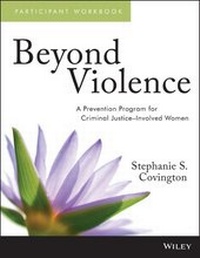
Beyond Violence
Description

More details
Other editions
Additional editions
Person
Content
Orientation Session 1
Introduction to the Program 1
Overview of the Program 2
Your Workbook 2
Group Introductions 3
Topics Covered in This Program 4
Group Agreements 5
Triggers and Coping Tools 6
Five Senses 7
Breathing and Exhaling 7
Statistics on Violence in the United States 8
Definition of Violence 10
The Social-Ecological Model (People in the Environment) 11
Creating a Container 14
Discovering Your Anger Style 16
Anger Survey 19
Assignment 20
Self-Soothing Activity: Palms Down, Palms Up 21
Part A: Self
Session One: Thinking Our Thoughts 25
The Spirals of Violence and Nonviolence 26
Cognitive Distortion 27
My Typical Distorted Thinking 29
Feelings Inside and Outside 31
The DVD of What I Want My Words To Do To You 32
Understanding Keila 32
Understanding Me 34
Assignment 36
Session Two: Feeling Our Feelings 39
Identifying Feelings 40
Beliefs About Feelings 43
Intensity of Feelings 44
Emotional Wellness 48
Feelings and the Body 49
When Feelings Threaten to Overwhelm You 50
The Observer Self 51
Assignment 52
Session Three: Violence and Trauma in Our Lives 53
Types of Abuse 54
The Process of Trauma 54
Calming Strategies 58
Two Calming Activities 59
Mindful Breathing 59
Ten-Point Body Scan 59
Assignment 60
Session Four: The Effects of Trauma 63
Adverse Childhood Experiences Survey 64
The Effects of Trauma and Substance Use on the Brain 68
Risk Factors for Addiction 69
Personal Experiences with Substances 70
Triggers and the Body 71
Yoga Poses and the Mind-Body Connection 74
Assignment 75
Session Five: Women and Anger 77
Words for Anger 78
Meeting a Feeling 79
The Anger Funnel 80
Anger Triggers 82
Anger Management Strategies 83
Anger Dos and Don'ts 85
Hidden Anger 87
Self-Inflicted Violence 88
Assignment 89
Session Six: Understanding Ourselves 91
DVD of What I Want My Words To Do To You 92
Understanding Keila 92
Understanding Me 94
Understanding My Behavior 96
Understanding Keila 96
Understanding Me 97
Becoming Whole 98
Assignment 100
Part B: Relationships
Session Seven: Our Families 103
Self-Soothing Activity: Deep Breathing 104
Risk Factors 105
Family Sculpture 106
The Cost of Violence 107
Feelings and the Family 108
The Anger Questionnaire 109
Wheel of the Nurturing Family 112
Assignment 115
Session Eight: Communication 117
Communication Styles 118
Nonverbal Communication 119
Communicating Emotions 120
Strategies for Creating Connection Through Communication 121
Responses to Stress 122
Assignment 124
Session Nine: Power and Control 125
The Power and Control Wheel 126
Types of Abuse in Relationships 130
The Violence Continuum 132
Escalation and De-escalation 134
Violence in Prison 136
Using the Time 137
Assignment 138
Session Ten: Conflict Resolution 141
Fair Fighting 142
Words, Words, Words 143
Impulse Control 144
The Equality Wheel 147
Assignment 150
Session Eleven: Creating Our Relationships 151
Falling in Love 152
Love and Addiction 153
Contrasting Intimate Relationships and Addictive Relationships 154
How to End a Relationship 155
Assignment 156
Part C: Community
Session Twelve: Our Communities 159
Self-Soothing Activity: Progressive Muscle Relaxation 160
Our Communities 162
Visualization 163
Friendship 167
Assignment 168
What's in a Name? 170
Session Thirteen: The Importance of Safety 171
Safety in the Community 172
The Four Kinds of Safety 173
Environment and Behavior 175
Safe and Unsafe Environments 176
Safety and the Body 177
Community Maps-Past, Present, and Future 178
Assignment 182
Session Fourteen: Creating Community 183
DVD of What I Want My Words To Do To You 184
Crossroads 186
Making Good Decisions 188
Assignment 190
Session Fifteen: The Power of Community 193
DVD of What I Want My Words To Do To You 194
Activity: Writing About a Kind Act 195
Assignment 196
Part D: Society
Session Sixteen: Society and Violence 199
Self-Soothing Activity: Breathing in the Positive 200
Reviewing the Risks for Violence 201
The Culture Wheel 202
Institutional and Cultural Supports for Domestic Violence 204
Working to End Violence 206
Art as an Expression of the Levels of Violence 209
Assignment 211
Session Seventeen: Creating Change 215
Health, Harmony, and Wholeness 216
The Spirals of Transformation 218
Assignment 221
Session Eighteen: Transforming Our Lives 223
Visualization 224
The Role of Remorse in Transformation 225
The Process of Transformation 226
Making Amends 227
Forgiveness 228
Assignment 229
Session Nineteen: Honoring Ourselves and Our Community 231
The Relational Wheel 232
Are You Becoming the Person You Want to Be? 234
ORID 235
Appreciation 237
Appendix Yoga Poses 239
About the Author 245
About the Cover 247
Session One
Thinking Our Thoughts
In this program, you will explore four different levels of your life, starting with the individual level, the self. Your risk for becoming a victim or victimizer (perpetrator of violence) is influenced by your personal history, including your family background, level of education, race, socioeconomic status, how you behave, and how others behave toward you. Things that contribute to risk are being abused in childhood or adulthood, mental health issues, alcohol and substance abuse, and a history of behaving aggressively (World Health Organization, 2004).
In Part A, you will be examining how your individual thoughts and feelings influence your behaviors. This will provide you with an opportunity to get to know yourself better. The goals for Session One are:
- To examine typical habits in thinking and
- To understand how our thoughts influence our feelings and behaviors.
Spirals of Violence and Nonviolence
The Spirals of Violence and Nonviolence
These spirals illustrate violence and nonviolence. The downward one on the left is the spiral of violence. The line in the middle represents aggression, violence, or use of force. As violence becomes more a part of your life, it constricts and limits your life. For victims, it may mean being shut off from contact with family members, friends, and social services-feeling isolated and alone. A victim also may be afraid to go to places and people who can help. For perpetrators or victimizers, it may mean trying to keep the violence a secret and hiding from law enforcement agencies. For both, the inner self (thoughts, feelings, and values) becomes more limited and hidden, and the outer self (behavior and relationships) becomes more isolated.
The upward spiral on the right is the spiral of nonviolence. The center line still represents violence, because, even if you are in the process of recovery or healing, the experience of violence does not go away. However, in the upward spiral, there is increasing room for growth and healing and many other life experiences. As you stop participating in aggressive or violent behavior and you begin to heal from the violence, the possibility of experiencing meaningful change in your life is created. The goal is to become whole: to have your inner self connected to your outer self. Then there can be truth and integrity in your life.
Cognitive Distortion
When your mind convinces you of something that isn't really true, it is called a "cognitive distortion." Such thoughts are also called "thinking errors," "negative self-talk," "twisted thinking," and "distorted information processing." Such distortions or inaccurate thoughts usually are used to reinforce negative thinking or emotions. Here are some examples of this type of thinking:
- Overgeneralizing: You tend to speak in terms of something "always" or "never" happening. For example, if you fail to do something, you may say, "I never remember things I'm supposed to." You may also interpret events in this way and say things like, "Why does this stuff always happen to me?"
- All-or-nothing thinking: Things are either right or wrong, black or white, great or horrible. There are only either/or categories; there is no middle ground or gray area. For example, if something doesn't live up to your expectations in some area, you may see it as a total failure.
- Mental filtering: You can let one fact or situation or event color your view of things so that you see everything through a darkened lens. For example, if you have been abused by a male, you may think that all men are rotten or dangerous.
- Disqualifying the positive: You may ignore or explain away any positive facts or experiences. If you can rationalize that something good "doesn't count" for some reason, you can maintain a negative belief system.
- Personalizing: You may take responsibility or blame for something bad that you had no control over. You may tell yourself, "It must be my fault somehow."
- Mind reading: You may decide that someone doesn't like you or thinks she is better than you without getting to know the person or checking your assumptions if you do. When you interpret someone's facial expressions or nonverbal communication with no other input, you are projecting what is in your mind, not the other person's.
- Magnifying or minimizing: You may give something more credit or more importance than it deserves or you may do the opposite and give it less credit or less importance than is actually called for. Sometimes this is called "making a mountain out of a molehill" or the reverse.
- Jumping to conclusions: You may decide early on that something is bad or will turn out badly, even without evidence to support that belief. You may make assumptions about things without waiting for more information. For example, if something is missing, you may assume that a particular person has stolen it before you have looked for it thoroughly.
- Fortune telling: When you assume that you know how things will turn out before they even happen, you are fortune telling. If you are looking at things through a darkened lens, you probably will predict a doom-and-gloom scenario.
- Emotional reasoning: You may let your feelings direct your interpretation of things. For example, if you are down, you may interpret things people do or say in a negative way. If you are feeling "up," you may see things through "rose-colored glasses." In short, "I feel it; therefore, it must be true."
- Using "should" and "must" statements: Your expectations may be directed by a rigid list of rules about how you and others should behave. If you think that you "should" or "should not" be a certain way, you may feel guilt when you don't think you live up to that expectation. Similarly, you may frequently be disappointed when others do not live up to the rules. If you use "should," "must," and "ought" often in your thinking or conversation, you may be setting yourself up for feelings of anger, frustration, and resentment.
- Labeling and mislabeling: This is a mental and verbal way of doing the above types of thinking. Instead of seeing a person or a behavior or an event as it is, you give it a label that allows you to dismiss or degrade it, in order to reinforce your negative outlook or interpretation. For example, if a person makes a mistake, you may label that person as "stupid."
What are the three types of cognitive distortion that you have used most often?
My Typical Distorted Thinking
When we have thoughts about a situation, we usually have feelings about it, too. Thoughts and feelings both affect our behaviors. The table shows some examples.
In the empty boxes, write in some typical situations and behaviors in your own life. Fill in all the columns for each of the examples you provide. These can be situations in prison or out of prison.
Feelings Inside and Outside
Sometimes we don't show on the outside how we are feeling on the inside. For example, you may smile at others when you are really feeling sad or scared. Or you may act angry when you are actually feeling vulnerable or scared. Getting your outside self to match your inside self is one way to feel more whole.
Can you recall a time when you felt one way inside but looked different to those around you? Draw or write about your experience below.
Feelings inside:
What you show others:
The DVD of What I Want My Words To Do To You
This film was made at the Bedford Hills Prison in the State of New York. A famous writer named Eve Ensler, who wrote the play called The Vagina Monologues, ran a writing group for women at Bedford. Your group will watch parts of the film in various sessions. By the time you complete this program, you will have seen the entire film.
Understanding Keila
In the session, the group used some of the ideas about the inner and outer selves, and how thoughts and feelings can affect behavior, and applied them to Keila's situation. What are your answers to the following questions?
- What were Keila's thoughts that day?
- What was she feeling?
- What did she do?
- We know that values and beliefs, as well as thoughts and feelings, create the inner self. Do we know any more about these in Keila's life?
- How did her inner self-her thoughts, feelings values, and beliefs-affect her behavior?
- What might have been different if she had had a "container" for her feelings?
- How could she have handled the situation differently?
Understanding Me
As you think about the event that brought you here, you will realize that your ways of thinking, your assumptions, your values, and your feelings all influenced your behavior. Please take a few moments to think about the crime that brought you into the criminal justice system and then begin to fill in the...
