

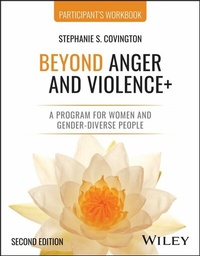
Beyond Anger and Violence+
Description

An essential resource for women participating in the Beyond Anger and Violence program
The Beyond Anger and Violence program is a forty-hour, evidence-based, gender-responsive, trauma-informed treatment program specifically developed for women who struggle to safely manage anger. It uses a Social-Ecological Model to understand anger and violence and explores the complex interplay between individual, relationship, community, and societal factors that gives rise to anger, assault, and property destruction.
In the newly revised second edition of the Beyond Anger and Violence: Program for Women Participant Workbook, internationally recognized clinician Stephanie S. Covington delivers a key resource for women undergoing the Beyond Anger and Violence program. This Workbook provides a place for participants to review the content of sessions, write down their thoughts and reactions, and complete activities during and after sessions.
Inside the book:
- Help in understanding the relationships between thoughts, feelings, and behaviors
- Techniques for communication, conflict resolution, decision making, and calming behaviors
- Ways to understand how our families, relationships, communities, and societies impact our lives
- Strategies for understanding the roles that anger and violence play in our relationships
An essential resource for all participants undergoing the Beyond Anger and Violence program, this Participant Workbook includes brand-new coverage of the impact of trauma, the meaning of "gender," the significance of child abuse, and how self-harm and suicide can affect anger- and violence-reduction strategies.
More details
Other editions
Additional editions
Content
Orientation Session
Introduction to the Program
During this program, you will attend this Orientation Session and twenty-five additional sessions with your group members. With them, you will have new experiences and learn new ways of viewing the world. The facilitator who will conduct the sessions has experience working with people who have reacted with anger and/or force toward others, and she understands the issues.
Taking part in this group will allow you to explore how seeing and experiencing anger and violence in your life has affected you and the decisions you have made. You will find support from others in your group. As you explore important topics together, you will learn new ways to cope and better ways to make decisions. You will experience a greater sense of power, inner strength, and peace.
The Beyond Anger and Violence+ program aims:
- To provide a place for you to reflect and learn more about yourself
- To provide information to help you better understand the relationships between your thoughts, feelings, and behaviors
- To help you understand the effects of your family, your relationships, your community, and the larger society on your life
- To help you understand more about the roles of anger and violence in your life
- To provide an opportunity for you to learn new skills, including skills in communication, conflict resolution, decision making, and calming or self-soothing techniques
- To help you become part of a group of people working to create a less violent world
Your Workbook
This workbook is a place to record your experiences during the journey that you are about to begin in the Beyond Anger and Violence+ program. This workbook will help you remember what you learn, think, and feel. The workbook contains:
- Some of the activities you will do during the group sessions
- Summaries of information that you will receive in the group sessions
- Questions and activities for you to do after each session
The activities will help you to examine many parts of your life. There are no right or wrong answers, and your responses will not be checked. You may be asked to share some of your responses in the group sessions, but this is voluntary, and other group members will also share. You do not need to worry about your handwriting or spelling. This workbook is a tool to help you with your growth and recovery.
You will keep your workbook to use between sessions. It is your responsibility to remember to bring your workbook to each group session.
If you are concerned about confidentiality by keeping your workbook with you, please discuss this with the group facilitator.
Group Introductions
The following are questions you can answer to introduce yourself to the group. This introduction allows you and the other group members to begin to get to know one another. As this program is created for women and gender-diverse people, we invite you to share your pronouns when you introduce yourselves.
If you are using this workbook independently, read the questions and think about how you would introduce yourself to others.
- My name: ______________________________________________________________
- When and where I was born: ______________________________________________ ________________________________________________________________________
- How I identify myself (including culture, ethnicity, race, and your preferred pronouns, if you want to include them): ____________________________________ ________________________________________________________________________
________________________________________________________________________
- The people in my family (can include a spouse or partner, children, parent(s), sibling(s), or whomever you consider your immediate family): ________________________________________________________________________________________ ________________________________________________________________________
________________________________________________________________________
- One thing I like about myself or a special gift that I have: _____________________ ________________________________________________________________________
________________________________________________________________________
Topics Covered in This Program
- How our thoughts and feelings affect our behaviors
- Ways to better manage our feelings, especially the powerful and painful ones
- The effects of families and relationships on our lives
- Information about abusive and healthy relationships
- The role of anger in our lives
- The effects of our communities on our lives, including support for anger and violence in our communities
- Making amends and restitution
- Envisioning a more peaceful world
Group Agreements
Your facilitator explained the purpose of group agreements. These describe behaviors that will help your group to be a safe, respectful, and supportive space for each group member. Please write down the agreements from your group on the next page.
If you are doing this alone, you may want to think about the kind of agreements you would want in a group. You also can list the goals you have for yourself while working through this program. Or you can skip this section.
Our Group Agreements
There are three agreements that are important to any group:
- Confidentiality. Group members need to honor one another's confidentiality. What is said in this room stays in this room. No personal information revealed in this room may be repeated outside this room.
- Sobriety. No one may attend a group session while under the influence of alcohol or another drug.
- Safety. There will be no physical or emotional abuse. Part of safety is showing respect for one another and for the uniqueness of each person's thoughts, feelings, experiences, and responses. We will let people express themselves in their own ways. Being rude or abusive to another group member is not okay.
Here are some other typical group agreements:
- Timing. Our sessions will start on time and end on time.
- Attendance. Regular group attendance is important. We all agree to show up at all the sessions.
- Eating or smoking. There will be no eating or smoking during the group sessions. Drinking bottled water may be permitted.
- Sharing. Everyone in the group should have the time to contribute and share the experience. We will try to let everyone have a chance to talk. We will not interrupt other group members but will let them finish before we respond or add something.
- Participation. We will try to assist one another in feeling safe enough to share and participate. We will ask...
