

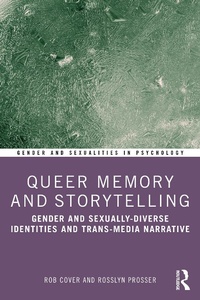
Queer Memory and Storytelling
Gender and Sexually-Diverse Identities and Trans-Media Narrative
1st Edition
Published on 27. February 2024
194 pages
978-1-003-85636-8 (ISBN)
Description

Queer Memory and Storytelling unpacks the ways in which the narrative practices of recounting past experiences play a formative role in formation of identities, cultures, and social change among gender and sexually diverse individuals.
Grounded in theoretical research, this work delves into historical accounts, case studies, and draws from the rich tapestry of interviews conducted during extensive LGBTQ+ research studies. It explores the power of memorial storytelling to shape the narratives surrounding gender and sexual diversity, offering profound insights into the role storytelling plays as a deeply subjective, personal, communal, and cultural form of expression. The book introduces a queer perspective that reframes the study of narrative psychology, community history, philosophies of subjectivity and the socio-cultural heritage of LGBTQ+ minority communities. It also focuses on the pivotal role played by memory and reflection found within online coming-up stories and contemporary modes of shared community memorialization. By employing queer theory, ethnographic research, interviews and meticulous media/textual analysis, the book presents new frameworks for comprehending the myriad facets of identity, and investigating what it means to remember and narrate selfhood in the context of social life, actively 'queering' the concept of memory.
Queer Memory and Storytelling will appeal to academics, researchers and students in psychology, sociology, gender and sexuality studies, and communication.
Grounded in theoretical research, this work delves into historical accounts, case studies, and draws from the rich tapestry of interviews conducted during extensive LGBTQ+ research studies. It explores the power of memorial storytelling to shape the narratives surrounding gender and sexual diversity, offering profound insights into the role storytelling plays as a deeply subjective, personal, communal, and cultural form of expression. The book introduces a queer perspective that reframes the study of narrative psychology, community history, philosophies of subjectivity and the socio-cultural heritage of LGBTQ+ minority communities. It also focuses on the pivotal role played by memory and reflection found within online coming-up stories and contemporary modes of shared community memorialization. By employing queer theory, ethnographic research, interviews and meticulous media/textual analysis, the book presents new frameworks for comprehending the myriad facets of identity, and investigating what it means to remember and narrate selfhood in the context of social life, actively 'queering' the concept of memory.
Queer Memory and Storytelling will appeal to academics, researchers and students in psychology, sociology, gender and sexuality studies, and communication.
More details
Series
Edition
1. Auflage
Language
English
Place of publication
London
United Kingdom
Publishing group
Taylor & Francis Ebooks
Target group
College/higher education
Illustrations
3 Halftones, black and white; 3 Illustrations, black and white
ISBN-13
978-1-003-85636-8 (9781003856368)
Copyright in bibliographic data and cover images is held by Nielsen Book Services Limited or by the publishers or by their respective licensors: all rights reserved.
Schweitzer Classification
Other editions
Additional editions
Rob Cover | Rosslyn Prosser
Queer Memory and Storytelling
Gender and Sexually-Diverse Identities and Trans-Media Narrative
Book
02/2024
1st Edition
Routledge
€59.90
Shipment within 10-20 days
Rob Cover | Rosslyn Prosser
Queer Memory and Storytelling
Gender and Sexually-Diverse Identities and Trans-Media Narrative
Book
02/2024
1st Edition
Routledge
€206.10
Shipment within 10-20 days
Persons
Rob Cover is Professor of Digital Communication at RMIT University, Melbourne, Australia.
Rosslyn Prosser is Senior Lecturer at the University of Adelaide, Australia, and Programme Leader in the Masters in Creative Writing at LASALLE College, University of the Arts, Singapore.
Rosslyn Prosser is Senior Lecturer at the University of Adelaide, Australia, and Programme Leader in the Masters in Creative Writing at LASALLE College, University of the Arts, Singapore.
Content
1. Queer Memory, Storytelling and the Narrative Psychology of Identity 2. Memorializing the Past in the Future Self: Remembering 'Coming Out' Online 3. Memory, Identity and Performativity 4. Queer Collecting and Strategic Intent 5. Queer Objects, Attachment and Memorial Storytelling 6. The Domestic Archive and Creative Reflection 7. Social Media as an Unwitting Memorial Archive 8. The Queer Monument in Space and Time 9. Queer Storytelling Futures
