

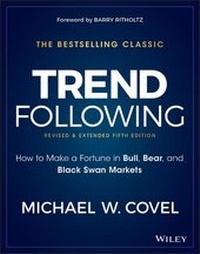
Trend Following
How to Make a Fortune in Bull, Bear, and Black Swan Markets
5th Edition
Published on 5. April 2017
688 pages
978-1-119-37191-5 (ISBN)
Description

Want to take the financial journey to a new investing philosophy that might very well affect the rest of your moneymaking life? No one can guarantee the yellow brick road, but Michael Covel promises the red pill will leave you wide freaking awake.
Trend Following reveals the truth about a trading strategy that makes money in up, down and surprise markets. By applying straightforward and repeatable rules, anyone can learn to make money in the markets whether bull, bear, or black swan--by following the trend to the end when it bends. In this timely reboot of his bestselling classic, Michael Covel dives headfirst into trend following strategy to examine the risks, benefits, people, and systems. You'll hear from traders who have made millions by following trends, and learn from their successes and mistakes--insights only here. You'll learn the trend philosophy, and how it has performed in booms, bubbles, panics and crashes. Using incontrovertible data and overwhelming supporting evidence, with a direct connection to the foundations of behavioral finance, Covel takes you inside the core principles of trend following and shows everyone, from brand new trader to professional, how alpha gets pulled from the market.
Covel's newest edition has been revised and extended, with 7 brand new interviews and research proof from his one of kind network. This is trend following for today's generation. If you're looking to go beyond passive index funds and trusting the Fed, this cutting edge classic holds the keys to a weatherproof portfolio.
* Meet great trend followers learning their rules and philosophy of the game
* Examine data to see how trend following excels when the you-know-what hits the fan
* Understand trend trading, from behavioral economics to rules based decision-making to its lambasting of the efficient markets theory
* Compare trend trading systems to do it yourself or invest with a trend fund
Trend following is not prediction, passive index investing, buy and hope or any form of fundamental analysis. It utilizes concrete rules, or heuristics, to profit from a behavioral perspective. Trend Following is clear-cut, straightforward and evidence-based and will secure your financial future in bull, bear and black swan markets. If you're finally ready to profit in the markets, Trend Following is the definitive treatise for a complex world in constant chaos.
More details
Other editions
Additional editions
Book
06/2017
5th Edition
Wiley
€43.50
Shipment within 15-20 days
Persons
Michael W. Covel searches. He digs. He goes behind the curtain to reveal a state of mind the system doesn't want you in.
Michael teaches beginners to seasoned pros how to generate profits with straightforward and repeatable rules. He is best known for popularizing the counterintuitive and controversial trading strategy, trend following. His perspectives have garnered international acclaim and have earned him invitations with a host of organizations: China Asset Management, GIC Private Limited (Singapore), BM&F Bovespa, the Managed Funds Association, Bank of China Investment Management, the Market Technicians Association, and multiple hedge funds and mutual funds. He also has the distinction of having interviewed five Nobel Prize winners, including Daniel Kahneman and Harry Markowitz, on his Trend Following podcast--which now exceeds 500 episodes and 5 million listens.
Michael's consulting clients include individual traders, hedge funds, sovereign wealth funds, and institutional investors in more than 70 countries. He splits his time between the United States and Asia.
www.trendfollowing.com
Content
1 - Trend Following [Seite 5]
2 - Contents [Seite 11]
3 - Foreword [Seite 17]
4 - Preface [Seite 21]
5 - Section I Trend Following Principles [Seite 33]
5.1 - 1 Trend Following [Seite 35]
5.1.1 - Speculation [Seite 35]
5.1.2 - Winning versus Losing [Seite 41]
5.1.3 - Investor versus Trader [Seite 42]
5.1.4 - Fundamental versus Technical [Seite 43]
5.1.5 - Discretionary versus Systematic [Seite 47]
5.1.6 - Hiding in Plain Sight [Seite 49]
5.1.7 - Change Is Life [Seite 51]
5.1.8 - Follow the Trend to the End When It Bends [Seite 54]
5.1.9 - Surf the Waves [Seite 58]
5.2 - 2 Great Trend Followers [Seite 63]
5.2.1 - David Harding [Seite 65]
5.2.2 - Bill Dunn [Seite 69]
5.2.2.1 - Extreme Performance Numbers [Seite 70]
5.2.2.2 - Be Nimble [Seite 74]
5.2.2.3 - Early Years [Seite 75]
5.2.2.4 - Life inside Dunn Capital [Seite 76]
5.2.2.5 - No Profit Targets [Seite 78]
5.2.2.6 - Check Your Ego [Seite 81]
5.2.3 - John W. Henry [Seite 81]
5.2.3.1 - Prediction Is Futile [Seite 82]
5.2.3.2 - On the Farm [Seite 83]
5.2.3.3 - Worldview Philosophy [Seite 84]
5.2.3.4 - What You Think You Know Gets You in Trouble [Seite 86]
5.2.3.5 - Starting with Research [Seite 87]
5.2.3.6 - On the Record [Seite 88]
5.2.3.7 - Change Is Overrated [Seite 90]
5.2.3.8 - Fade the Fed [Seite 91]
5.2.3.9 - Trading Retirement [Seite 92]
5.2.4 - Ed Seykota [Seite 94]
5.2.4.1 - Performance [Seite 95]
5.2.4.2 - The Secret [Seite 95]
5.2.4.3 - Never Mind the Cheese [Seite 96]
5.2.4.4 - System Dynamics [Seite 97]
5.2.4.5 - FAQs [Seite 98]
5.2.4.6 - Students [Seite 99]
5.2.5 - Keith Campbell [Seite 101]
5.2.5.1 - Campbell versus Benchmarks [Seite 104]
5.2.5.2 - Correlation and Consistency [Seite 104]
5.2.6 - Jerry Parker [Seite 106]
5.2.6.1 - Skeptics [Seite 106]
5.2.6.2 - Intelligence [Seite 107]
5.2.7 - Salem Abraham [Seite 107]
5.2.8 - Richard Dennis [Seite 109]
5.2.8.1 - Turtle Traders [Seite 109]
5.2.8.2 - Selection Process [Seite 110]
5.2.9 - Richard Donchian [Seite 115]
5.2.9.1 - Personification of Persistence [Seite 116]
5.2.9.2 - Students [Seite 118]
5.2.10 - Jesse Livermore and Dickson Watts [Seite 119]
5.3 - 3 Performance Proof [Seite 123]
5.3.1 - Absolute Returns [Seite 124]
5.3.2 - Volatility versus Risk [Seite 125]
5.3.2.1 - Volatility [Seite 128]
5.3.3 - Drawdowns [Seite 131]
5.3.4 - Correlation [Seite 136]
5.3.5 - Zero Sum [Seite 138]
5.3.6 - George Soros [Seite 140]
5.3.6.1 - Don't Blame Zero-Sum [Seite 142]
5.3.7 - Berkshire Hathaway [Seite 143]
5.4 - 4 Big Events, Crashes, and Panics [Seite 149]
5.4.1 - Event 1: Great Recession [Seite 151]
5.4.1.1 - Day-to-Day Analysis [Seite 162]
5.4.2 - Event 2: Dot-com Bubble [Seite 164]
5.4.2.1 - Drawdowns and Recoveries [Seite 164]
5.4.2.2 - Enron, California, and Natural Gas [Seite 170]
5.4.2.3 - September 11, 2001 [Seite 176]
5.4.3 - Event 3: Long-Term Capital Management [Seite 177]
5.4.3.1 - The Losers [Seite 180]
5.4.3.2 - The Winners [Seite 181]
5.4.3.3 - Footnotes to LTCM [Seite 188]
5.4.4 - Event 4: Asian Contagion [Seite 189]
5.4.4.1 - Niederhoffer on Trend Following [Seite 192]
5.4.5 - Event 5: Barings Bank [Seite 193]
5.4.5.1 - Who Won? [Seite 193]
5.4.6 - Event 6: Metallgesellschaft [Seite 196]
5.4.7 - Event 7: Black Monday [Seite 199]
5.5 - 5 Thinking Outside the Box [Seite 209]
5.5.1 - Baseball [Seite 210]
5.5.2 - Billy Beane [Seite 212]
5.5.3 - Bill James [Seite 213]
5.5.4 - Stats Take Over [Seite 215]
5.6 - 6 Human Behavior [Seite 221]
5.6.1 - Prospect Theory [Seite 222]
5.6.2 - Emotional Intelligence [Seite 227]
5.6.3 - Neuro-Linguistic Programming [Seite 229]
5.6.4 - Trading Tribe [Seite 229]
5.6.5 - Curiosity, Not PhDs [Seite 231]
5.6.6 - Commitment [Seite 233]
5.7 - 7 Decision Making [Seite 237]
5.7.1 - Occam's Razor [Seite 238]
5.7.2 - Fast and Frugal Decision Making [Seite 239]
5.7.3 - Innovator's Dilemma [Seite 242]
5.7.4 - Process versus Outcome versus Gut [Seite 243]
5.8 - 8 The Scientific Method [Seite 247]
5.8.1 - Critical Thinking [Seite 248]
5.8.2 - Linear versus Nonlinear [Seite 249]
5.8.3 - Compounding [Seite 254]
5.9 - 9 Holy Grails [Seite 257]
5.9.1 - Buy and Hope [Seite 260]
5.9.2 - Warren Buffett [Seite 261]
5.9.3 - Losers Average Losers [Seite 263]
5.9.4 - Avoiding Stupidity [Seite 268]
5.10 - 10 Trading Systems [Seite 279]
5.10.1 - Risk, Reward, and Uncertainty [Seite 280]
5.10.2 - Five Questions [Seite 284]
5.10.2.1 - What Do You Buy or Sell? [Seite 285]
5.10.2.2 - How Much Do You Buy or Sell? [Seite 288]
5.10.2.3 - When Do You Buy or Sell? [Seite 290]
5.10.2.4 - When Do You Get Out of a Loser? [Seite 292]
5.10.2.5 - When Do You Get Out of a Winner? [Seite 294]
5.10.3 - Your Trading System [Seite 295]
5.10.4 - Frequently Asked Questions [Seite 296]
5.10.4.1 - FAQ 1 : Starting Capital [Seite 296]
5.10.4.2 - FAQ 2: Trend Following for Stocks [Seite 297]
5.10.4.3 - FAQ 3: Computers and Curve Fitting [Seite 297]
5.10.4.4 - FAQ 4: Day Trading Limits [Seite 301]
5.10.4.5 - FAQ 5: Wrong Way to View a Trade [Seite 302]
5.11 - 11 The Game [Seite 305]
5.11.1 - Acceptance [Seite 306]
5.11.2 - Don't Blame Me [Seite 308]
5.11.3 - Decrease Leverage, Decrease Return [Seite 309]
5.11.4 - Fortune Favors the Bold [Seite 310]
6 - Section II Trend Following Interviews [Seite 313]
6.1 - 12 Ed Seykota [Seite 315]
6.2 - 13 Martin Lueck [Seite 327]
6.3 - 14 Jean-Philippe Bouchaud [Seite 343]
6.4 - 15 Ewan Kirk [Seite 351]
6.5 - 16 Alex Greyserman [Seite 367]
6.6 - 17 Campbell Harvey [Seite 385]
6.7 - 18 Lasse Heje Pedersen [Seite 399]
7 - Section III Trend Following Research [Seite 413]
7.1 - 19 A Multicentennial View of Trend Following [Seite 415]
7.1.1 - The Tale of Trend Following: A Historical Study [Seite 417]
7.1.2 - Return Characteristics over the Centuries [Seite 420]
7.1.2.1 - Interest Rate Regime Dependence [Seite 421]
7.1.2.2 - Inflationary Environments [Seite 423]
7.1.2.3 - Financial Bubbles and Crisis [Seite 424]
7.1.2.4 - Market Divergence [Seite 427]
7.1.3 - Risk Characteristics over the Centuries [Seite 430]
7.1.4 - Portfolio Benefits over the Centuries [Seite 432]
7.1.5 - Summary [Seite 433]
7.1.5.1 - Assumptions and Approximations [Seite 435]
7.2 - 20 Two Centuries of Trend Following [Seite 437]
7.2.1 - Introduction [Seite 438]
7.2.2 - Trend Following on Futures since 1960 [Seite 440]
7.2.2.1 - Measuring Trends [Seite 440]
7.2.2.2 - The Pool of Assets [Seite 441]
7.2.2.3 - The Results [Seite 441]
7.2.3 - Extending the Time Series: A Case-by-Case Approach [Seite 444]
7.2.3.1 - Currencies [Seite 444]
7.2.3.2 - Government Rates [Seite 444]
7.2.3.3 - Indexes and Commodities [Seite 446]
7.2.3.4 - Validating the Proxies [Seite 447]
7.2.4 - Trend over Two Centuries [Seite 449]
7.2.4.1 - Results of the Full Simulation [Seite 449]
7.2.4.2 - A Closer Look at the Signal [Seite 450]
7.2.4.3 - A Closer Look at the Recent Performance [Seite 452]
7.2.4.4 - Interpretation [Seite 454]
7.2.5 - Conclusions [Seite 455]
7.3 - 21 Trend Following [Seite 457]
7.3.1 - Overview [Seite 457]
7.3.2 - Introduction to Different Trend Following Models [Seite 457]
7.3.3 - Diversification between Different Trend Following Models [Seite 459]
7.3.4 - Aspect's Approach to Trend Following [Seite 461]
7.3.5 - Aspect's Model Compared to Other Trend Following Models [Seite 463]
7.3.6 - Conclusion [Seite 465]
7.3.7 - Chart Disclaimer [Seite 466]
7.4 - 22 Evaluating Trading Strategies [Seite 467]
7.4.1 - Testing in Other Fields of Science [Seite 467]
7.4.2 - Revaluating the Candidate Strategy [Seite 469]
7.4.3 - Two Views of Multiple Testing [Seite 472]
7.4.4 - False Discoveries and Missed Discoveries [Seite 474]
7.4.5 - Haircutting Sharpe Ratios [Seite 476]
7.4.6 - An Example with Standard and Poor's Capital IQ [Seite 477]
7.4.7 - In Sample and Out of Sample [Seite 478]
7.4.8 - Trading Strategies and Financial Products [Seite 479]
7.4.9 - Limitations and Conclusions [Seite 480]
7.5 - 23 Black Box Trend Following-Lifting the Veil [Seite 483]
7.5.1 - Synopsis [Seite 483]
7.5.2 - The Strategies [Seite 484]
7.5.2.1 - Strategy Mechanics [Seite 484]
7.5.2.2 - Markets Traded [Seite 485]
7.5.2.3 - Data Notes [Seite 486]
7.5.2.4 - Trade Sizing [Seite 486]
7.5.2.5 - Sector Weights [Seite 486]
7.5.2.6 - Time Span [Seite 487]
7.5.2.7 - Commission and Slippage [Seite 487]
7.5.2.8 - Interest [Seite 487]
7.5.2.9 - Fees [Seite 487]
7.5.3 - Performance Results and Graphs [Seite 488]
7.5.4 - Sector Performance [Seite 490]
7.5.5 - Performance of Long versus Short Trades [Seite 493]
7.5.6 - Stability of Parameters [Seite 495]
7.5.7 - Are CTAs a Diversifier or a Hedge to the SP500? [Seite 498]
7.5.8 - Summary [Seite 500]
7.6 - 24 Risk Management [Seite 503]
7.6.1 - Risk [Seite 503]
7.6.2 - Risk Management [Seite 503]
7.6.2.1 - The Coin Toss Example [Seite 503]
7.6.3 - Optimal Betting [Seite 505]
7.6.4 - Hunches and Systems [Seite 505]
7.6.4.1 - Fixed Bet and Fixed-Fraction Bet [Seite 505]
7.6.5 - Simulations [Seite 506]
7.6.6 - Pyramiding and Martingale [Seite 506]
7.6.7 - Optimizing-Using Simulation [Seite 507]
7.6.8 - Optimizing-Using Calculus [Seite 509]
7.6.9 - Optimizing-Using the Kelly Formula [Seite 510]
7.6.10 - Some Graphic Relationships Between Luck, Payoff, and Optimal Bet Fraction [Seite 511]
7.6.11 - Nonbalanced Distributions and High Payoffs [Seite 511]
7.6.12 - Almost-Certain-Death Strategies [Seite 512]
7.6.13 - Diversification [Seite 514]
7.6.14 - The Uncle Point [Seite 514]
7.6.15 - Measuring Portfolio Volatility: Sharpe, VaR, Lake Ratio, and Stress Testing [Seite 515]
7.6.16 - Stress Testing [Seite 516]
7.6.17 - Portfolio Selection [Seite 517]
7.6.18 - Position Sizing [Seite 517]
7.6.19 - Psychological Considerations [Seite 518]
7.6.20 - Risk Management-Summary [Seite 519]
7.7 - 25 How to GRAB a Bargain Trading Futures ... Maybe [Seite 521]
7.7.1 - Introduction [Seite 521]
7.7.2 - How to GRAB a Bargain Trading Futures [Seite 522]
7.7.3 - Following Trends Is Hard Work [Seite 522]
7.7.4 - Figuring Out How the Pros Do It [Seite 523]
7.7.5 - A Computer Model of the Pros [Seite 524]
7.7.6 - A Terrible Discovery [Seite 525]
7.7.7 - Solving the Mystery-Why Does the GRAB System Lose? [Seite 526]
7.7.8 - Often It Is Out of Sync with the Market [Seite 526]
7.7.9 - Worse Still, It Misses the Best Moves! [Seite 527]
7.7.10 - Maybe Being Profitable Means Being Uncomfortable? [Seite 528]
7.7.11 - GRAB Trading System Details [Seite 528]
7.7.12 - Buys on Break of Support, Sells on Break of Resistance [Seite 528]
7.7.13 - Testing Reveals Some Behavior I Do Not Expect [Seite 530]
7.7.14 - Difference between Parameter Values Defines Character of GRAB System [Seite 530]
7.7.15 - GRAB Trading System Code [Seite 532]
7.8 - 26 Why Tactical Macro Investing Still Makes Sense [Seite 535]
7.8.1 - Introduction [Seite 535]
7.8.2 - Managed Futures [Seite 536]
7.8.3 - Defining Managed Futures and CTAs [Seite 539]
7.8.4 - Where Institutional Investors Position Managed Futures and CTAs [Seite 539]
7.8.5 - Skewness and Kurtosis [Seite 539]
7.8.6 - Data [Seite 541]
7.8.7 - Basic Statistics [Seite 542]
7.8.8 - Stocks, Bonds, Plus Hedge Funds or Managed Futures [Seite 543]
7.8.9 - Hedge Funds Plus Managed Futures [Seite 544]
7.8.10 - Stocks, Bonds, Hedge Funds, and Managed Futures [Seite 545]
7.8.11 - Conclusion [Seite 549]
7.8.12 - Appendix A [Seite 552]
7.8.13 - Appendix B [Seite 556]
7.8.14 - Appendix C [Seite 562]
7.9 - 27 Carry and Trend in Lots of Places [Seite 565]
7.9.1 - Carry and Trend: Definitions, Data, and Empirical Study [Seite 568]
7.9.2 - Carry and Trend in Interest Rate Futures [Seite 571]
7.9.3 - Trend and Carry across Asset Classes [Seite 573]
7.9.4 - Carry and Trend across Rate Regimes [Seite 577]
7.9.5 - Conclusions [Seite 578]
7.10 - 28 The Great Hypocrisy [Seite 581]
8 - Epilogue [Seite 601]
9 - Afterword by Larry Hite [Seite 607]
10 - Trend Following Podcast Episodes [Seite 611]
11 - Endnotes [Seite 615]
12 - Bibliography [Seite 653]
13 - Acknowledgments [Seite 667]
14 - About the Author [Seite 671]
15 - Index [Seite 673]
16 - EULA [Seite 691]
2 - Contents [Seite 11]
3 - Foreword [Seite 17]
4 - Preface [Seite 21]
5 - Section I Trend Following Principles [Seite 33]
5.1 - 1 Trend Following [Seite 35]
5.1.1 - Speculation [Seite 35]
5.1.2 - Winning versus Losing [Seite 41]
5.1.3 - Investor versus Trader [Seite 42]
5.1.4 - Fundamental versus Technical [Seite 43]
5.1.5 - Discretionary versus Systematic [Seite 47]
5.1.6 - Hiding in Plain Sight [Seite 49]
5.1.7 - Change Is Life [Seite 51]
5.1.8 - Follow the Trend to the End When It Bends [Seite 54]
5.1.9 - Surf the Waves [Seite 58]
5.2 - 2 Great Trend Followers [Seite 63]
5.2.1 - David Harding [Seite 65]
5.2.2 - Bill Dunn [Seite 69]
5.2.2.1 - Extreme Performance Numbers [Seite 70]
5.2.2.2 - Be Nimble [Seite 74]
5.2.2.3 - Early Years [Seite 75]
5.2.2.4 - Life inside Dunn Capital [Seite 76]
5.2.2.5 - No Profit Targets [Seite 78]
5.2.2.6 - Check Your Ego [Seite 81]
5.2.3 - John W. Henry [Seite 81]
5.2.3.1 - Prediction Is Futile [Seite 82]
5.2.3.2 - On the Farm [Seite 83]
5.2.3.3 - Worldview Philosophy [Seite 84]
5.2.3.4 - What You Think You Know Gets You in Trouble [Seite 86]
5.2.3.5 - Starting with Research [Seite 87]
5.2.3.6 - On the Record [Seite 88]
5.2.3.7 - Change Is Overrated [Seite 90]
5.2.3.8 - Fade the Fed [Seite 91]
5.2.3.9 - Trading Retirement [Seite 92]
5.2.4 - Ed Seykota [Seite 94]
5.2.4.1 - Performance [Seite 95]
5.2.4.2 - The Secret [Seite 95]
5.2.4.3 - Never Mind the Cheese [Seite 96]
5.2.4.4 - System Dynamics [Seite 97]
5.2.4.5 - FAQs [Seite 98]
5.2.4.6 - Students [Seite 99]
5.2.5 - Keith Campbell [Seite 101]
5.2.5.1 - Campbell versus Benchmarks [Seite 104]
5.2.5.2 - Correlation and Consistency [Seite 104]
5.2.6 - Jerry Parker [Seite 106]
5.2.6.1 - Skeptics [Seite 106]
5.2.6.2 - Intelligence [Seite 107]
5.2.7 - Salem Abraham [Seite 107]
5.2.8 - Richard Dennis [Seite 109]
5.2.8.1 - Turtle Traders [Seite 109]
5.2.8.2 - Selection Process [Seite 110]
5.2.9 - Richard Donchian [Seite 115]
5.2.9.1 - Personification of Persistence [Seite 116]
5.2.9.2 - Students [Seite 118]
5.2.10 - Jesse Livermore and Dickson Watts [Seite 119]
5.3 - 3 Performance Proof [Seite 123]
5.3.1 - Absolute Returns [Seite 124]
5.3.2 - Volatility versus Risk [Seite 125]
5.3.2.1 - Volatility [Seite 128]
5.3.3 - Drawdowns [Seite 131]
5.3.4 - Correlation [Seite 136]
5.3.5 - Zero Sum [Seite 138]
5.3.6 - George Soros [Seite 140]
5.3.6.1 - Don't Blame Zero-Sum [Seite 142]
5.3.7 - Berkshire Hathaway [Seite 143]
5.4 - 4 Big Events, Crashes, and Panics [Seite 149]
5.4.1 - Event 1: Great Recession [Seite 151]
5.4.1.1 - Day-to-Day Analysis [Seite 162]
5.4.2 - Event 2: Dot-com Bubble [Seite 164]
5.4.2.1 - Drawdowns and Recoveries [Seite 164]
5.4.2.2 - Enron, California, and Natural Gas [Seite 170]
5.4.2.3 - September 11, 2001 [Seite 176]
5.4.3 - Event 3: Long-Term Capital Management [Seite 177]
5.4.3.1 - The Losers [Seite 180]
5.4.3.2 - The Winners [Seite 181]
5.4.3.3 - Footnotes to LTCM [Seite 188]
5.4.4 - Event 4: Asian Contagion [Seite 189]
5.4.4.1 - Niederhoffer on Trend Following [Seite 192]
5.4.5 - Event 5: Barings Bank [Seite 193]
5.4.5.1 - Who Won? [Seite 193]
5.4.6 - Event 6: Metallgesellschaft [Seite 196]
5.4.7 - Event 7: Black Monday [Seite 199]
5.5 - 5 Thinking Outside the Box [Seite 209]
5.5.1 - Baseball [Seite 210]
5.5.2 - Billy Beane [Seite 212]
5.5.3 - Bill James [Seite 213]
5.5.4 - Stats Take Over [Seite 215]
5.6 - 6 Human Behavior [Seite 221]
5.6.1 - Prospect Theory [Seite 222]
5.6.2 - Emotional Intelligence [Seite 227]
5.6.3 - Neuro-Linguistic Programming [Seite 229]
5.6.4 - Trading Tribe [Seite 229]
5.6.5 - Curiosity, Not PhDs [Seite 231]
5.6.6 - Commitment [Seite 233]
5.7 - 7 Decision Making [Seite 237]
5.7.1 - Occam's Razor [Seite 238]
5.7.2 - Fast and Frugal Decision Making [Seite 239]
5.7.3 - Innovator's Dilemma [Seite 242]
5.7.4 - Process versus Outcome versus Gut [Seite 243]
5.8 - 8 The Scientific Method [Seite 247]
5.8.1 - Critical Thinking [Seite 248]
5.8.2 - Linear versus Nonlinear [Seite 249]
5.8.3 - Compounding [Seite 254]
5.9 - 9 Holy Grails [Seite 257]
5.9.1 - Buy and Hope [Seite 260]
5.9.2 - Warren Buffett [Seite 261]
5.9.3 - Losers Average Losers [Seite 263]
5.9.4 - Avoiding Stupidity [Seite 268]
5.10 - 10 Trading Systems [Seite 279]
5.10.1 - Risk, Reward, and Uncertainty [Seite 280]
5.10.2 - Five Questions [Seite 284]
5.10.2.1 - What Do You Buy or Sell? [Seite 285]
5.10.2.2 - How Much Do You Buy or Sell? [Seite 288]
5.10.2.3 - When Do You Buy or Sell? [Seite 290]
5.10.2.4 - When Do You Get Out of a Loser? [Seite 292]
5.10.2.5 - When Do You Get Out of a Winner? [Seite 294]
5.10.3 - Your Trading System [Seite 295]
5.10.4 - Frequently Asked Questions [Seite 296]
5.10.4.1 - FAQ 1 : Starting Capital [Seite 296]
5.10.4.2 - FAQ 2: Trend Following for Stocks [Seite 297]
5.10.4.3 - FAQ 3: Computers and Curve Fitting [Seite 297]
5.10.4.4 - FAQ 4: Day Trading Limits [Seite 301]
5.10.4.5 - FAQ 5: Wrong Way to View a Trade [Seite 302]
5.11 - 11 The Game [Seite 305]
5.11.1 - Acceptance [Seite 306]
5.11.2 - Don't Blame Me [Seite 308]
5.11.3 - Decrease Leverage, Decrease Return [Seite 309]
5.11.4 - Fortune Favors the Bold [Seite 310]
6 - Section II Trend Following Interviews [Seite 313]
6.1 - 12 Ed Seykota [Seite 315]
6.2 - 13 Martin Lueck [Seite 327]
6.3 - 14 Jean-Philippe Bouchaud [Seite 343]
6.4 - 15 Ewan Kirk [Seite 351]
6.5 - 16 Alex Greyserman [Seite 367]
6.6 - 17 Campbell Harvey [Seite 385]
6.7 - 18 Lasse Heje Pedersen [Seite 399]
7 - Section III Trend Following Research [Seite 413]
7.1 - 19 A Multicentennial View of Trend Following [Seite 415]
7.1.1 - The Tale of Trend Following: A Historical Study [Seite 417]
7.1.2 - Return Characteristics over the Centuries [Seite 420]
7.1.2.1 - Interest Rate Regime Dependence [Seite 421]
7.1.2.2 - Inflationary Environments [Seite 423]
7.1.2.3 - Financial Bubbles and Crisis [Seite 424]
7.1.2.4 - Market Divergence [Seite 427]
7.1.3 - Risk Characteristics over the Centuries [Seite 430]
7.1.4 - Portfolio Benefits over the Centuries [Seite 432]
7.1.5 - Summary [Seite 433]
7.1.5.1 - Assumptions and Approximations [Seite 435]
7.2 - 20 Two Centuries of Trend Following [Seite 437]
7.2.1 - Introduction [Seite 438]
7.2.2 - Trend Following on Futures since 1960 [Seite 440]
7.2.2.1 - Measuring Trends [Seite 440]
7.2.2.2 - The Pool of Assets [Seite 441]
7.2.2.3 - The Results [Seite 441]
7.2.3 - Extending the Time Series: A Case-by-Case Approach [Seite 444]
7.2.3.1 - Currencies [Seite 444]
7.2.3.2 - Government Rates [Seite 444]
7.2.3.3 - Indexes and Commodities [Seite 446]
7.2.3.4 - Validating the Proxies [Seite 447]
7.2.4 - Trend over Two Centuries [Seite 449]
7.2.4.1 - Results of the Full Simulation [Seite 449]
7.2.4.2 - A Closer Look at the Signal [Seite 450]
7.2.4.3 - A Closer Look at the Recent Performance [Seite 452]
7.2.4.4 - Interpretation [Seite 454]
7.2.5 - Conclusions [Seite 455]
7.3 - 21 Trend Following [Seite 457]
7.3.1 - Overview [Seite 457]
7.3.2 - Introduction to Different Trend Following Models [Seite 457]
7.3.3 - Diversification between Different Trend Following Models [Seite 459]
7.3.4 - Aspect's Approach to Trend Following [Seite 461]
7.3.5 - Aspect's Model Compared to Other Trend Following Models [Seite 463]
7.3.6 - Conclusion [Seite 465]
7.3.7 - Chart Disclaimer [Seite 466]
7.4 - 22 Evaluating Trading Strategies [Seite 467]
7.4.1 - Testing in Other Fields of Science [Seite 467]
7.4.2 - Revaluating the Candidate Strategy [Seite 469]
7.4.3 - Two Views of Multiple Testing [Seite 472]
7.4.4 - False Discoveries and Missed Discoveries [Seite 474]
7.4.5 - Haircutting Sharpe Ratios [Seite 476]
7.4.6 - An Example with Standard and Poor's Capital IQ [Seite 477]
7.4.7 - In Sample and Out of Sample [Seite 478]
7.4.8 - Trading Strategies and Financial Products [Seite 479]
7.4.9 - Limitations and Conclusions [Seite 480]
7.5 - 23 Black Box Trend Following-Lifting the Veil [Seite 483]
7.5.1 - Synopsis [Seite 483]
7.5.2 - The Strategies [Seite 484]
7.5.2.1 - Strategy Mechanics [Seite 484]
7.5.2.2 - Markets Traded [Seite 485]
7.5.2.3 - Data Notes [Seite 486]
7.5.2.4 - Trade Sizing [Seite 486]
7.5.2.5 - Sector Weights [Seite 486]
7.5.2.6 - Time Span [Seite 487]
7.5.2.7 - Commission and Slippage [Seite 487]
7.5.2.8 - Interest [Seite 487]
7.5.2.9 - Fees [Seite 487]
7.5.3 - Performance Results and Graphs [Seite 488]
7.5.4 - Sector Performance [Seite 490]
7.5.5 - Performance of Long versus Short Trades [Seite 493]
7.5.6 - Stability of Parameters [Seite 495]
7.5.7 - Are CTAs a Diversifier or a Hedge to the SP500? [Seite 498]
7.5.8 - Summary [Seite 500]
7.6 - 24 Risk Management [Seite 503]
7.6.1 - Risk [Seite 503]
7.6.2 - Risk Management [Seite 503]
7.6.2.1 - The Coin Toss Example [Seite 503]
7.6.3 - Optimal Betting [Seite 505]
7.6.4 - Hunches and Systems [Seite 505]
7.6.4.1 - Fixed Bet and Fixed-Fraction Bet [Seite 505]
7.6.5 - Simulations [Seite 506]
7.6.6 - Pyramiding and Martingale [Seite 506]
7.6.7 - Optimizing-Using Simulation [Seite 507]
7.6.8 - Optimizing-Using Calculus [Seite 509]
7.6.9 - Optimizing-Using the Kelly Formula [Seite 510]
7.6.10 - Some Graphic Relationships Between Luck, Payoff, and Optimal Bet Fraction [Seite 511]
7.6.11 - Nonbalanced Distributions and High Payoffs [Seite 511]
7.6.12 - Almost-Certain-Death Strategies [Seite 512]
7.6.13 - Diversification [Seite 514]
7.6.14 - The Uncle Point [Seite 514]
7.6.15 - Measuring Portfolio Volatility: Sharpe, VaR, Lake Ratio, and Stress Testing [Seite 515]
7.6.16 - Stress Testing [Seite 516]
7.6.17 - Portfolio Selection [Seite 517]
7.6.18 - Position Sizing [Seite 517]
7.6.19 - Psychological Considerations [Seite 518]
7.6.20 - Risk Management-Summary [Seite 519]
7.7 - 25 How to GRAB a Bargain Trading Futures ... Maybe [Seite 521]
7.7.1 - Introduction [Seite 521]
7.7.2 - How to GRAB a Bargain Trading Futures [Seite 522]
7.7.3 - Following Trends Is Hard Work [Seite 522]
7.7.4 - Figuring Out How the Pros Do It [Seite 523]
7.7.5 - A Computer Model of the Pros [Seite 524]
7.7.6 - A Terrible Discovery [Seite 525]
7.7.7 - Solving the Mystery-Why Does the GRAB System Lose? [Seite 526]
7.7.8 - Often It Is Out of Sync with the Market [Seite 526]
7.7.9 - Worse Still, It Misses the Best Moves! [Seite 527]
7.7.10 - Maybe Being Profitable Means Being Uncomfortable? [Seite 528]
7.7.11 - GRAB Trading System Details [Seite 528]
7.7.12 - Buys on Break of Support, Sells on Break of Resistance [Seite 528]
7.7.13 - Testing Reveals Some Behavior I Do Not Expect [Seite 530]
7.7.14 - Difference between Parameter Values Defines Character of GRAB System [Seite 530]
7.7.15 - GRAB Trading System Code [Seite 532]
7.8 - 26 Why Tactical Macro Investing Still Makes Sense [Seite 535]
7.8.1 - Introduction [Seite 535]
7.8.2 - Managed Futures [Seite 536]
7.8.3 - Defining Managed Futures and CTAs [Seite 539]
7.8.4 - Where Institutional Investors Position Managed Futures and CTAs [Seite 539]
7.8.5 - Skewness and Kurtosis [Seite 539]
7.8.6 - Data [Seite 541]
7.8.7 - Basic Statistics [Seite 542]
7.8.8 - Stocks, Bonds, Plus Hedge Funds or Managed Futures [Seite 543]
7.8.9 - Hedge Funds Plus Managed Futures [Seite 544]
7.8.10 - Stocks, Bonds, Hedge Funds, and Managed Futures [Seite 545]
7.8.11 - Conclusion [Seite 549]
7.8.12 - Appendix A [Seite 552]
7.8.13 - Appendix B [Seite 556]
7.8.14 - Appendix C [Seite 562]
7.9 - 27 Carry and Trend in Lots of Places [Seite 565]
7.9.1 - Carry and Trend: Definitions, Data, and Empirical Study [Seite 568]
7.9.2 - Carry and Trend in Interest Rate Futures [Seite 571]
7.9.3 - Trend and Carry across Asset Classes [Seite 573]
7.9.4 - Carry and Trend across Rate Regimes [Seite 577]
7.9.5 - Conclusions [Seite 578]
7.10 - 28 The Great Hypocrisy [Seite 581]
8 - Epilogue [Seite 601]
9 - Afterword by Larry Hite [Seite 607]
10 - Trend Following Podcast Episodes [Seite 611]
11 - Endnotes [Seite 615]
12 - Bibliography [Seite 653]
13 - Acknowledgments [Seite 667]
14 - About the Author [Seite 671]
15 - Index [Seite 673]
16 - EULA [Seite 691]
