

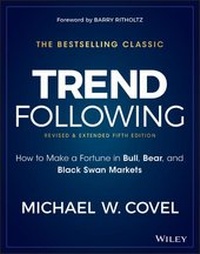
Trend Following
Description

More details
Other editions
Additional editions
Persons
Content
Preface
Men wanted for hazardous journey. Small wages. Bitter cold. Long months of complete darkness. Constant danger. Safe return doubtful. Honor and recognition in case of success.1
Want to take the financial journey to a new investing philosophy that might very well affect the rest of your moneymaking life? I can't guarantee the yellow brick road, but I can promise the red pill will leave you wide awake.
Nearly every time I strayed from the herd, I've made a lot of money. Wandering away from the action is the way to find the new action.
Jim Rogers
In late 2016 The Wall Street Journal reported that Steve Edmundson, the investment chief for the Nevada Public Employees' Retirement System, has no coworkers, rarely takes meetings, and eats leftovers at his desk. His daily trading strategy: Do as little as possible, usually nothing. The Nevada system's $35 billion in stocks and bonds are all in low-cost funds that mimic indexes. He may make one change to the portfolio a year.2
Not exactly a life changing revelation, I know, but that do-nothing, sit-on-your-hands investing premise doesn't stop with one-man shows. Dimensional Fund Advisors LP (DFA), the sixth-largest mutual fund manager, is drawing in nearly $2 billion in net assets per month at a time when investors are fleeing other firms. DFA is built on the bedrock belief that active management practiced by traditional stock pickers is futile, if not an absurdity. DFA's founders are pioneers of index funds.3
Now we are getting somewhere, because just about everyone has money tied up in an index fund-which in 2017 is not exactly pioneering. But the much larger issue at hand, unknown to most, is that there is an academic theory that allows anyone to confidently index.
To receive my free interactive trend following presentation send a picture of your receipt to receipt@trendfollowing.com.
Q: Do you pencil it in first?
A: No, you just start drawing.
Q: But don't you make mistakes?
A: There is no such thing as a mistake. A mistake is an opportunity to do something else. You have to leave it and let nature take it course.
Ralph Steadman, British artist best known for his work with American author Hunter S. Thompson, talking to Anthony Bourdain.
The efficient market theory (EMT) states asset prices fully reflect all available information. This means it is impossible for average investors-or superstars, for that matter-to beat the market consistently on a risk-adjusted basis, since market prices should only react to new information or changes in discount rates. EMT, set in motion with Louis Bachelier's PhD thesis published in 1900, and developed by University of Chicago professor Eugene Fama, argues stocks always trade at fair value, making it impossible for investors to either purchase undervalued stocks or sell stocks for inflated prices.4
Let me drop the nuclear warhead on that perspective.
There is a mind-numbingly large hole in this cool-sounding theory. EMT by definition leaves the epic October 2008 stock market meltdown out of the academic equation. And for those who know about the sausage making of writing peer review papers or engineering a PhD, much of modern finance's foundation was bricked together with EMT mortar. Fama was ultimately awarded the 2013 Nobel Prize in Economic Sciences because his findings "changed market practice"-that is, the worldwide acceptance of index funds.
Those findings are the generally accepted status quo.
Not everyone, however, is a true believer guzzling the Kool-Aid.
One of the first and loudest critics of EMT was famed mathematician Benoit Mandelbrot. He saw EMT proponents sweep big events like 2008 under the carpet, like kids house cleaning for the first time, calling them "acts of God." French physicist Jean-Philippe Bouchaud sees EMT marketing in play: "The efficient market hypothesis is not only intellectually enticing, but also very reassuring for individual investors, who can buy stock shares without risking being outsmarted by more savvy investors."5
Bouchaud continues: "Classical economics is built on very strong assumptions that quickly become axioms: the rationality of economic agents, the invisible hand and market efficiency, etc. An economist once told me, to my bewilderment: 'These concepts are so strong that they supersede any empirical observation.' As Robert Nelson argued in his book, Economics as Religion, 'the marketplace has been deified.' In reality, markets are not efficient, humans tend to be over-focused in the short-term and blind in the long-term, and errors get amplified through social pressure and herding, ultimately leading ?to collective irrationality, panic and crashes. Free markets are wild markets."6
David Harding, a man you might not know yet, ratchets up the polemic by describing EMT in apocalyptic terms: "Imagine if the economy as we know it was built on a myth. Imagine if that myth was the foundation stone on which the mainstream financial systems that control the global economy have been erected-the great bazaars of stock markets, bond markets, fiendishly complex financial instruments, credit default swaps, futures and options on which the fortunes of billions rest. Imagine if the myth was the key cause of the global crash in 2008-and if its perpetuation today threatened another catastrophic crash in the future. We don't have to imagine. The myth is Efficient Market Theory (EMT)."7
The efficient market theory is about two questions: Can the market be beat and is the market price the right price? First, evidence says the market can be beat. Second, debating the right or wrong price is futile. There is only the market price and it's the most real, objective piece of data in finance. Don't make the market a morality tale.
Michael Covel
Harding does not have a Nobel Prize, but he does have a net worth of $1.4 billion.8 He is a flat-out financial heretic and would not be offended if you called him a punk rocker for his antiestablishment attitude. In prior centuries he absolutely would have been burned at the stake for his wholesale dressing down of the financial high priests. He knows to question EMT is seen as madness by academics, banks, pension funds, and endowments.9
Interestingly, and with a bipolar flair, the Nobel committee split the 2013 Nobel Prize among economists with radically different theories. Robert Shiller, a man focused more on behavior and who shares the Nobel Prize with Fama, sees the contradictions: "I think that maybe he has a cognitive dissonance. [His] research shows that markets are not efficient. So what do you do if you are living in the University of Chicago? It's like being a Catholic priest and then discovering that God doesn't exist or something you can't deal with so you've got to somehow rationalize it."10
Harding goes further, explaining EMT madness in an everyman way: "This theory of rational markets treats economics like a physical science-like Newtonian physics-when in fact it is a human or social science. Human beings are prone to unpredictable behavior, to over-reaction or slumbering inaction, to mania and panic. The markets that reflect this behavior do not assume some supra-human wisdom, they can and sometimes do reflect that volatility."11
When it is a question of money, everyone is of the same religion.
Voltaire
Further translation: Human nature isn't rational. It blows bubbles and then pops bubbles-and you can see this going back hundreds of years:
- Dutch Tulip Mania (1634-1637)
- The South Sea Bubble (1716-1720)
- The Mississippi Bubble (1716-1720)
- The British Railway Mania Bubble (1840s)
- The Panic of 1857
- The Florida Real Estate Bubble of the 1920s
- The stock market crash of 1929
- The 1973-1974 stock market crash
- Black Monday-the stock market crash of 1987
- Japan's bubble economy and crash, 1989-current
- Dot-com bubble (1999-2002)
- United States bear market (2007-2009)
- Flash Crash (2010)
- Chinese stock market crash (2015-2016)
- Brexit (2016)
And on and on. . . .
But it's beyond being not rational. Those events, the human actions driving those booms and busts, are best described by academia's prospect theory, cognitive dissonance, the bandwagon effect, loss aversion, and assorted heuristics in judgment and decision-making-to name a few of the hundreds of biases inherent in people's lizard brains.
No doubt, the efficient versus not-efficient debate will not be resolved in these pages. Perhaps it will never be satisfactorily resolved in an academic mine is bigger than yours sense, which would not be surprising given that human beings and their egos, greed, fear, and money are knotted up so tight as to restrict brain blood flow. And please...
