

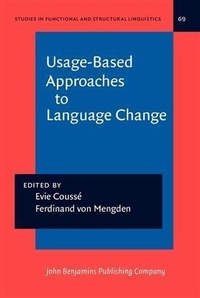
Usage-Based Approaches to Language Change
1st Edition
Published on 10. July 2014
V, 275 pages
978-90-272-7009-2 (ISBN)
Description

Usage-based approaches to language have gained increasing attention in the last two decades. The importance of change and variation has always been recognized in this framework, but has never received central attention. It is the main aim of this book to fill this gap. Once we recognize that usage is crucial for our understanding of language and linguistic structures, language change and variation inevitably take centre stage in linguistic analysis. Along these lines, the volume presents eight studies by international authors that discuss various approaches to studying language change from a usage-based perspective. Both theoretical issues and empirical case studies are well-represented in this collection. The case studies cover a variety of different languages - ranging from historically well-studied European languages via Japanese to the Amazonian isolate Yurakaré with no written history at all. The book provides new insights relevant for scholars interested in both functional and cognitive linguistic theory, in historical linguists and in language typology.
More details
Other editions
Additional editions
Evie Cousse | Ferdinand von Mengden
Usage-Based Approaches to Language Change
Book
07/2014
John Benjamins Publishing Co
€104.94
Shipment within 10-15 days
Persons
Content
- Usage-Based Approaches to Language Change
- Editorial page
- Title page
- LCC data
- Table of content
- Introduction
- 1. Original context of the notion 'usage-based'
- 2. The interplay between usage and grammar
- 3. From a cognition-centred to a communication-centred usage-based perspective
- 4. Usage, variation, and change
- 5. Overview of the contributions
- References
- Part 1. Challenging mainstream modelsof language change
- Does innovation need reanalysis?
- 1. Introduction
- 2. Reanalysis
- 3. Problems
- 3.1 Abruptness
- 3.2 Ambiguity
- 4. Innovation
- 4.1 Innovation through analogy
- 4.2 Innovation through other mechanisms
- 4.3 Structural indeterminacy
- 5. Conclusions
- Acknowledgements
- References
- On cognition and communication in usage-based models of language change
- 1. Introduction
- 2. Usage events, linguistic structure and the 'ontology of observing'
- 3. Models of communication
- 4. The primacy of meaning
- 5. The linguistic sign
- 6. Entrenchment, system history and the role of frequency
- 7. Dynamic stability: feedback, attractors and Eigenwerte
- 8. Innovation theory and actuation/actualisation
- 9. Variation and Diffusion
- Conclusion and outlook
- References
- Part 2. The role of usage in semantic change
- From inferential to mirative
- 1. Introduction
- 1.1 Background on Yurakaré
- 1.2 Structure of the paper
- 2. A usage- and interaction-based approach to semantic change
- 3. Data and method
- 4. Evidentiality and mirativity
- 5. The Yurakaré inferential evidential =tiba
- 5.1 Evidentiality in Yurakaré
- 5.2 The inferential reading
- 5.3 Use in confirmation requests
- 5.4 Confirmation requests with a small inferential step
- 5.5 Use in reconfirmation requests
- 5.6 Use in mirative responses
- 6. Discussion
- 7. Conclusion
- References
- Abbreviations
- Conversational transcript
- Glosses
- The motivation for using English suspended dangling participles
- 1. Introduction
- 2. Semantics of the dangling participial construction in English
- 3. Subjective and intersubjective meanings of some suspended dangling participles: The rise of new constructional meanings
- 3.1 Considering
- 3.1.1 Characteristics of the main clause
- 3.1.2 Omitted Object of Considering
- 3.2 Moving on: Guiding the hearer's attention
- 3.3 The Intersubjectivity of the suspended dangling participial construction: A case of constructionalization
- 3.4 The subjectivity-intersubjectivity continuum
- 3.5 Degree of intersubjectivity
- 4. Conclusion
- Acknowledgments
- References
- The nature of speaker creativity in linguistic innovation
- 1. Introduction
- 2. Terminological problems
- 3. Speaker creativity in linguistic innovation
- 4. The relationship between speaker creativity and its linguistic instantiations
- 5. Conclusion
- Acknowledgment
- References
- Part 3. The role of usage and structurein language change
- Reanalysis and gramma(ticaliza)tion of constructions
- 1. Introduction
- 1.1 Basic assumptions, hypotheses and research questions
- 1.1.1 Basic assumptions
- 1.1.2. Hypotheses
- 1.1.3. Research questions
- 1.2. Corpus
- 1.3. Outline of the paper
- 2. Reanalysis A & B (1): From subordinate to deictic relative construction
- 2.1. Characteristics of the deictic relative construction
- 2.2. The origin of the deictic relative construction
- 3. Reanalysis A & B (2), the aspectual progressive feature and the actualization of the deictic relative
- 3.1. The progressive nature of the deictic relative
- 3.2. The actualization process with 'voir'
- 3.2.1. Middle French
- 3.2.2. Classical and Modern French
- 3.3. Summary
- 4. Reanalysis A & (B &) C: Voici and voilà
- 4.1 Origin of voici and voilà
- 4.2. Characteristics of voici and voilà + the deictic relative construction
- 4.3. The actualization process
- 4.4. Summary
- 4.5 Discussion
- 5. Conclusion
- References
- Sources for empirical data
- Constructional change, paradigmatic structure and the orientation of usage processes
- 1. Introduction
- 2. The descriptive issue: Danish IO constructions
- 2.1 A preliminary characterisation of the change of the IO in Danish
- 2.2 Research questions
- 3. Semantic roles and the IO-construction: The content description of constructions
- 4. Syntagms and paradigms
- 5. Reflexive free indirect objects
- 6. The paradigm of the 18th century IO
- 6.1 The paradigmatic organisation of the 18th century IO
- 6.2 Finnish and Danish IOs compared
- 6.3 The role of markedness
- 6.4 Comparing 18th century Danish to the modern language
- 6.5 Invariance and prototypicality
- 7. The verbs skaffe and købe: Some details of 19th and 20th century usage
- 7.1 Skaffe
- 7.2 Købe
- 8. Lexical recategorisations
- 7.1 Change of valency as a consequence of constructional change
- 7.2 Orienting lexical change on the background of the structure of constructions
- 9. Conclusion
- Sources
- References
- Filling empty distinctions of expression with content
- 1. Introduction
- 1.1 Usage and structure
- 1.2 Grammaticalization
- 1.3 Reanalysis
- 1.4 Empty distinctions
- 2. Case study 1: Old High German umlaut
- 3. Case study 2: Polish masculine nominative plural
- 3.1 Data
- 3.2 Interpretation
- 4. Case study 3: quantification in Russian
- 5. Conclusion
- Sources
- References
- Author index
- Subject index
