

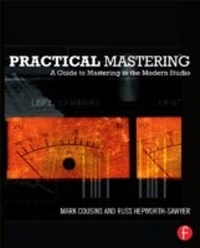
Practical Mastering
A Guide to Mastering in the Modern Studio
1st Edition
Published on 21. August 2013
261 pages
978-1-136-11373-4 (ISBN)
Description

Guiding you through the history and emergence of modern mastering techniques, then providing practical hints and tips on how to use them in your set up, Practical Mastering is the book for anyone interested in tackling this elusive art form. Providing you with sold mastering theory underpinned by years of professional experience and hands-on advice for getting the most out of your set up while honing your ears to efficiently and effectively listen to your mixes in order to create perfectly polished master tracks.
More details
Language
English
Place of publication
London
United Kingdom
Publishing group
Taylor & Francis Ltd
Target group
Professional and scholarly
Mastering recording, mixing engineers, musicians and producers. For all levels of student and professionals.
The primary market of this title would be those people wishing to master their own mixes or those training to one day become mastering engineers in their own right. In addition anyone aiming to work in themMusic Iindustry and requiring a knowledge of how mastering relates to their vocation.
Product notice
Reflowable
File size
54,46 MB
ISBN-13
978-1-136-11373-4 (9781136113734)
Copyright in bibliographic data and cover images is held by Nielsen Book Services Limited or by the publishers or by their respective licensors: all rights reserved.
Schweitzer Classification
Other editions
Additional editions
Book
07/2017
1st Edition
Routledge
€249.50
Shipment within 10-20 days
Book
04/2013
1st Edition
Focal Press
€49.55
Shipment within 15-20 days
Persons
Mark Cousins works as a composer, programmer and engineer, as well as being senior writer for Music Tech Magazine. His professional work includes composing music for some of the world's largest production music companies - including Universal Publishing Production Music - with broadcaster credits including BBC1, BBC2, ITV, Channel 4, Five, BBC World and Sky One, among others. He has also had works performed by the Royal Philharmonic Orchestra, the East of England Orchestra, City of Prague Philharmonic Orchestra and the Brighton Festival Chorus, as well as having mixed several orchestral albums for BMG Zomba.
Russ Hepworth-Sawyer is a sound engineer and producer with extensive experience in all things audio. He is a member of the Association of Professional Recording Services and the Audio Engineering Society; a Fellow of the Institute For Learning (U.K.); and a board member of the Music Producer's Guild. Through MOTTOsound (www.mottosound.co.uk), Russ works freelance in the industry as a mastering engineer, a producer, writer, and consultant. Russ currently lectures part-time for York St John University and Barnsley College Online and has taught extensively in higher education at British institutions including Leeds College of Music, London College of Music, and Rose Bruford College. He currently writes for Pro Sound News Europe, has contributed to Sound On Sound magazine, and has written many titles for Focal Press.
Russ Hepworth-Sawyer is a sound engineer and producer with extensive experience in all things audio. He is a member of the Association of Professional Recording Services and the Audio Engineering Society; a Fellow of the Institute For Learning (U.K.); and a board member of the Music Producer's Guild. Through MOTTOsound (www.mottosound.co.uk), Russ works freelance in the industry as a mastering engineer, a producer, writer, and consultant. Russ currently lectures part-time for York St John University and Barnsley College Online and has taught extensively in higher education at British institutions including Leeds College of Music, London College of Music, and Rose Bruford College. He currently writes for Pro Sound News Europe, has contributed to Sound On Sound magazine, and has written many titles for Focal Press.
Content
Introduction
Setting the scene on a practical level.
Why engage in mastering?
What can users expect to achieve from using their own equipment.
What is mastering?
Why self-master?
History of Mastering:
The early days
Original Media - The need for dynamic containment
Cutting
pre-mastering
creative mastering
the CD age
Through the 90's to 00's - Louder....louder....louder > > >
The future holds...
Mastering Tools
Professional Mastering v. Project Studio Mastering
Professional Studio: (as scene setter)
DAW
A/D D/A
Monitoring
Desk|
Single Processing|
Project Studio Mastering: (this should be about how to improve your studio to some extent, as well as the equipment you need to master effectively)
DAW
Digital processing (plug-ins)
Analogue processing
Monitoring
Acoustic treatment
Mastering
(Step-by-step guide to the key processes in mastering - from which the authors will explore in more detail in the rest of section 2. It's important the reader understands the whole picture first, before we deal with the specifics.)
Source material & File Formats
Source Material
quality of
dynamic range
spread of frequencies and energy
mastered already?
Source material musically
Making an assessment
per track
per album
File Formats
types
bit depth
sample frequencies
Pre-mastering processing
Editing and Compilation
Codes and specifications
DAW and Plug-in Comparison
(A DAW comparison - looking at the methods involved in using range of standard DAWs for mastering. Applies chapter 2 in context of main apps. This sets the scene for the application in the following chapters).
Logic/Waveburner
Cubase
Pro Tools
Reason
Ableton
Redefining Timbre
Equalisation
Multiband Compression
Exciters
Distortion & Other Effects
Controlling Dynamics
Single band
Multiband
other techniques
Creating & Managing Loudness
techniques to improve loudness
Techniques such as parallel compression, productions strategies, limiting, Inflation and Enhancement, role of frequency in loudness, auditory perception of loudness, and so on.
Editing
Track editing
Fades, crossfades and cuts.
Programme editing
timings, gap lengths etc.
Making a Product
Creating a master
Using Codes
ISRC, UPC/EAN, PQ sheets and how to register these with PPL and so on
Track names
discussion about CD TEXT and pros and cons.
Formats
CD-A
DDPi
Delivery
FTP versus DVD
Others
Knowledgebase - Listening is Key
All you need is Listening
How we listen
audio theory placed in context with listening.
the ear
the brain
the auditory system
Decibels and Hertz!
Monitoring systems and Setups
How to listen
Introduction
Macro (holistic) versus micro listening
Listening - Music versus Sound
discussion about switching between the musical engagement and simply the higher altitude listening of just the sound,
frequencies, timbres and their relationship to each other.
Listening Analysis
Listening Exercises/Examples
Setting the scene on a practical level.
Why engage in mastering?
What can users expect to achieve from using their own equipment.
What is mastering?
Why self-master?
History of Mastering:
The early days
Original Media - The need for dynamic containment
Cutting
pre-mastering
creative mastering
the CD age
Through the 90's to 00's - Louder....louder....louder > > >
The future holds...
Mastering Tools
Professional Mastering v. Project Studio Mastering
Professional Studio: (as scene setter)
DAW
A/D D/A
Monitoring
Desk|
Single Processing|
Project Studio Mastering: (this should be about how to improve your studio to some extent, as well as the equipment you need to master effectively)
DAW
Digital processing (plug-ins)
Analogue processing
Monitoring
Acoustic treatment
Mastering
(Step-by-step guide to the key processes in mastering - from which the authors will explore in more detail in the rest of section 2. It's important the reader understands the whole picture first, before we deal with the specifics.)
Source material & File Formats
Source Material
quality of
dynamic range
spread of frequencies and energy
mastered already?
Source material musically
Making an assessment
per track
per album
File Formats
types
bit depth
sample frequencies
Pre-mastering processing
Editing and Compilation
Codes and specifications
DAW and Plug-in Comparison
(A DAW comparison - looking at the methods involved in using range of standard DAWs for mastering. Applies chapter 2 in context of main apps. This sets the scene for the application in the following chapters).
Logic/Waveburner
Cubase
Pro Tools
Reason
Ableton
Redefining Timbre
Equalisation
Multiband Compression
Exciters
Distortion & Other Effects
Controlling Dynamics
Single band
Multiband
other techniques
Creating & Managing Loudness
techniques to improve loudness
Techniques such as parallel compression, productions strategies, limiting, Inflation and Enhancement, role of frequency in loudness, auditory perception of loudness, and so on.
Editing
Track editing
Fades, crossfades and cuts.
Programme editing
timings, gap lengths etc.
Making a Product
Creating a master
Using Codes
ISRC, UPC/EAN, PQ sheets and how to register these with PPL and so on
Track names
discussion about CD TEXT and pros and cons.
Formats
CD-A
DDPi
Delivery
FTP versus DVD
Others
Knowledgebase - Listening is Key
All you need is Listening
How we listen
audio theory placed in context with listening.
the ear
the brain
the auditory system
Decibels and Hertz!
Monitoring systems and Setups
How to listen
Introduction
Macro (holistic) versus micro listening
Listening - Music versus Sound
discussion about switching between the musical engagement and simply the higher altitude listening of just the sound,
frequencies, timbres and their relationship to each other.
Listening Analysis
Listening Exercises/Examples
