

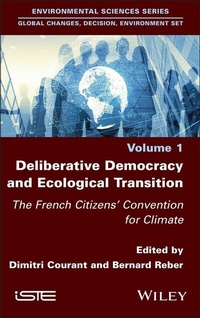
Deliberative Democracy and Ecological Transition
Description

Democracies are struggling to respond to the climate crisis. One promising approach to the ecological transition is based on innovations involving panels of citizens drawn at random. Many countries have experimented with this form of deliberative democracy at national and local levels. These citizens' assemblies formulate public policy proposals.
The French Citizens' Convention for Climate is the largest in terms of size, duration and mandate. Thanks to a multi-disciplinary field survey involving around twenty researchers, this book provides an understanding of the complexity of this experience from several angles: procedures and processes; the identity and roles of its members; relationships with expertise and representatives; evaluation and comparison with other cases.
Deliberative Democracy and Ecological Transition plays an important role in reflecting on an original practice of democratic innovation and its potential for fair governance of climate policies.
More details
Other editions
Additional editions
Persons
Dimitri Courant is a postdoctoral researcher at Harvard University, USA. He holds a double doctorate in political science from the University of Lausanne, Switzerland, and the University of Paris 8, France. He was a postdoctoral Fung Global Fellow at Princeton University, USA.
Bernard Reber is a philosopher, specializing in ethics and politics, Director of Research at the CNRS and a member of the Political Research Center at Sciences Po Paris, Cevipof, France. For over two decades, he has analyzed and helped to set up a number of deliberative experiments.
Content
Endorsements xiii
Acknowledgements xv
Introduction xvii
Dimitri COURANT and Bernard REBER
I.1. Deliberative mini-publics, elsewhere and previously xix
I.2. An exceptional scheme xxi
I.3. A cross-disciplinary study to move past an oversimplistic narrative xxiii
I.4. Presentation of the book xxv
I.5. An atypical field study for a multidisciplinary collective xxxii
I.6. References xxxvi
Part 1. A Complex Deliberative Process 1
Chapter 1. Genesis and Evolution of the Citizens' Convention for Climate 3
Dimitri COURANT
1.1. Precursors and context: the Grand débat national and the citizen group of the ESEC 4
1.2. A negotiated and hybrid device: between militant lobbying and political strategy 5
1.3. Modifications and crises 16
1.4. Conclusion 25
1.5. References 25
Chapter 2. Governing Committee and Political Role 29
Jean-Michel FOURNIAU
2.1. Self-government or external leadership of citizens' assemblies 30
2.2. Composition of the governing committee: a political negotiation 33
2.3. Role of the governing committee and scope of autonomy 37
2.4. "Sovereignty" of the Convention 40
2.5. Conclusion: an innovative participatory device or a new form of democratic representation 42
2.6. References 43
Chapter 3. Comparing Ireland's Citizens' Assembly and France's Citizens' Convention 47
Dimitri COURANT
3.1. Random selection to the rescue of democracy and ecology 47
3.2. Ireland's Citizens' Assembly: between citizen autonomy and control by the managers 51
3.3. Comparative analysis with France's Convention: a more partial but more productive deliberation 59
3.4. Conclusion 69
3.5. Acknowledgements 70
3.6. References 70
Chapter 4. The Pandemic and Conflicts of Legitimacy: Session 6bis 75
Bernard REBER and Nathalie BLANC
4.1. Accelerated improvisation 77
4.2. Influences on the Co-Chairs' and citizens' reactions 82
4.3. Management, selection and cascading votes 87
4.4. Media leak and crisis within the governing committee 93
4.5. Conclusion 95
4.6. References 99
Part 2. Convention Members and Public Opinion 101
Chapter 5. France in Miniature: The Descriptive Legitimacy of the Random Selection Process 103
Jean-Michel FOURNIAU, Bénédicte APOUEY and Solène TOURNUS
5.1. Initial recruitment of the 150 citizens 104
5.2. Changes in the Convention's composition as it progressed 111
5.3. Sociodemographic characteristics of the participants in the Citizens' Convention for Climate 113
5.4. Composition of the thematic groups 118
5.5. References 123
Chapter 6. Profiles and Opinions of the Convention Members Compared to Those of the Population 125
Adrien FABRE, Bénédicte APOUEY, Thomas DOUENNE, Jean-Michel FOURNIAU, Louis-Gaëtan GIRAUDET, Jean-François LASLIER and Solène TOURNUS
6.1. Introduction 126
6.2. Statistical representativity 128
6.3. Deliberative citizens 145
6.4. The general public's perceptions of the Convention 149
6.5. Conclusion 156
6.6. References 157
Chapter 7. The Convention Members' Opinions on Climate Measures 159
Bénédicte APOUEY, Thomas DOUENNE and Jean-François LASLIER
7.1. Originally, mass support for the measures... with three exceptions 161
7.2. Sociodemography of the support for the climate measures 165
7.3. Perceptions relating to climate change and support for the measures 170
7.4. Trust, life satisfaction, expectations and degree of support for the measures 174
7.5. Citizens divided on the issue of the carbon tax, from the outset 179
7.6. Evolution of the degree of support for the measures over the course of the Convention 182
7.7. Conclusion 183
7.8. References 185
Part 3. Deliberations, Proposals and Expertise 187
Chapter 8. Deliberative Impartiality and Legitimacy of the Influences 189
Dimitri COURANT and Simon BAECKELANDT
8.1. Impartiality as a deliberative imperative 191
8.2. Objectivizing impartiality 194
8.3. Around the citizens: politically committed organizers and experts 196
8.4. Evaluating attempts to influence: modes of interaction and legitimacy 199
8.5. Conclusion: proceduralizing impartiality 216
8.6. References 220
Chapter 9. Roles of the Experts and of the Citizens in Devising the Measures Put Forward: The Thematic Group "Housing" 225
Louis-Gaëtan GIRAUDET and Hélène GUILLEMOT
9.1. Characteristics and issues surrounding "Housing" as a field 226
9.2. Experts and stakeholders 227
9.3. Development and progression of the measures 229
9.4. Role of the citizens, and role of the experts 232
9.5. The measures, and what became of them 235
9.6. Conclusion 238
9.7. References 239
Chapter 10. The Relationships to Expertise in Light of "Technical" Democracy 241
Selma TILIKETE
10.1. The C3 in line with a dialog-based model? 244
10.2. Acting in a situation of "consensus on the diagnosis" 251
10.3. Expanding the approach to the climate problem 255
10.4. Relaying the experts' proposals, and making them fairer 259
10.5. Conclusion 262
10.6. References 264
Chapter 11. Getting Around the Issue of the "Carbon Tax" 267
Romane ROZENCWAJG, Bénédicte APOUEY, Maxime GABORIT, Laurent JEANPIERRE and Jean-François LASLIER
11.1. Initial rejection of the "carbon tax" 268
11.2. In search of substitute measures 275
11.3. Conclusion 283
11.4. References 285
Part 4. Social Movements, Justice and Exceptions 287
Chapter 12. Conceptions of Social, Environmental and Climate Justice 289
Nathalie BLANC and Laurence GRANCHAMP
12.1. Definitions of social, environmental and climate justice 291
12.2. Political and organizational frameworks 292
12.3. Debates on social justice in Session 2 of the C3 294
12.4. A step toward environmental and climate justice 299
12.5. Conclusion 303
12.6. References 304
Chapter 13. Contestation and Deliberation: Activists and the Randomly Selected Citizens 307
Maxime GABORIT
13.1. An organization open to social dynamics 309
13.2. Diversity of interactions between activists and randomly selected citizens 313
13.3. Moving past the dichotomy between contestation and deliberation 322
13.4. References 324
Chapter 14. Representativity and Exceptionality: Citizens from Overseas and Co-decision 327
Christiane RAFIDINARIVO
14.1. Dynamics of co-decision on public policy and construction of the research object 329
14.2. Descriptive representativity and political representation: the exceptionality of the Overseas Territories 334
14.3. The argument of exceptionality 341
14.4. Conclusion 355
14.5. Acknowledgements 358
14.6. References 359
Part 5. Comparisons, Filters and Accountability 365
Chapter 15. The Bürgerrat Klima: Germany's Informal Model for Integrating Citizen Deliberation into Politics 367
Rikki DEAN and Gabriel PELLOQUIN
15.1. Bürgerrat Klima's internal characteristics 369
15.2. The Assembly's integrative characteristics 375
15.3. Conclusion 382
15.4. References 384
Chapter 16. Ambiguities of the Phrase "With No Filter" and the Necessary Filters 387
Bernard REBER
16.1. "With no filter": the ambiguity of a promise 390
16.2. The filters of the Convention 396
16.3. Legal filters 404
16.4. The lacking filters of conceptions of justice 407
16.5. Evaluation of the accountability process 410
16.6. Conclusion: filters as "fictions", necessary for mutual understanding 419
16.7. References 422
Conclusion 427
Bernard REBER
C.1. Evaluation as a conflictive issue: doing better than the GDN 428
C.2. No analysis without descriptive and normative filters 431
C.3. The filters represented by the criteria used, and adherence to them 432
C.4. Justifications of the criteria 433
C.5. Presuppositions 436
C.6. With and beyond Habermasian fiction and Rawlsian conjecture 438
C.7. References 439
List of Authors 443
Index 445
Introduction
Multi-disciplinary Analysis of a Complex Deliberative Process
Dimitri COURANT and Bernard REBER1
Of all of the issues facing today's world, climate is the most crucial. However, as we face the prospect of an unprecedented disaster, the institutions of what is termed "representative democracy" appear to be relatively impotent. They are afflicted by: short-term vision linked to relatively short electoral cycles; the preponderance of lobbyists and interest groups; reticence to change on the part of general populations; difficulties in effecting systemic transitions; etc. Clearly, there is no shortage of challenges. As a potential remedy, while some people advocate a so-called "green dictatorship", others propose innovative democratic measures. Such innovations would ensure pluralism and efforts to find compromise. Above all, they would ensure an informed, collective decision-making process, in line with the freedoms that the Rule of Law States guarantee to their citizens. The goal of this approach is to enhance citizen participation, improve the quality of political deliberation, and adopt an alternative method for making long-term decisions; decisions that are urgently needed but that elected officials, constrained by short-term popularity, are reluctant to take. In recent years, many citizens' assemblies on the climate issue have been held in the Global North. However, these assemblies do not always share the same goals. France's Convention citoyenne pour le climat (C3 - Citizens' Convention for Climate) leads the pack in this area, in terms of size, duration and the number of political proposals it produced. With an official mandate from the French government, the C3 included 150 citizens selected at random, making up a diverse panel designed to represent the diversity of French society. Launched in October 2019, participants listened to presentations from guest experts, deliberated for nine months, and put forward 149 recommendations to the French President in June 2020. In February 2021, a final session was held for the citizens to appraise the government's response to the recommendations. This lengthy process involved organizers, facilitators, experts, representatives of special interest groups, journalists, and political figures. Any worthy analysis of the C3 must reflect the complexity and richness of the process. In order to analyze and evaluate the C3, a group of researchers worked throughout the Convention - and indeed outside and beyond it - conducting observations, surveys, and interviews. Their work is intended to be more than merely a simplified overview of this extraordinary initiative.
What lessons can be drawn from the Citizens' Convention for Climate? Is it possible to combine deliberative democracy with an ecological transition that advances social justice? These two questions are addressed throughout this book. Their implications extend beyond France. The French President, Emmanuel Macron, later opined that the question put to the Convention - "How can we achieve a 40% reduction in greenhouse gas emissions by 2030, in keeping with the spirit of social justice?" - was too broad. Nevertheless, this question is at the heart of the balance which needs to be struck in order to bring about an ecological transition within any democracy, where decision-making and sustainable implementation are informed by true deliberation (Reber 2023).
Hereafter in this introduction, we will briefly examine the C3's place in relation to similar initiatives; specifically, the constellation of deliberative mini-publics, which pre-date the C3 by some distance. Thus, it was not a radical innovation which came out of nowhere. However, we will underline some of the features which set it apart from other initiatives (it was notably distinguished by its exceptional scale). We will then describe how this book is structured and provide overviews of the individual chapters. Finally, we will reflect on the unusual research carried out in this field study, by a multi-disciplinary group of some twenty researchers, studying just one experiment (an extraordinarily high number). The conclusion completes this reflection and looks at the problem of evaluation: the levels, bases, and criteria used. Indeed, the assessment criteria and the way in which they are interpreted serve as filters to allow for an analysis to be carried out. The aim of this book is to analyze the process of the C3, with all its strengths and weaknesses, in order to enrich our knowledge of citizen deliberation, in particular, on climate policies.
I.1. Deliberative mini-publics, elsewhere and previously
The C3 would not have been possible, or even conceivable, without the development of other deliberative mini-publics, over a long period of time. Mini-publics constitute a type of democratic innovation (i.e. a set of practices and devices which allow for the involvement of ordinary citizens beyond the usual context of voting and elections, social movements, or trade unions). Widely varying arguments have been employed to justify these practices, based on a range of democratic theories or simple interpretations of guidelines to lend them legitimacy. Such is the case, for example, with the theory of deliberative democracy (Reber 2011a, 2011b, 2023; Bächtiger et al. 2018). At least four types of democratic innovations can be distinguished: 1) local assemblies and participatory budgeting; 2) referenda and popular initiatives; 3) "e-democracy" (electronic/digital); and 4) mini-publics constituted by random selection (Smith 2009; Elstub and Escobar 2019). Mini-publics are diverse panels of citizens selected at random, who deliberate on one or more political issues, and make recommendations (Grönlund et al. 2014; Harris 2019). The lottery procedures are combined with selection criteria to ensure that the diversity of the resulting panel reflects that of society.
After the advent of commonly known legal juries (or lay juries) (Gissinger-Bosse 2019), it was not until the early 1970s that new randomly selected citizens' assemblies emerged. We can point to at least six generations of mini-publics (Courant and Sintomer 2019). First of all, in 1969 in France, came the launch of the Conseil supérieur de la fonction militaire (High Council of Military Function). It was the world's first mini-public, but also the longest-lasting and the first permanent assembly of randomly selected members in the 20th century. This deliberative body brings together 80 military personnel who are proportionally representative of the various ranks and groups within the army twice a year. It then produces a report that is submitted directly to the Minister for Defense (Courant 2019b).
Subsequently, in the 1970s, came the citizens' juries and planning cells, set up respectively in the USA and Germany (Dienel and Renn 1995; Crosby and Nethercut 2005; Vergne 2010). In the 1980s, the Danish Board of Technology organized a number of "consensus conferences" to produce reports on controversial technologies. Other European countries, including Switzerland, used this same model to implement "hybrid forums" (Joss and Bellucci 2002; Hendriks 2005; Reber 2005, 2011). France also adopted them, albeit much later than Denmark. However, in France, they are held less frequently and are known as citizens' conferences (Boy et al. 2000; Bourg and Boy 2005). All of these democratic innovations brought together between 15 and 40 citizens for three weekends. Thus, they were on a smaller scale than those which were to follow. France also experimented with citizens' conferences within a larger setting: the États généraux de la bioéthique (Reber 2010). This very French name harkens back to the country's historical Estates General.
In the 1990s, deliberative polls offered greater representativity, thanks to the larger number of participants (between 100 and 600). However, they were a decrease in terms of deliberative production, as they merely expressed the "enlightened opinion" of a representative sample through surveys, instead of asking the panel to produce recommendations on public policies (Fishkin 2009; Mansbridge 2010).
The next stage takes us from the 2000s up to today, with Citizens' assemblies commissioned by the state, made up of between 100 and 200 participants. Pilot projects in this direction have been run in Canada (Warren and Pearse 2008; Lang 2010), the Netherlands (Fournier et al. 2011), Ireland (Suiter et al. 2019; Courant 2021), France (Reber 2020), the United Kingdom, and many other countries. In parallel to these "state-led citizens' assemblies", NGOs have organized "civil society-led citizens' assemblies" (Courant 2019a) in Belgium (Caluwaerts and Reuchamps 2018), Iceland (Bergmann 2016), Germany (see Chapter 15) and Australia (Carson et al. 2013). Similar initiatives have also been set up by universities (Reber 2011b).
Finally, in the 2010s, many US states set up a Citizens' Initiative Review (CIR): a deliberative panel of around thirty participants, charged with producing a statement to inform voters about the opportunities and risks surrounding an upcoming referendum (Knobloch et al. 2015). This process was replicated in Switzerland at local level in 2019 by the...
