

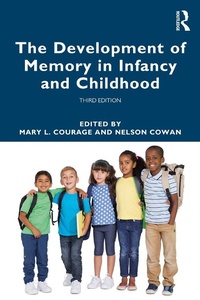
The Development of Memory in Infancy and Childhood
3rd Edition
Published on 16. May 2022
442 pages
978-1-000-57627-6 (ISBN)
Description

The Development of Memory in Infancy and Childhood provides a thorough update and expansion of the previous edition and offers new research on significant themes and ideas that have emerged in the past decade such as the cognitive neuroscience of memory development, autobiographical memory and infantile amnesia, and the cognitive and social factors that underlie memory for events.
In this volume, Courage and Cowan bring together leading international experts to review the current state of the science of memory development in their own research areas. They note questions of theory and basic science addressed in their research, highlight the real-world applications of those findings, and propose an agenda for future research. The book also considers the implications of their work for the development of atypical children, specifically, how these new findings might be adapted to enrich the lives of those children and to inform and validate our current expectations of individual differences in the development of typical children. The first of three groups of chapters focuses on basic neurobiological, perceptual, and cognitive processes that underlie memory and its development (i.e., encoding, consolidation and storage, retrieval). The second group focuses primarily on the social, contextual, and cultural factors that enable, shape, and mediate these basic processes, while the rest of the chapters focus on practical applications of this knowledge to real-world settings and issues.
The book provides a new look at memory development, including new topics such as spatial representation and spatial working, prospective memory, false memories, and memory and culture. This classic yet contemporary volume will appeal to senior undergraduate and graduate students of developmental and cognitive psychology, as well as to developmental psychologists who want a compendium of key topics in memory development.
In this volume, Courage and Cowan bring together leading international experts to review the current state of the science of memory development in their own research areas. They note questions of theory and basic science addressed in their research, highlight the real-world applications of those findings, and propose an agenda for future research. The book also considers the implications of their work for the development of atypical children, specifically, how these new findings might be adapted to enrich the lives of those children and to inform and validate our current expectations of individual differences in the development of typical children. The first of three groups of chapters focuses on basic neurobiological, perceptual, and cognitive processes that underlie memory and its development (i.e., encoding, consolidation and storage, retrieval). The second group focuses primarily on the social, contextual, and cultural factors that enable, shape, and mediate these basic processes, while the rest of the chapters focus on practical applications of this knowledge to real-world settings and issues.
The book provides a new look at memory development, including new topics such as spatial representation and spatial working, prospective memory, false memories, and memory and culture. This classic yet contemporary volume will appeal to senior undergraduate and graduate students of developmental and cognitive psychology, as well as to developmental psychologists who want a compendium of key topics in memory development.
More details
Edition
3rd edition
Language
English
Place of publication
London
United Kingdom
Publishing group
Taylor & Francis Ebooks
Target group
College/higher education
Illustrations
5 Tables, black and white; 14 Line drawings, black and white; 2 Halftones, black and white; 16 Illustrations, black and white
ISBN-13
978-1-000-57627-6 (9781000576276)
Copyright in bibliographic data and cover images is held by Nielsen Book Services Limited or by the publishers or by their respective licensors: all rights reserved.
Schweitzer Classification
Other editions
Additional editions
Book
05/2022
3rd Edition
Psychology Press Ltd
€207.00
Shipment within 15-20 days

Book
05/2022
3rd Edition
Psychology Press Ltd
€75.80
Shipment within 15-20 days
Persons
Mary L. Courage (Ph.D. Memorial University, Canada, 1985) is an Emeritus Professor in the Department of Psychology and has held cross-appointments to the Faculty of Medicine (Pediatrics) at Memorial University. Her work on the early development of vision, attention, and memory has been published in many academic journals, and has been funded consistently by the Natural Sciences and Engineering Research Council of Canada. She co-edited three special issues of Developmental Review on early memory development in 2004, on the impact of video on toddlers in 2010, and on multitasking in 2015.
Nelson Cowan (Ph.D. University of Wisconsin, 1980) is Curators' Distinguished Professor at the University of Missouri. His work focusing on short-term working memory and its relation to selective attention in children and adults has been published in various academic journals and has been funded by the National Institutes of Health since 1984. He has served as Editor of the Journal of Experimental Psychology: General and Associate Editor for three journals in experimental psychology.
Nelson Cowan (Ph.D. University of Wisconsin, 1980) is Curators' Distinguished Professor at the University of Missouri. His work focusing on short-term working memory and its relation to selective attention in children and adults has been published in various academic journals and has been funded by the National Institutes of Health since 1984. He has served as Editor of the Journal of Experimental Psychology: General and Associate Editor for three journals in experimental psychology.
Content
1. A Developmental Cognitive Neuroscience Approach to the Study of Memory 2. The Development of Infant Memory 3. Representational Flexibility in Infants and Young Children 4. Infant and Toddler Working Memory 5. Working Memory Development in Childhood 6. The Development of Working Memory and Spatial Representation: How are They Related? 7. The Development of Prospective Memory during Childhood 8. The Development of Semantic Memory: The Role of Memory Strategies and Metacognition 9. Implicit Memory in Children: Moving Beyond Developmental Invariance 10. Autobiographical Memory: Early Onset and Developmental Course 11. Sociocultural Perspectives on Autobiographical Memory 12. Memory Development from Infancy to Early Childhood: Cross-cultural Perspectives 13. Children's Memory Development: Emotion, Distress, and Trauma 14. Memory Development and the Forensic Context 15. The Counterintuitive Course of False Memory Development During Childhood 16. Reflections and Future Directions
