

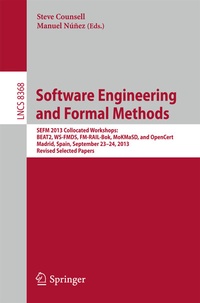
Software Engineering and Formal Methods
Description

This book constitutes the revised selected papers of the collocated workshops of the 11th International Conference on Software Engineering and Formal Methods, SEFM 2013, held in Madrid, Spain, in September 2013.
The conference hosted 5 workshops: The Second International Workshop on Behavioural Types (BEAT2). The aim was to pursue research topics in the use of behavioural type theory as the basis for new foundations, programming languages and software development methods for communication-intensive distributed systems. The Third Workshop on Formal Methods in the Development of Software (WS-FMDS). The aim was to bring together scientists and practitioners active in the area of formal methods and interested in exchanging their experiences in the industrial usage of these methods. The Workshop on a Formal Methods Body of Knowledge for Railway Control and Safety Systems (FM-RAIL-BOK). In many engineering-based application areas such as in the railway domain, formal methods have reached a level of maturity that already enables the compilation of a so-called body of knowledge. The Second International Symposium on Modelling and Knowledge Management for Sustainable Development (MoKMaSD). The aim was to bring together researchers and practitioner from academia, industry, government and non-government organisations to present research results and exchange experience, ideas and solutions for modelling and analysing complex systems. In particular in areas including economy, governance, health, biology, ecology, climate and poverty reduction. The 7th International Workshop on Foundations and Techniques for Open Source Software Certification (Open Cert). The aim was to bring together researchers from Academia and Industry interested in the quality assessment of OSS projects, as well as the metrics, procedures and tools used in OSS communities and for the measurement and assessment of OSS quality.
More details
Other editions
Additional editions
Content
Towards Global and Local Types for Adaptation.- A Concurrent Programming Language with Refined Session Types.- Behavioural Types Inspired by Cellular Thresholds.- Ensuring Faultless Communication Behaviour in A Commercial Cloud.- A Typing System for Privacy.- Compliance and Testing Preorders Differ.- Scalable Session Programming for Heterogeneous High-Performance Systems.- A Supervisor Synthesis Tool for Finite Nondeterministic Automata with Data.- SMT-Constrained Symbolic Execution for Eclipse CDT/Codan.- IOCO as a Simulation.- Modeling and Simulating Interaction Protocols Using Nested Petri Nets.- PetriCode: A Tool for Template-Based Code Generation from CPN Models.- Twenty-Five Years of Formal Methods and Railways: What Next.- What IS a BoK? Large - Extended Abstract.- Verification of Scheme Plans Using CSPjjB.- Applied Bounded Model Checking for Interlocking System Designs.- Formal Implementation of Data Validation for Railway Safety-Related Systems with OVADO.- Validation of Railway Interlocking Systems by Formal Verification, A Case Study.- Verification of Solid State Interlocking Programs.- Towards Knowledge Modeling for Sustainable Transport.- XBRL-Driven Business Process Improvement: A Simulation Study in the Accounting Domain.- The Role of Linked Data and Semantic-Technologies for Sustainability Idea Management.- Stochastic Modelling of Seasonal Migration Using Rewriting Systems with Spatiality.- A Computational Formal Model of the Invasiveness of Eastern Species in European Water Frog Populations.- Process Ordering in a Process Calculus for Spatially-Explicit Ecological Models.- DISPAS: An Agent-Based Tool for the Management of Fishing Effort.- Certifying Machine Code Safe from Hardware Aliasing: RISC is Not Necessarily Risky.- Soundness and Completeness of the NRB Verification Logic.- Analysis of FLOSS Communities as Learning Contexts.- Small World Characteristics of FLOSS Distributions.
