

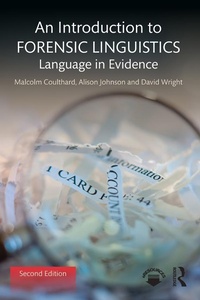
An Introduction to Forensic Linguistics
Language in Evidence
2nd Edition
Published on 22. July 2016
270 pages
978-1-317-24666-4 (ISBN)
Description

An Introduction to Forensic Linguistics: Language in Evidence has established itself as the essential textbook written by leading authorities in this expanding field. The second edition of this bestselling textbook begins with a new introduction and continues in two parts.
Part One deals with the language of the legal process, and begins with a substantial new chapter exploring key theoretical and methodological approaches. In four updated chapters it goes on to cover the language of the law, initial calls to the emergency services, police interviewing, and courtroom discourse. Part Two looks at language as evidence, with substantially revised and updated chapters on the following key topics:
the forensic linguist
forensic phonetics
authorship attribution
the linguistic investigation of plagiarism
the linguist as expert witness.
The authors combine an array of perspectives on forensic linguistics, using knowledge and experience gained in legal settings - Coulthard in his work as an expert witness for cases such as the Birmingham Six and the Derek Bentley appeal, and Johnson as a former police officer. Research tasks, further reading, web links, and a new conclusion ensure that this remains the core textbook for courses in forensic linguistics and language and the law. A glossary of key terms is also available at https://www.routledge.com/products/9781138641716 and on the Routledge Language and Communication Portal.
Part One deals with the language of the legal process, and begins with a substantial new chapter exploring key theoretical and methodological approaches. In four updated chapters it goes on to cover the language of the law, initial calls to the emergency services, police interviewing, and courtroom discourse. Part Two looks at language as evidence, with substantially revised and updated chapters on the following key topics:
the forensic linguist
forensic phonetics
authorship attribution
the linguistic investigation of plagiarism
the linguist as expert witness.
The authors combine an array of perspectives on forensic linguistics, using knowledge and experience gained in legal settings - Coulthard in his work as an expert witness for cases such as the Birmingham Six and the Derek Bentley appeal, and Johnson as a former police officer. Research tasks, further reading, web links, and a new conclusion ensure that this remains the core textbook for courses in forensic linguistics and language and the law. A glossary of key terms is also available at https://www.routledge.com/products/9781138641716 and on the Routledge Language and Communication Portal.
Reviews / Votes
"This book is quite superb. It provides a neat introduction to the subject area for those who have no formal background in linguistics." Matthew Kewley, Barrister 'The substantially revised edition of this pioneering forensic linguistics textbook combines the formidable expertise and wisdom of two of the field's most respected leaders with the fresh perspective of one of its bright new scholars. Students will love the fascinating illustrative data from a large number of real cases from five continents.' Diana Eades, University of New England, Australia'This book is quite superb. It provides a neat introduction to the subject area for those who have no formal background in linguistics.' Matthew Kewley, Barrister
'The revisions to this book have given it a renewed clarity of voice within this impressive body of work particularly through the attention to theoretical and methodological context at the outset and the forward-looking conclusion at the end.' Francis Rock, Cardiff University, UK
'Comprehensive and well-written. Very much improved on 1st edition. Exercises invaluable for teachers. Authors are genuine forensic linguists with hands-on experience - this shines through the book.' Paul Simpson, Liverpool University, UK
More details
Edition
2nd edition
Language
English
Place of publication
London
United Kingdom
Publishing group
Taylor & Francis Ltd
Target group
College/higher education
Edition type
Revised edition
Illustrations
5 s/w Abbildungen, 1 farbige Abbildung, 9 s/w Tabellen
9 Tables, black and white; 1 Illustrations, color; 5 Illustrations, black and white
File size
1,69 MB
ISBN-13
978-1-317-24666-4 (9781317246664)
Copyright in bibliographic data and cover images is held by Nielsen Book Services Limited or by the publishers or by their respective licensors: all rights reserved.
Schweitzer Classification
Other editions
Additional editions
Malcolm Coulthard | Alison Johnson | David Wright
An Introduction to Forensic Linguistics
Language in Evidence
Book
07/2016
2nd Edition
Routledge
€261.30
Shipment within 10-20 days
Malcolm Coulthard | Alison Johnson | David Wright
An Introduction to Forensic Linguistics
Language in Evidence
Book
07/2016
2nd Edition
Routledge
€76.60
Shipment within 10-20 days
Persons
Coulthard, Malcolm; Johnson, Alison; Wright, David
Content
List of Tables
List of Figures
Acknowledgements
1. Introduction
PART I - The Language of the Legal Process
2 Critical, theoretical, and methodological approaches to language in legal settings
3 The language of the law
4 Emergency service calls and police interviewing
5 Trial discourse
PART II - Language as Evidence
6 The work of the forensic linguist
7 Forensic phonetics
8 Authorship Attribution
9 On textual borrowing
10 The linguist as expert witness
11 Conclusion
References
Index
List of Figures
Acknowledgements
1. Introduction
PART I - The Language of the Legal Process
2 Critical, theoretical, and methodological approaches to language in legal settings
3 The language of the law
4 Emergency service calls and police interviewing
5 Trial discourse
PART II - Language as Evidence
6 The work of the forensic linguist
7 Forensic phonetics
8 Authorship Attribution
9 On textual borrowing
10 The linguist as expert witness
11 Conclusion
References
Index
