

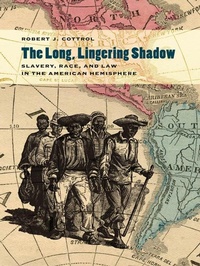
The Long, Lingering Shadow
Description

Students of American history know of the law's critical role in systematizing a racial hierarchy in the United States. Showing that this history is best appreciated in a comparative perspective, The Long, Lingering Shadow looks at the parallel legal histories of race relations in the United States, Brazil, and Spanish America. Robert J. Cottrol takes the reader on a journey from the origins of New World slavery in colonial Latin America to current debates and litigation over affirmative action in Brazil and the United States, as well as contemporary struggles against racial discrimination and Afro-Latin invisibility in the Spanish-speaking nations of the hemisphere.
Ranging across such topics as slavery, emancipation, scientific racism, immigration policies, racial classifications, and legal processes, Cottrol unravels a complex odyssey. By the eve of the Civil War, the U.S. slave system was rooted in a legal and cultural foundation of racial exclusion unmatched in the Western Hemisphere. That system's legacy was later echoed in Jim Crow, the practice of legally mandated segregation. Jim Crow in turn caused leading Latin Americans to regard their nations as models of racial equality because their laws did not mandate racial discrimination- a belief that masked very real patterns of racism throughout the Americas. And yet, Cottrol says, if the United States has had a history of more-rigid racial exclusion, since the Second World War it has also had a more thorough civil rights revolution, with significant legal victories over racial discrimination. Cottrol explores this remarkable transformation and shows how it is now inspiring civil rights activists throughout the Americas.
More details
Other editions
Additional editions
Person
Content
- Cover
- Contents
- Acknowledgments
- Introduction
- PART I: OUR BONDAGE AND OUR FREEDOM
- CHAPTER 1 Casta y Color, Movilidad y Ambigüedad: Slavery and Race in the Spanish Empire
- CHAPTER 2 Terra de Nosso Senhor: The Paradox of Race and Slavery in Brazil
- CHAPTER 3 Race, Democracy, and Inequality: Origins of the American Dilemma
- PART II: A WHITE MAN'S COUNTRY
- CHAPTER 4 Blanqueamiento: Building White Nations in Spanish America
- CHAPTER 5 No País do Futuro: Brazil's Journey from National Whitening to "Racial Democracy"
- CHAPTER 6 Jim Crow: The House the Law Built
- PART III: FROM EMANCIPATION TO EQUALITY
- CHAPTER 7 An American Sea Change: The Law's Power and Limitations
- CHAPTER 8 Um País para Todos? The Brazilian Journey from Racial Democracy to Racial Reform
- CHAPTER 9 New Awakenings in Spanish America
- Epilogue
- Notes
- Glossary of Spanish and Portuguese Terms
- A
- B
- C
- D
- E
- F
- G
- H
- I
- L
- M
- N
- O
- P
- Q
- R
- S
- T
- U
- V
- Z
- Bibliography
- Index
- A
- B
- C
- D
- E
- F
- G
- H
- I
- J
- K
- L
- M
- N
- O
- P
- Q
- R
- S
- T
- U
- V
- W
