

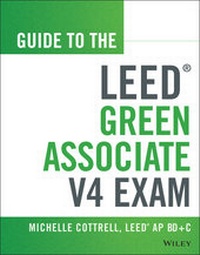
Guide to the LEED Green Associate V4 Exam
Description

More details
Other editions
Additional editions
Person
Content
Acknowledgments xi
Introduction xiii
Part I: Ramping Up 1
Chapter 1 Understanding the Credentialing Process 3
The Tiers of the Credentialing Process 3
LEED Green Associate 3
LEED Accredited Professional with Specialty 4
LEED Fellow 4
LEED Professional CertificatesTM 5
The Exam Registration Process 5
Register! 6
Schedule! 6
Why Earn LEED Credentials? 6
Quiz Time! 7
Online Resources 8
Notes 8
Chapter 2 Introduction to The Concepts of Sustainable Design 9
The Benefits of Green Buildings 10
The Triple Bottom Line 11
Systems Thinking 12
Feedback Loops 12
Leverage Points 13
Life-Cycle Approach 13
Do Green Buildings Cost More? 15
Quiz Time! 15
Notes 17
Chapter 3 Integrative Process 19
The Project Team Members 19
The Traditional Approach 20
The Integrative Approach to Design and Construction 21
Discovery 21
Design and Construction 24
Occupancy, Operations, and Performance Feedback 26
Quiz Time! 27
Online Resources 28
Notes 29
Chapter 4 Third-Party Verification 31
USGBCR and GBCI(TM) 31
Roles and Responsibilities 32
The Policies of USGBC and GBCI 32
Quiz Time! 34
Online Resources 36
Notes 36
Chapter 5 The Leed Green Building Certification Program 37
LEED for Building Design and Construction (BD+C) 38
LEED for New Construction and Major RenovationsTM 38
LEED for SchoolsTM 38
LEED for HealthcareTM 39
LEED for Core & ShellTM 39
LEED for Retail: New ConstructionTM 40
LEED for Data CentersTM 40
LEED for Warehouses and Distribution CentersTM 40
LEED for Hospitality2. LEED for Homes: Homes and Multifamily LowriseTM and LEED for HOMES: Multifamily MidriseTM40
LEED for Homes 40
LEED for Homes: Homes and Multifamily LowriseTM and LEED for HOMES: Multifamily MidriseTM 40
LEED for Interior Design and Construction (ID+C) 41
LEED for Commercial InteriorsTM 41
LEED for Building Operations and Maintenance (O+M) 41
LEED for Existing Buildings: Operations & Maintenance 41
LEED for Neighborhood Development (ND) 42
LEED for Neighborhood Development: PlanTM and LEED for Neighborhood Development: Built ProjectTM 42
The Categories of LEED 42
Prerequisites and Credits 43
Credit Weightings 45
Quiz Time! 45
Online Resources 48
Notes 49
Chapter 6 Essential Leed® Concepts 51
LEED-Online 51
Minimum Program Requirements 52
MPR 1. Must Be in a Permanent Location on Existing Land 52
MPR 2. Must Use Reasonable LEED Boundaries 53
MPR 3. Must Comply with Project Size Requirements 53
Boundary Types 53
The Steps to Certification 54
Devising a LEED Work Plan 54
The Certification Process 55
LEED for Existing Buildings: Operations & MaintenanceTM 57
The Time Frames of Certification Reviews 58
Special Projects 59
Quiz Time! 59
Online Resources 63
Notes 63
Part II: Diving In: The Strategies and Technologies of LEED® 65
Chapter 7 Location and Transportation 67
Location 67
Strategies 69
Transportation 71
Strategies 71
Documenting Transportation Strategies 74
Neighborhood Pattern and Design 75
Strategies 76
Quiz Time! 77
Online Resources 80
Notes 80
Chapter 8 Sustainable Sites 81
Site Design and Management 82
Strategies 82
Rainwater Management 86
Strategies 86
Heat Island Effect 90
Strategies 90
Quiz Time! 92
Online Resources 95
Notes 95
Chapter 9 Water Efficiency 97
Indoor Water Use 100
Process Water 100
Strategies 100
Outdoor Water 103
Strategies 104
Quiz Time! 106
Online Resources 108
Notes 108
Chapter 10 Energy and Atmosphere 109
Commissioning 109
Minimum Energy Performance 110
Process Energy versus Regulated Energy 111
Refrigerants 115
Existing Buildings 115
Strategies to Satisfy EA Prerequisites and Credits 115
Energy Demand 116
Energy Efficiency 118
Renewable Energy 124
Ongoing Energy Performance 124
Quiz Time! 126
Online Resources 129
Notes 130
Chapter 11 Materials and Resources 131
Conservation of Materials 132
Strategies 132
Environmentally Preferable Materials 133
Strategies 137
Calculating Green Building Products for LEED 138
Waste Management 142
Strategies to Reduce Waste during Construction 143
Strategies to Reduce Waste during Operations and Maintenance 144
Quiz Time! 145
Online Resources 150
Notes 150
Chapter 12 Indoor Environmental Quality 151
Indoor Air Quality 152
Strategies for Designing for Good IAQ 153
Strategies for Improving IAQ during Construction 154
Strategies for Improving IAQ during Operations and Maintenance 154
Thermal Comfort 158
Strategies 158
Lighting 160
Strategies 162
Acoustics 162
Strategies 162
Quiz Time! 164
Notes 168
Chapter 13 Innovation and Regional Priority 169
Innovation 169
Regional Priority 171
Quiz Time! 172
Online Resources 173
Notes 173
Part III: Study Tips and Appendices 175
Chapter 14 Study Tips 177
Preparing for the Leed® Green Associate(TM) Exam: Week Seven 177
Practice Exam Approach 178
The Testing Center Environment 178
Exam Structure 179
When at the Testing Center 180
Exam Scoring 180
After the Exam 181
Online Resources 181
Appendix A Rating Systems Overview 183
Appendix B Minimum Program Requirements (MPRs) 185
Notes 186
Appendix C Leed® Certification Process 187
Appendix D Main Category Summaries 189
Appendix E Trade-Offs and Synergies 193
Appendix F Sample Leed for New Construction(TM) Scorecard 195
Appendix G Sample Credit 197
SS Credit Open Space 197
1 Point 197
Notes 197
Appendix H Referenced Standards 199
Appendix I Abbreviations and Acronyms 207
Appendix J Answers to Quiz Questions 211
Notes 220
Index 221
Sample Flashcards
Introduction
Guide to the LEED®Green Associate V4 Exam is the resource to prepare for the Leadership in Energy and Environmental Design (LEED®) Green Associate exam. This exam prep guide provides a road map to studying for the LEED Green Associate exam as administered by Green Building Certification Institute (GBCIT). Guide to the LEED Green Associate V4 Exam is aimed at those professionals seeking knowledge about the basic knowledge and understanding that is required in order to pass the exam and earn the LEED Green Associate accreditation.
As a means to introduce myself, I am a LEED consultant and an education provider, focused on sustainable design and building operation concepts. I have traveled the country helping many students to prepare for the LEED Green Associate and LEED Accredited Professional (AP) exams. The LEED Green Associate class typically is a one-day seminar and reviews all of the information as presented in this book. During this class, I share my LEED project experiences and study tips in order to help make sense of this challenging information and present it in a logical format to help streamline the studying efforts for my students. This book breaks down the difficult information to be retained into a coherent and straightforward approach, as compared to simply repeating what would be found in the study reference material outlined by GBCI.
EXAM PREP GUIDE STRUCTURE
Guide to the LEED Green Associate V4 Exam is organized into three parts as a method to break down the information to comprehend. First, an introduction is needed to review the concepts and processes, in order to then understand the next part, the technologies and strategies to implement. Finally, the appendices include charts and diagrams summarizing the critical information, as well as other resources to narrow down the amount of information to be studied as preparation to sit for the LEED Green Associate exam. The composition of the book is as follows:
Part I: Ramping Up is composed of the following information:
- Chapter 1: Understanding the Credentialing Process
- Chapter 2: Introduction to the Concepts of Sustainable Design
- Chapter 3: Integrative Process
- Chapter 4: Third-Party Verification
- Chapter 5: The LEED Green Building Certification Program
- Chapter 6: Essential LEED Concepts
Part II: Diving In: The Strategies and Technologies of LEED details the categories that are included in the rating systems, as well as the strategies to achieve each basic concept contained within. Part II details the critical information to be retained for the exam.
In this part of the book, the following LEED categories are reviewed:
- Chapter 7: Location and Transportation
- Chapter 8: Sustainable Sites
- Chapter 9: Water Efficiency
- Chapter 10: Energy and Atmosphere
- Chapter 11: Materials and Resources
- Chapter 12: Indoor Environmental Quality
- Chapter 13: Innovation and Regional Priority
Part III: Study Tips and Appendices is dedicated to summarizing the critical information, details, and concepts to retain, as well as providing an overview of the testing center environment. The appendices include additional resources to help after Part I and Part II of this book have been completed.
Study: Keep an eye out for these STUDY TIPS!, as they will point out the intricacies and nuances to remember.
STUDY TIPS! are located throughout the book as tools to help stay focused on the pertinent information. They will include things to remember and point out side note-type information. Sample exam questions (in terms of format and content) are also found in the book, as well as more basic quiz questions placed sporadically throughout.
Be sure to spot these FLASHCARD TIPS! to create flashcards along the way. Use the white cards for Part I and the color-coded ones for Part II.
While reading though this book, be sure to also keep an eye out for FLASHCARD TIPS!, as they will help to depict the important aspects for the exam and act as an indicator to create critical flashcards. All of the FLASHCARD TIPS! referenced throughout the book are collected at the end, following the index, although it is suggested that you make your own to enhance your studying. It is recommended to purchase plain white cards, as well as the color-coded flashcards (i.e., pink, yellow, blue, green, and purple). Use the white ones for the information to be covered in Part I and the color-coded cards for Part II of this exam prep book. The FLASHCARD TIPS! suggest a starting point for flashcard creation, but feel free to make more as needed. If you decide to make your own with the help of the FLASHCARD TIPS!, be sure to refer to the flashcards at the end of the book for some additional suggestions. If you decide to use the flashcards from the end of the book, you can always use markers or highlighters to color-code them if you wish.
Be sure to look out for these Bring-All-of-It-Together Tips, which are referred to as BAIT TIPS! These tips will reinforce the important concepts and bring all of it together as synergies and trade-offs are pointed out for green building strategies and technologies.
One of the main concepts of sustainable design is the integrative fashion in which green buildings are designed and constructed. It is critical to understand how strategies and technologies have synergies and trade-offs. For example, green roofs can have an impact on a construction budget but can help save on operational energy costs, which may present a breakeven or surplus. Green roofs also have synergistic qualities, as they can help reduce the heat burden on a building, as well as help to manage rainwater (Figure I.1). These types of concepts will be discussed in greater detail in Part II of this exam prep guide, but for now be sure to look for these BAIT TIPS! throughout Part II to help bring the concepts together.
Figure I.1 The CCI Center in Pittsburgh earned its gold certification under the LEED for Existing Buildings: Operations & Maintenance rating system by reducing the amount of rainwater runoff from the site, increasing the amount of open space, promoting biodiversity, reducing cooling loads, and reducing the impacts of the urban heat-island effect by implementing a vegetated roof.
Photo courtesy of Conservation Consultants, Inc.
Career: Interested in a career in sustainability? Look out for these CAREER TIPS! for more information on which professional typically is responsible for the different strategies and concepts identified in Part II.
After the first edition of this book, I received feedback from some of the readers eager for more information than you are required to know for the exam. I learned that most of the individuals preparing for the Green Associate exam are looking to enter into green building but are not quite sure what part they wish play. If you are one of these individuals, be sure to look out for CAREER TIPS! throughout Part II. These tips will depict which team member typically contributes to implementing different green building strategies and the type of education they typically have.
V3V4: Need clarification on the changes from LEED 2009? Look for these V3V4! tips for more information.
Did you unsuccessfully attempt to pass the previous version of the LEED Green Associate Exam? If you started studying but were unable to sit for the previous version of the exam, look for V3V4! tips for insight on the changes from LEED 2009.
Another new addition to this edition of Guide to the LEED Green Associate V4 Exam is the Online Resources section. With the new version of the LEED Rating Systems, U.S. Green Building Council (USGBC®) has posted numerous videos and articles to help educate the industry about the benefits of green building strategies and how to implement them into different project types. Visit these links to access these incredible resources.
STUDY SCHEDULE
Week Chapters Pages 1 Part I: Ramping Up (Chapters 1-3) 1-30 2 Part I: Ramping Up (Chapters 4-6) 31-64 3 Part II: Location and Transportation and Sustainable Sites (Chapters 7 and 8) 65-96 4 Part II: Water Efficiency and Energy & Atmosphere (Chapters 9 and 10) 97-130 5 Part II: Materials & Resources (Chapter 11) 131-150 6 Part II: Indoor Environmental Quality, Innovation and Regional Priority (Chapters 12 and 13) 151-174 7 Part III: Study Tips (Chapter 14), Study Flashcards, rewrite your Cheat Sheet a few times, and take online Practice Exams 175-182 8 Register and Take LEED Green Associate Exam!!
As the preceding table shows, it is recommended that you read through Parts I and II of this exam prep book within six weeks. Introductory terminology from Part I should be absorbed to get on the right path to understand the more critical exam-oriented information presented in Part II. The goal is to...
