

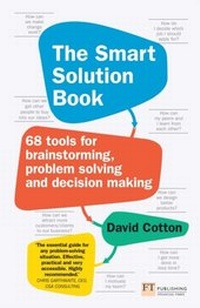
Smart Solution Book, The
68 Tools For Brainstorming, Problem Solving And Decision Making
1st Edition
Published on 13. October 2016
192 pages
978-1-292-14236-4 (ISBN)
Description

THE MOST COMPREHENSIVE COLLECTION OF PROBLEM-SOLVING TOOLS, GAMES AND TECHNIQUES USED BY BRAINSTORMERS, GAMECHANGERS AND TRAILBLAZERS.
As working life becomes more complex, we are increasingly faced with problems which may at first seem insoluble. The Smart Solution Book is your guide to solving these problems, whatever their size.
The Smart Solution Book explains each tool in detail - what it is, when and how to use it, its strengths and its limitations. The tools range from quick fixes, which can be used by someone working alone, to large scale solutions which can be used by groups of 100 and more. You can also use the tools separately or in combination with each other.
* Frame problems so they can be solved
* Find a solution to even the most intractable problem
* Enjoy the process of problem solving, whether alone or in collaboration with others
* Become more creative in your thinking so that, over time, solutions begin to present themselves
The Smart Solution Book will change your way of thinking about business problems: apply the techniques and see the solutions unfold.
"The essential guide for any problem solving situation. Effective, practical and very accessible. Highly recommended." Chris Garthwaite, CEO CGA Consulting
"There isn't a single individual or organisation that could fail to benefit from the many practical approaches to problem-solving in this book. Everyone should read it!" Andrew Hilton, Managing Director, Corporate Training Partnerships Ltd
"F. Durrenmatt says 'What concerns everyone, can only be solved by everyone' - and David's book is the practical guide to getting everyone fully engaged with a creative technique to solve any of your challenges." Peter SchwanhTMusser, Partner, papilio ag, Zurich
"As one of the most highly respected and long standing professionals on the Leadership and Management Development circuit, when David Cotton recommends a particular problem solving approach, you know it has earned its place in his invaluable new book. Look no further for a comprehensive compendium of pragmatic and well thought through techniques." David McWhir, Consultancy Verite Limited
As working life becomes more complex, we are increasingly faced with problems which may at first seem insoluble. The Smart Solution Book is your guide to solving these problems, whatever their size.
The Smart Solution Book explains each tool in detail - what it is, when and how to use it, its strengths and its limitations. The tools range from quick fixes, which can be used by someone working alone, to large scale solutions which can be used by groups of 100 and more. You can also use the tools separately or in combination with each other.
* Frame problems so they can be solved
* Find a solution to even the most intractable problem
* Enjoy the process of problem solving, whether alone or in collaboration with others
* Become more creative in your thinking so that, over time, solutions begin to present themselves
The Smart Solution Book will change your way of thinking about business problems: apply the techniques and see the solutions unfold.
"The essential guide for any problem solving situation. Effective, practical and very accessible. Highly recommended." Chris Garthwaite, CEO CGA Consulting
"There isn't a single individual or organisation that could fail to benefit from the many practical approaches to problem-solving in this book. Everyone should read it!" Andrew Hilton, Managing Director, Corporate Training Partnerships Ltd
"F. Durrenmatt says 'What concerns everyone, can only be solved by everyone' - and David's book is the practical guide to getting everyone fully engaged with a creative technique to solve any of your challenges." Peter SchwanhTMusser, Partner, papilio ag, Zurich
"As one of the most highly respected and long standing professionals on the Leadership and Management Development circuit, when David Cotton recommends a particular problem solving approach, you know it has earned its place in his invaluable new book. Look no further for a comprehensive compendium of pragmatic and well thought through techniques." David McWhir, Consultancy Verite Limited
All prices
More details
Edition
1. Auflage
Language
English
Place of publication
Harlow
United Kingdom
Target group
Professional and scholarly
ISBN-13
978-1-292-14236-4 (9781292142364)
Copyright in bibliographic data and cover images is held by Nielsen Book Services Limited or by the publishers or by their respective licensors: all rights reserved.
Schweitzer Classification
Other editions
Additional editions
David Cotton
Smart Solution Book, The
68 Tools for Brainstorming, Problem Solving and Decision Making
Book
10/2016
1st Edition
FT Publishing International
€21.99
Shipment within 10-20 days
Person
David Cotton spent 21 years with Arthur Andersen and PwC before becoming a freelance trainer in 2002. He has worked in four continents and more than 40 countries, delivering a wide range of training in management, leadership, communication skills, business networking, confidence building, dealing with difficult people, change management, business strategy, coaching and mentoring.
David's clients span local and national government and nearly every industry sector and include the European Parliament, European Commission and many of its agencies, the United Nations, BBC, Syrian Ministry for Foreign Affairs, Russian Federal Commission, Croatian MOD, PwC, most of the major Middle Eastern oil and gas companies, Manchester Business School and many others.
He has published scores of articles and more than a dozen books, including Key Management Development Models (FT Publishing, 2015).
David's clients span local and national government and nearly every industry sector and include the European Parliament, European Commission and many of its agencies, the United Nations, BBC, Syrian Ministry for Foreign Affairs, Russian Federal Commission, Croatian MOD, PwC, most of the major Middle Eastern oil and gas companies, Manchester Business School and many others.
He has published scores of articles and more than a dozen books, including Key Management Development Models (FT Publishing, 2015).
Content
About the author
Acknowledgements
Introduction
Part 1 - Which tools to use and when
Tools for broad problem areas
Tools for specific problems
Part 2 - Problem solving essentials
Barriers to problem solving
Framing a problem
Stages in problem solving
Preparation for group problem solving
Equipment needed
Part 3 - Problem solving techniques for individuals and small groups
1. Force field analysis and graphical force field analysis
2. Tough questions
3. Ritual dissent (and ritual assent)
4. Brain-friendly brainstorming
5. Reverse brainstorming
6. Procrastination
7. Cartesian logic
8. Brainwriting
9. Individual and collective mind mapping
10. Structured walkthroughs
11. Life through a lens
12. Nominal group technique
13. GROW for problem-solving
14. Head/Heart-Push/Pull
15. Osborne-Parnes critical problem solving process
16. Appreciative inquiry
17. Competitive ideas
18. Why not?
19. MUSE
20. Ishikawa fishbone diagrams
21. Deming's PDSA Cycle (The 'Shewhart Cycle')
22. 3D stakeholder mapping
23. Two words technique
24. The association grid
25. Delphi technique
26. Lotus blossom technique
27. Photographic associations
28. Random word technique
29. Challenging assumptions
30. Metaphorical problem-solving
31. Who else has solved this problem?
32. How-How?
33. The 5 Whys/Question Everything
34. Jelly Baby Tree
35. Future shock
36. What if?
37. What if we didn't?
38. Reframing
39. Ripple effect (systems thinking)
40. What I need from you
41. Concentration diagrams
42. Pareto analysis - simplified version
43. Solution effect analysis
44. The work map
45. Competing values framework
46. Timelining
47. One question
48. Peer assist
49. Action learning
50. Story circles
51. Swim Lane diagrams (Rummler-Brache diagrams)
Part 4 - Large group problem solving techniques
52. Crawford's Slip
53. Charrette Procedure
54. Starbursting
55. Open space
56. World cafe
57. Pro-action cafe
Part 5 - Problem solving business games
When and how to use business games
58. Retirement speeches
59. Convince me
60. Evolution
61. It's in the news
62. The trial
63. Tortoise and hare
64. Art gallery
65. Proverbial problem solving
66. There are no rules
67. Documentary
68. Pitch Perfect
Part 6 - Sharing and implementing solutions
Sharing solutions
Implementing solutions
Acknowledgements
Introduction
Part 1 - Which tools to use and when
Tools for broad problem areas
Tools for specific problems
Part 2 - Problem solving essentials
Barriers to problem solving
Framing a problem
Stages in problem solving
Preparation for group problem solving
Equipment needed
Part 3 - Problem solving techniques for individuals and small groups
1. Force field analysis and graphical force field analysis
2. Tough questions
3. Ritual dissent (and ritual assent)
4. Brain-friendly brainstorming
5. Reverse brainstorming
6. Procrastination
7. Cartesian logic
8. Brainwriting
9. Individual and collective mind mapping
10. Structured walkthroughs
11. Life through a lens
12. Nominal group technique
13. GROW for problem-solving
14. Head/Heart-Push/Pull
15. Osborne-Parnes critical problem solving process
16. Appreciative inquiry
17. Competitive ideas
18. Why not?
19. MUSE
20. Ishikawa fishbone diagrams
21. Deming's PDSA Cycle (The 'Shewhart Cycle')
22. 3D stakeholder mapping
23. Two words technique
24. The association grid
25. Delphi technique
26. Lotus blossom technique
27. Photographic associations
28. Random word technique
29. Challenging assumptions
30. Metaphorical problem-solving
31. Who else has solved this problem?
32. How-How?
33. The 5 Whys/Question Everything
34. Jelly Baby Tree
35. Future shock
36. What if?
37. What if we didn't?
38. Reframing
39. Ripple effect (systems thinking)
40. What I need from you
41. Concentration diagrams
42. Pareto analysis - simplified version
43. Solution effect analysis
44. The work map
45. Competing values framework
46. Timelining
47. One question
48. Peer assist
49. Action learning
50. Story circles
51. Swim Lane diagrams (Rummler-Brache diagrams)
Part 4 - Large group problem solving techniques
52. Crawford's Slip
53. Charrette Procedure
54. Starbursting
55. Open space
56. World cafe
57. Pro-action cafe
Part 5 - Problem solving business games
When and how to use business games
58. Retirement speeches
59. Convince me
60. Evolution
61. It's in the news
62. The trial
63. Tortoise and hare
64. Art gallery
65. Proverbial problem solving
66. There are no rules
67. Documentary
68. Pitch Perfect
Part 6 - Sharing and implementing solutions
Sharing solutions
Implementing solutions
