

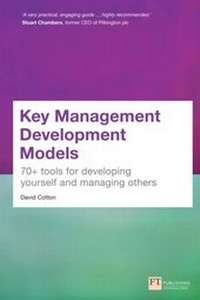
Key Management Development Models
Description

Stuart Chambers, former CEO of Pilkington plc
Key Management Development Models gives you, at a glance, instant access to a full range of the best models available for developing your management skills and helping others to work and perform at their peak.
For anyone seeking to develop their management skills it can be hard to know where to begin. Key Management Development Models explains the tools in detail - what they are and when and how to use them, with key practical tips. It's like having your very own management development coach on hand explaining all the tools that you will ever need to know.
EXPERT GUIDANCE FOR YOUR MANAGEMENT CAREER
All prices
More details
Other editions
Additional editions
Person
David Cotton spent 21 years with Arthur Andersen & PwC before becoming a freelance trainer. He's worked in 40 countries and his clients include the European Parliament, European Commission, UN, BBC, Syrian Ministry for Foreign Affairs, Russian Federal Commission, Croatian MOD, PwC, many Middle Eastern oil & gas companies, Manchester Business School & more.
Content
About the author
Acknowledgements
Preface
Using this book
DEVELOPING YOURSELF
PART ONE Happiness
1 Positive affirmations
2 Positive mental attitude and content reframing
PART TWO Memory and recall
3 Loci method
4 Number/rhyme method
PART THREE Motivation
5 Maslow's hierarchy of needs
6 Glasser's choice theory
7 Pink's model of motivation
PART FOUR Personal change
8 Cognitive restructuring
9 The Secret/law of attraction (Byrne)
10 Seven habits of highly effective people (Covey)
PART FIVE Problem solving and decision making
11 Force field analysis
12 Is/is not problem-solving technique
13 Ladder of inference (Argyris)
14 OODA loop
15 Polarity management
16 Vroom-Yetton-Jago decision model
PART SIX Resilience
17 Kobasa and 'hardiness'
PART SEVEN Self-awareness
18 360° feedback
19 Emotional intelligence
20 Johari window
21 Multiple intelligences
PART EIGHT Self-confidence and stress management
22 Anchoring a calm state
23 Meditation
24 Mindfulness
PART NINE Time management, concentration and focus
25 Covey's time matrix (Eisenhower)
26 Getting things done (Allen)
27 Wheel of life
PART TEN Learning
28 Accelerated learning
29 Benziger's thinking styles assessment
30 Kolb/Honey and Mumford learning styles
PART ELEVEN Listening skills
31 Active listening
32 Critical listening
33 Relationship listening
MANAGING OTHERS
PART TWELVE Assertiveness
34 The broken record
35 Fogging
PART THIRTEEN Coaching
36 CLEAR model (Hawkins)
37 GROW model (Whitmore et al.)
38 Solution-focused coaching (OSKAR)
PART FOURTEEN Communication
39 DISC
40 Matching and mirroring
41 Storytelling
42 VAK (visual, auditory, kinaesthetic)
PART FIFTEEN Conflict management
43 Betari Box
44 Thomas-Kilmann conflict mode instrument
PART SIXTEEN Creativity
45 Brain-friendly brainstorming
46 Challenging assumptions
47 PMI (plus, minus, interesting)
48 Random word technique
49 SCAMPER
PART SEVENTEEN Giving feedback
50 EEC Model
51 EENC
PART EIGHTEEN Goal setting
52 Locke and Latham's five principles
53 Reticular activating system
54 SMART goals
55 CASE - behavioural objectives
PART NINETEEN Influence and persuasion
56 4Ps of persuasion
57 Bilateral brain theory
58 Embedded commands
59 Locus of control (Weiner's attribution theory)
