

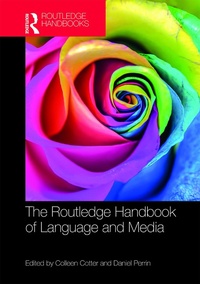
The Routledge Handbook of Language and Media
Published on 4. August 2017
588 pages
978-1-317-37524-1 (ISBN)
Description

The Routledge Handbook of Language and Media provides an accessible and comprehensive overview of state-of-the-art research in media linguistics. This handbook analyzes both language theory and practice, demonstrating the vital role of this research in understanding language use in society. With over thirty chapters contributed by leading academics from around the world, this handbook:
addresses issues of language use, form, structure, ideology, practice, and culture in the context of both traditional and new communication media;
investigates mediated language use in public spheres, organizations, and personal communication, including newspaper journalism, broadcasting, and social media;
examines the interplay of language and media from both linguistic and media perspectives, discussing auditory and visual media and graphic modes, as well as language and gender, multilingualism, and language change;
analyzes the advantages and shortcomings of current approaches within media linguistics research and outlines avenues for future research.
The Routledge Handbook of Language and Media is a must-have survey of this key field, and is essential reading for those interested in media linguistics.
addresses issues of language use, form, structure, ideology, practice, and culture in the context of both traditional and new communication media;
investigates mediated language use in public spheres, organizations, and personal communication, including newspaper journalism, broadcasting, and social media;
examines the interplay of language and media from both linguistic and media perspectives, discussing auditory and visual media and graphic modes, as well as language and gender, multilingualism, and language change;
analyzes the advantages and shortcomings of current approaches within media linguistics research and outlines avenues for future research.
The Routledge Handbook of Language and Media is a must-have survey of this key field, and is essential reading for those interested in media linguistics.
Reviews / Votes
"Cotter and Perrin have assembled a stellar cast of established and emerging sociolinguists, discourse analysts and communication scholars to deliver a cutting-edge, critical and comprehensive reference book for the study of print, broadcast and online media."Adam Jaworski, The University of Hong Kong
"Bringing together an impressive and convincing selection of leading names and emerging scholars, and covering a range of contexts, media and technological domains, and methodological approaches, this collection represents an essential 'state of the art' for all those interested in the field of media linguistics."
Helen Kelly-Holmes, University of Limerick, Ireland
More details
Language
English
Place of publication
London
United Kingdom
Publishing group
Taylor & Francis Ltd
Target group
College/higher education
Product notice
Reflowable
Illustrations
11 s/w Zeichnungen, 25 s/w Abbildungen, 13 s/w Tabellen, 14 s/w Photographien bzw. Rasterbilder
13 Tables, black and white; 11 Line drawings, black and white; 14 Halftones, black and white; 25 Illustrations, black and white
File size
3,34 MB
ISBN-13
978-1-317-37524-1 (9781317375241)
Copyright in bibliographic data and cover images is held by Nielsen Book Services Limited or by the publishers or by their respective licensors: all rights reserved.
Schweitzer Classification
Other editions
Additional editions
Colleen Cotter | Daniel Perrin
The Routledge Handbook of Language and Media
Book
12/2020
1st Edition
Routledge
€74.80
Shipment within 15-20 days
Colleen Cotter | Daniel Perrin
The Routledge Handbook of Language and Media
Book
08/2017
1st Edition
Routledge
€364.31
Shipment within 10-20 days
Persons
Colleen Cotter is Reader in Media Linguistics at Queen Mary University of London, UK.
Daniel Perrin is Professor of Media Linguistics at ZHAW Zurich University of Applied Sciences, Switzerland.
Daniel Perrin is Professor of Media Linguistics at ZHAW Zurich University of Applied Sciences, Switzerland.
Content
Introduction - Colleen Cotter and Daniel Perrin
Part A Research frameworks and methods: Summarising the field(s)1 Media Linguistic Approaches - Daniel Perrin2 Sociolinguistic Approaches - Jane Stuart-Smith3 Cognitive Approaches - Anna Pleshakova4 Critical Approaches - Michal Kryzyzanowski and David Machin5 Ethnographic Approaches - Colleen Cotter and Diana ben-Aaron
6 Corpus Approaches - Sylvia Jaworska
Part B Media contexts and domains: Locating relevance
7 Media Discourse, Technological Change and Broadcast Talk - Martin Montgomery8 Politics and Framing - Elisabeth Wehling
9 Media Markets and Political Economy - Mark Allen Peterson10 Journalism and Public Discourse - Martin Conboy and Scott Eldridge
11 Organizations and Corporate Communication - Geert Jacobs12 Social Media and Community Building - Aleksandra Gnach
Part C Media and modes: Mapping out variation in language use
13 Auditory Media - Juerg Haeusermann
14 Visual Media - Helen Caple15 Surveillant Media - Rodney Jones
16 Linguistic Modes - Diana ben-Aaron
17 Graphic Modes - Wibke Weber and Martin Engebretsen
18 Combining Modes - Agnieszka Lyons
19 Future Modes - Astrid Ensslin
Part D Language in focus: Highlighting sociocultural complexity
20 Language Policy and the Media - Rachelle Vessey
21 Media, Language, and Gender - Tommaso Milani
22 Media and Minority Languages - Elisabeth Le and Enrique Uribe-Jongbloed
23 Multilingualism and Media - Daniel Perrin, Maureen Ehrensperger-Dow and Marta Zampa
24 Media and Translation - Krisztina Karoly
25 Media and Language Change - Jannis Androutsopoulos
26 Media and Quoting - Lauri Haapanen and Daniel Perrin
Part E Operationalizing media practice: Identifying outcomes and impact27 Interacting to Mediatize - Steven Clayman and Laura Loeb 28 Routinizing Communication - Martin Luginbuehl29 Schematisizing Information - Juergen Spitzmueller
30 Transforming Knowledge - Gitte Gravengaard
31 Participating with Media - Jan Chovanec
32 Tracing and Tracking Impact - Cornelius Puschmann and Antonio Compagnone
Index
Part A Research frameworks and methods: Summarising the field(s)1 Media Linguistic Approaches - Daniel Perrin2 Sociolinguistic Approaches - Jane Stuart-Smith3 Cognitive Approaches - Anna Pleshakova4 Critical Approaches - Michal Kryzyzanowski and David Machin5 Ethnographic Approaches - Colleen Cotter and Diana ben-Aaron
6 Corpus Approaches - Sylvia Jaworska
Part B Media contexts and domains: Locating relevance
7 Media Discourse, Technological Change and Broadcast Talk - Martin Montgomery8 Politics and Framing - Elisabeth Wehling
9 Media Markets and Political Economy - Mark Allen Peterson10 Journalism and Public Discourse - Martin Conboy and Scott Eldridge
11 Organizations and Corporate Communication - Geert Jacobs12 Social Media and Community Building - Aleksandra Gnach
Part C Media and modes: Mapping out variation in language use
13 Auditory Media - Juerg Haeusermann
14 Visual Media - Helen Caple15 Surveillant Media - Rodney Jones
16 Linguistic Modes - Diana ben-Aaron
17 Graphic Modes - Wibke Weber and Martin Engebretsen
18 Combining Modes - Agnieszka Lyons
19 Future Modes - Astrid Ensslin
Part D Language in focus: Highlighting sociocultural complexity
20 Language Policy and the Media - Rachelle Vessey
21 Media, Language, and Gender - Tommaso Milani
22 Media and Minority Languages - Elisabeth Le and Enrique Uribe-Jongbloed
23 Multilingualism and Media - Daniel Perrin, Maureen Ehrensperger-Dow and Marta Zampa
24 Media and Translation - Krisztina Karoly
25 Media and Language Change - Jannis Androutsopoulos
26 Media and Quoting - Lauri Haapanen and Daniel Perrin
Part E Operationalizing media practice: Identifying outcomes and impact27 Interacting to Mediatize - Steven Clayman and Laura Loeb 28 Routinizing Communication - Martin Luginbuehl29 Schematisizing Information - Juergen Spitzmueller
30 Transforming Knowledge - Gitte Gravengaard
31 Participating with Media - Jan Chovanec
32 Tracing and Tracking Impact - Cornelius Puschmann and Antonio Compagnone
Index
