

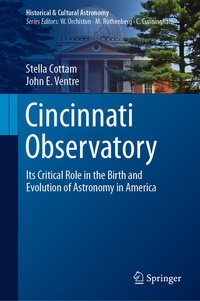
Cincinnati Observatory
Description

Previously dependent on Europe for scientific knowledge, the United States came into its own during the nineteenth century. A prime example of this is evident in the establishment of the Cincinnati Observatory, in Cincinnati, Ohio. Funded by the citizenry of that city, it was initiated, with ceremony, by the oration by former President John Quincy Adams, at the laying of the cornerstone in 1843.
In this book, you will read about the Cincinnati Observatory's most notable contributions, big and small, that were made over the course of its years in existence. You will learn about the Observatory's role in primitive weather forecasting, star cataloging, and even advancements it helped to create during World War II.
Now known as the Cincinnati Observatory Center, it is a functional observatory and a dedicated center of astronomy education for all ages. It continues to contribute a rich cultural and scientific history to its community and nation.
More details
Other editions
Additional editions
Persons
Stella Cottam was born in New York City in 1949, and has B.S. degrees in physics and medical technology from Fordham University and the University of Nevada respectively, an M.S. degree in library science from the University of Kentucky and a Master of Astronomy from the University of Western Sydney in Australia. She worked as a microbiologist at the Veterans Administration Hospital in Reno, Nevada and Lexington, Kentucky for 30 years. She obtained her Ph.D. through the Centre for Astronomy at James Cook University in Townsville, Australia. Her thesis topic was "Solar Eclipses and Transits of Venus, 1868-1882, and Their Role in the Popularization of Astronomy in the USA," for which her supervisors were Wayne Orchiston and Richard Stephenson.
John E. Ventre was born in 1936, and he has degrees in engineering, industrial management, and business administration. He taught astronomy for 12 years at the University of Cincinnati. During the late 1990s he was one of the principals who formed the Cincinnati Observatory Center (COC), a 501(c)(3) not-for-profit organization to save the Observatory from demolition. Ventre was one of the signatories of the incorporation document, served as the COC's first Administrator/Director, and served on the Center's Charter Board. Then for the following 23 years he served as the COC's Historian, accumulating the rich history of Ormsby MacKnight Mitchel, the Observatory's founder in 1842, and the history of the Observatory to current times. It is the history of the birthplace of American Astronomy.
Content
Chapter 1: Astronomy Comes to Cincinnati.- Chapter 2: John Quincy Adams - The Great Orator.- Chapter 3: Birthplace of American Astronomy.- Chapter 4: What's the Weather Going to Be, Professor?- Chapter 5: Ramping Up an Institution at a New Location.- Chapter 6: 45 Years of Classical Astronomy.- Chapter 7: Astronomy Survives the Depression.- Chapter 8: Patriotism, Science, and Pop Culture.- Chapter 9: Saving the Observatory.- Chapter 10: Epilogue.
