

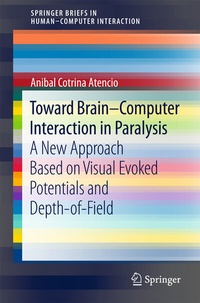
Toward Brain-Computer Interaction in Paralysis
Description

This book presents up-to-date information on Brain-computer Interfaces (BCI).
BCIs are systems that record brain signals, extract features and translate them into computer commands. For instance, in BCIs based on the steady-state visual evoked potentials (SSVEP-BCI), brain potentials evoked by visual stimuli are used for controlling computer-based devices.
Inspired by the optical phenomenon of depth of field, this book introduces, describes, and evaluates a novel way of setting visual stimuli for SSVEP-BCI. It employs two stimuli that were placed at different distances from the subjects so that if one stimulus is focused on, the other one is non-focused. This assessment allows SSVEP-BCI users to modulate their brain signals by shifting their focus because focused and non-focused stimuli evoke different brain potentials. It allows people to send two brain commands with high accuracy rate by shifting their focus. Hence, computer interaction systems can be proposed for people with paralysis, such as patients with amyotrophic lateral sclerosis since focusing mechanism does not demand head, neck, or eyeball movements.
The matter assessed in this book that includes offline and online experiments, is useful for researchers in human-machine interaction who are looking for relevant possibilities of improving the quality of life of people in paralysis situation.
More details
Other editions
Additional editions
Content
Introduction.- Fundamentals: From Light to Command.- The Novel Stimulation Setup.- Frequency Demodulation for a SSVEP-BCI based on Depth-of-Field.- Offline Evaluation of Command Detection.- Online Applications to Communication and Control.- Future Directions in Patients with Paralysis.
