

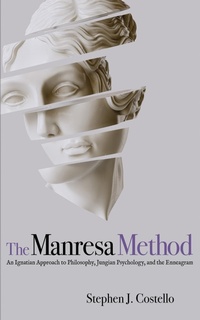
The Manresa Method
An Ignatian Approach to Philosophy, Jungian Psychology, and the Enneagram
Published on 30. January 2026
254 pages
979-8-3852-5725-6 (ISBN)
Description

Inspired by Ignatius Loyola's Spiritual Exercises, this book explores what Stephen Costello calls the Manresa Method of self-examination, imagination, and contemplation. Beginning with St Ignatius's Formula of the Institute and Constitutions, this book outlines the charism of the Society of Jesus before accompanying the Basque saint on his travels as relayed through his Autobiography and Spiritual Diary.
Topics and themes treated include consolation, desolation, conversion, and consciousness as refracted through the lenses of philosophers (Plato, Boethius, Ludwig Wittgenstein, Simone Weil, Eric Voegelin, Bernard Lonergan, and Charles Taylor), depth-psychologists (C. G. Jung, Ira Progoff, and James Hillman), theologians (Romano Guardini, Karl Rahner, Anthony de Mello, and Pierre Teilhard de Chardin), mystics (St John of the Cross and St Teresa of Ávila), a poet (Gerard Manley Hopkins), an economist (E. F. Schumacher), a painter (Salvador Dalí), and a Jesuit Pope (Francis). The Enneagram system receives extensive treatment to show its compatibility with Christianity.
This work, which can be read as a companion volume to Costello's Ignatian Mysticism, will be of immense interest to those exploring the space between contemporary philosophy, Jungian psychoanalysis, and spirituality (Ignatian and Carmelite).
Topics and themes treated include consolation, desolation, conversion, and consciousness as refracted through the lenses of philosophers (Plato, Boethius, Ludwig Wittgenstein, Simone Weil, Eric Voegelin, Bernard Lonergan, and Charles Taylor), depth-psychologists (C. G. Jung, Ira Progoff, and James Hillman), theologians (Romano Guardini, Karl Rahner, Anthony de Mello, and Pierre Teilhard de Chardin), mystics (St John of the Cross and St Teresa of Ávila), a poet (Gerard Manley Hopkins), an economist (E. F. Schumacher), a painter (Salvador Dalí), and a Jesuit Pope (Francis). The Enneagram system receives extensive treatment to show its compatibility with Christianity.
This work, which can be read as a companion volume to Costello's Ignatian Mysticism, will be of immense interest to those exploring the space between contemporary philosophy, Jungian psychoanalysis, and spirituality (Ignatian and Carmelite).
More details
Other editions
Additional editions
Person
Stephen J. Costello is a prominent philosopher, depth psychologist, certified Enneagram coach, the author of sixteen books, and founder of the Viktor Frankl Institute of Ireland. He was educated at St. Gerard's School, Castleknock College, University College Dublin, and Trinity College Dublin. He has over thirty years' experience working in private clinical practice, as well as giving lectures, talks, and seminars in Ireland, the UK, the USA, Austria (Vienna), and Switzerland (the C.G. Jung Institute).
