

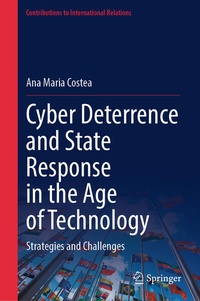
Cyber Deterrence and State Response in the Age of Technology
Description

At a time when technological advances are creating new threats to national and international security, traditional views of security, war, and deterrence are becoming obsolete. This book examines the different cyber security strategies being developed by states. It reveals significant differences between conventional adversaries such as Russia, China, and the West, but also between allies such as NATO and EU members.
Despite the EU's efforts, no binding international rules have been established, and the Tallinn Manual remains a Western-centric interpretation of the laws of cyber warfare. At the same time, critical infrastructure is often in private hands, and the low cost of cyber attacks enables individuals to pose significant threats. This book discusses effective state strategies for protecting and projecting influence in cyberspace. By analysing national and international strategies, notable cyber attacks, and ethical concerns, it also offers policy recommendations for improving cyber deterrence in a rapidly evolving landscape.
The book will appeal to students, scholars, and researchers in international relations, law, security studies, cybersecurity, and political science, as well as policymakers and practitioners interested in a better understanding of cyber deterrence and cybersecurity.
More details
Other editions
Additional editions
Person
Ana Maria Costea is an Associate Professor at the National University of Political Studies and Public Administration (SNSPA), Bucharest, Romania. Her research focuses on regional security, cybersecurity, geopolitics, the international regulations of cyberspace, arms control, and nuclear non-proliferation. She serves as the Editor-in-Chief of the academic journal "Europolity" since 2015. Ana Maria Costea is also the author of several BDI and ISI academic articles that are centred around the concept cybersecurity and its influence over the international power politics.
Content
Chapter 1. Introduction.- Chapter 2. Deterrence as a Strategy.- Chapter 3. International regulations in cyberspace (UNGE reports, UN Convention on Cybercrime, CBM, Budapest Convention, SCO Ekaterinburg agreements), and the Tallinn Manual approach.- Chapter 4. The Cybersecurity Landscapes.- Chapter 5. The Possibility of a Cyberwar: Accountability, Ever Evolving Threats, No Ultimate Weapon, Threshold, Armed Attack.- Chapter 6. Applicability of Deterrence in the Cyberspace.- Chapter 7. Conclusions.
