

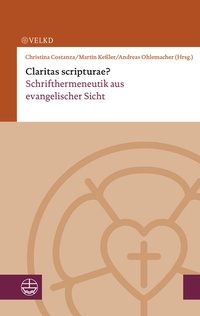
Claritas scripturae?
Schrifthermeneutik aus evangelischer Sicht
1st Edition
Published on 4. January 2021
280 pages
978-3-374-06647-6 (ISBN)
Description

Die »Klarheit der Heiligen Schrift« ist nicht selbstverständlich gegeben. Zugleich ist es protestantisches Grundanliegen, christliche Existenz auf »der Schrift« aufzubauen. Jahrhunderte historisch-kritischer Exegese haben zu vertieftem und tragfähigerem Verständnis geführt - und zu Herausforderungen. Hermeneutische Konzepte - auch aus Philosophie, Psychologie sowie den Literatur- und Kulturwissenschaften - bieten vielfältige Ansätze für ein zeitgemäßes Verständnis der Schriftbindung, ohne Engführungen zu folgen oder Glaubensgehalte aufzugeben.
Diesen Ansätzen haben sich auf Einladung der Vereinigten Evangelisch-lutherischen Kirche Deutschlands (VELKD) 16 Nachwuchswissenschaftlerinnen und -wissenschaftler aus zehn Fakultäten und vier Ländern sowie ein begleitender Professor gewidmet. Konzepte von Martin Luther über Martin Heidegger bis zu Ulrich Barth und Ulrich H. J. Körtner wurden geprüft. Entstanden ist eine Kombination von Zugängen, die gerade in ihrer Interdisziplinarität und Verschiedenheit zeigt, dass es sich lohnt, weiter nach der »Klarheit der Schrift« zu fragen.
[Claritas scripturae? Protestant Perspectives on the Hermeneutics of Scripture]
Martin Luther's axiom of the »clarity of scripture« today seems to be gone. Still it is part of protestant identity and "mission" to build Christian existence on scripture. Centuries of academic exegesis, especially the application of historical-critical methods, have deepened and improved the understanding of biblical texts - and did raise further challenges. "Loans" from philosophy and psychology, from literary and cultural studies did add to contemporary options of understanding, neither following too narrow paths nor hastily giving up elements of faith.
Invited by the United Lutheran Church of Germany 16 junior academic theologians and a professor of church history as mentor, coming from ten faculties of theology in four countries, have joined to examine concepts from Martin Luther and Martin Heidegger to Ulrich Barth and Ulrich H. J. Körtner, and to apply insights provided by current exegetical debates as well as those from the aesthetics of reception and from church history. The interdisciplinary and diverse approach underlined that it is still highly worthwhile to search for the highest possible »clarity of scripture«.
Diesen Ansätzen haben sich auf Einladung der Vereinigten Evangelisch-lutherischen Kirche Deutschlands (VELKD) 16 Nachwuchswissenschaftlerinnen und -wissenschaftler aus zehn Fakultäten und vier Ländern sowie ein begleitender Professor gewidmet. Konzepte von Martin Luther über Martin Heidegger bis zu Ulrich Barth und Ulrich H. J. Körtner wurden geprüft. Entstanden ist eine Kombination von Zugängen, die gerade in ihrer Interdisziplinarität und Verschiedenheit zeigt, dass es sich lohnt, weiter nach der »Klarheit der Schrift« zu fragen.
[Claritas scripturae? Protestant Perspectives on the Hermeneutics of Scripture]
Martin Luther's axiom of the »clarity of scripture« today seems to be gone. Still it is part of protestant identity and "mission" to build Christian existence on scripture. Centuries of academic exegesis, especially the application of historical-critical methods, have deepened and improved the understanding of biblical texts - and did raise further challenges. "Loans" from philosophy and psychology, from literary and cultural studies did add to contemporary options of understanding, neither following too narrow paths nor hastily giving up elements of faith.
Invited by the United Lutheran Church of Germany 16 junior academic theologians and a professor of church history as mentor, coming from ten faculties of theology in four countries, have joined to examine concepts from Martin Luther and Martin Heidegger to Ulrich Barth and Ulrich H. J. Körtner, and to apply insights provided by current exegetical debates as well as those from the aesthetics of reception and from church history. The interdisciplinary and diverse approach underlined that it is still highly worthwhile to search for the highest possible »clarity of scripture«.
More details
Other editions
Additional editions

Christina Costanza | Martin Keßler | Andreas Ohlemacher
Claritas scripturae?
Schrifthermeneutik aus evangelischer Sicht
Book
12/2020
1st Edition
Evangelische Verlagsanstalt
€29.80
Shipment within 5-7 days
Persons
Editor
Christina Costanza, Dr. theol., Jahrgang 1977, studierte Evangelische Theologie und wurde im fach Systematische Theologie in Göttingen promoviert. Sie ist Pastorin, derzeit tätig als Studienleiterin im Theologischen Studienseminar der Vereinigten Evangelisch-Lutherischen Kirche Deutschlands in Pullach.
Content
- Frontmatter
- Cover
- Titel
- Impressum
- Inhalt
- Klare Schrift oder helle Vernunft: Zu den Anfängen des reformatorischen Schriftprinzips
- Biblische Dogmatik?: Das Problem des Einbezugs der Bibel in ein System der Dogmatik
- Eindeutig umstritten: Klarheit und Umstrittenheit der Schrift bei Luther und in der neueren Schrifttheorie
- Von Jerusalem nach Trient: Der Streit um die Interpretation des Apostelkonzils (Apg 15) in der Reformation und im konfessionellen Zeitalter und das Problem der Klarheit der Heiligen Schrift
- Figuration und die Klarheit der Schrift: Überlegungen zu einem hermeneutischen Modell der Metafigur im Anschluss an Mk 10,46-16,8
- Franz Delitzschs Erfahrungshermeneutik: Erwägungen für das Alte Testament
- Der vielfache Schriftsinn: Typen pluraler Schrifthermeneutik
- Widmerpools Mantel: Überlegungen zur Schrifthermeneutik im Anschluss an Martin Heidegger
- Schriftbindung evangelischer Theologie: Ein Forschungsbericht aus interdisziplinären Gesprächen
- Alles Schriftauslegung?: Literaturtheoretische Zugänge zur Kirchengeschichte
- Schrifterklärung, Schriftbeweis, Schriftvergleich: Einblicke in Johann Gerhards Schriftgebrauch
- Schrifthermeneutik zu Beginn der Aufklärung in Deutschland: Die Predigtempfehlungen Johann Lorenz von Mosheims
- The Shaking of the Foundations: Schriftgebrauch am Beispiel von Paul Tillichs späten Predigten
- Evangelikales Schriftverständnis: Eine Analyse des Jahrbuchs für Evangelikale Theologie
- Rezeptionsästhetische Texthermeneutik: Weiterführung eines lutherischen Schriftverständnisses
- Interreligiöse Hermeneutik vs. Interreligiöse Sprachanalytik: Versuch einer Verhältnisbestimmung
- Backmatter
- Weitere Veröffentlichungen
