

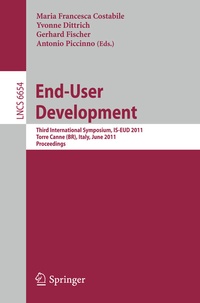
End-User Development
Third International Symposium, IS-EUD 2011, Torre Canne, Italy, June 7-10, 2011, Proceedings
Published on 21. June 2011
XVI, 426 pages
978-3-642-21530-8 (ISBN)
Description

This book constitutes the refereed proceedings of the Third International Symposium on End-User Development, IS-EUD 2011, held in Torre Canne, Italy, in June 2011.
The 14 long papers and 21 short papers presented were carefully reviewed and selected for inclusion in the book. In addition the volume contains 2 keynote speeches, 14 doctoral consortia, and information on 3 workshops. The contributions are organized in topical sections on mashups, frameworks, users as co-designers, infrastructures, methodologies and guidelines, beyond the desktop, end-user development in the workplace, meta-design, and supporting end-user developers.
More details
Other editions
Additional editions
Maria Francesca Costabile | Yvonne Dittrich | Gerhard Fischer
End-User Development
Third International Symposium, IS-EUD 2011, Torre Canne, Italy, June 7-10, 2011, Proceedings
Book
05/2011
1st Edition
Springer
€53.49
Shipment within 7-9 days
Content
- Title
- Preface
- Organization
- Table of Contents
- Part I Keynote Speeches
- End-User Development at Scale: Real-World Experience with Product Development for a Large and Engaged User Community
- How End-User Development Will Save Composition Technologies from Their Continuing Failures
- Failure of Composition Technologies
- End-User Composition
- References
- Part II Long Papers
- Mashups
- Enabling End User Development through Mashups: Requirements, Abstractions and Innovation Toolkits
- Introduction
- Rationale and Background
- User-Based Innovation and Innovation Toolkits
- End Users Involvement in the Mashup Development Scenario
- The Need for Lightweight Development Processes
- The DashMash Platform for Sentiment Analysis
- DashMash Architecture
- Validation
- Related Works
- Conclusions
- References
- Versioning for Mashups - An Exploratory Study
- Introduction
- Background and Related Work
- Versioning for Yahoo! Pipes
- Empirical Study
- Participants
- Study Setup and Design
- Tasks
- Threats to Validity
- Results and Analysis
- Discussion
- Conclusion
- References
- Creating Mashups by Direct Manipulation of Existing Web Applications
- Introduction
- Related Work
- An Example Application Scenario
- The Architecture of the Environment
- Evaluation
- Conclusions and Future Work
- References
- Frameworks
- Alternative Representations for End User Composition of Service-Based Systems
- Introduction
- Development of Service-Based Systems
- Focus Groups to Evaluate Three Design Alternatives for End User-Based Composition of Service-based Systems
- Method
- Procedure
- Materials
- Design Two: Data Flow-Based Application Development Approach
- Design Three: System Driven Application Development Approach
- Results
- Comparison of Three Application Development Approaches
- Conclusions and Lessons
- References
- Designing a Framework for End User Applications
- Introduction/Background
- Case Study
- Framework Approach
- Evaluation
- Discussion/Limitations
- Conclusion
- References
- Users as Co-Designers
- From Human Crafters to Human Factors to Human Actors and Back Again: Bridging the Design Time - Use Time Divide
- Introduction
- A Brief History of the Design of Interactive Systems
- In the Beginning: Human Crafters
- Fitting Man to Machine: Human Factors
- Users as Active Agents: Human Actors
- A Return to Designing in Use: Human Crafters
- Designing for Design in Use
- Understanding the Complexities of Use Time
- Is Participatory Co-Design Possible?
- Principles for Designing in Use
- Conclusion
- References
- An Ontology-Based Approach to Product Customization
- Introduction
- Mass Customization
- Product Configurators
- The Case Study
- Ontology-Based Approach
- The Developed Prototype
- Conclusion and Future Work
- References
- Infrastructures
- End-User Development of e-Government Services through Meta-modeling
- Introduction
- e-Government Services
- Toward End-User Development of G2C Services
- From e-Government Service Analysis to a Service Meta-model
- A Multi-faceted Description of e-Government Services
- A Meta-model for e-Government Services
- An EUD Environment for Service Creation
- Related Work
- Conclusion
- References
- From System Development toward Work Improvement: Developmental Work Research as a Potential Partner Method for EUD
- Introduction
- From an EUP System to in Situ Systems Design
- Approaching End-User Programming
- Approaching the Work Practice
- Approaching the Ecological Systems Design In Situ
- Ecological Views on Technology
- Information Ecology
- Coping with Complexity
- Work Development
- Developmental Work Research
- Participatory and Interventionist Approaches
- Change Laboratory
- DWR: A Potential Partner Method for EUD
- References
- Infrastructuring When You Don't - End-User Development and Organizational Infrastructure
- Introduction
- End User Development, Organizations, and Infrastructures
- Tailoring of Common Tools
- Organizational Support for EUD
- Infrastructure Development
- Research Methods
- The Two Cases
- Case 1: Electronic Forms and Contact Database
- Case 2: The Registry System
- Analysis and Discussion
- Maneuvering as an Informal Developer
- Frontline User Cooperation
- From One Software Developer to Another
- . Something that Otherwise Would Be Defined as a Project
- Technical Platform
- Conclusions
- References
- Methodologies and Guidelines
- Semiotic Traces of Computational Thinking Acquisition
- Introduction
- A Study with Brazilian Students
- Method of Analysis
- Findings from our Study
- Discussion and Future Work
- References
- Where Are My Intelligent Assistant's Mistakes? A Systematic Testing Approach
- Introduction
- Intelligent Assistant Assessment as a Testing Problem
- Related Work
- The WYSIWYT/ML Approach
- How WYSIWYT/ML and Adam Work Together
- Cognitive Dimensions Analysis
- Empirical Study
- Results
- RQ1 (Efficacy): Finding Bugs
- RQ2 (Satisfaction): User Attitudes
- RQ3 (Efficiency): The Partnership's Test Coverage
- Discussion
- Conclusion
- References
- Beyond the Desktop
- An End-User Oriented Building Pattern for Interactive Art Guides
- Introduction
- The PuD Mobile Guide
- The PuD Guide Model
- The PuD Guide Implementation
- The Content Management System
- Overview of the CMS
- The CMS Abstract Data Model
- Implementation
- A Case Study
- Conclusion
- References
- Beefing Up End User Development: Legal Protection and Regulatory Compliance
- Introduction
- End User Development
- Legal Issue
- Data Protection, Security and Confidentiality
- Intellectual Property Rights
- Licenses
- Choice of Law and Jurisdiction
- Conclusion
- References
- Part III Short Papers
- Mashups
- Light-Weight Composition of Personal Documents from Distributed Information
- Introduction
- Related Work
- A Scenario
- Managing Resources
- Conclusions
- References
- Really Simple Mash-Ups
- Introduction
- Existing Support for Sharing of Mashables and Data Aggregation
- Really Simple Mash-Ups
- RSM Keys
- A Global RSM Dictionary
- Annotating Web Service Results
- Discussion and Conclusion
- References
- Teachers as Designers: Enabling Teachers to Specify Dynamic Web Programming Projects for Students
- Introduction
- The wConnect Developmental Community
- High School Workshops as an Outreach Activity
- wProjects: A Drupal-Based Authoring Tool for Web Projects
- Specifying Projects Using wProjects: The Basic Concept
- A Simple Scenario
- Design Tradeoffs
- Status and Open Issues
- References
- Frameworks
- A Framework for User-Tailored City Exploration
- Introduction
- Related Work
- Research Approach
- Scenarios for Tailored City Exploration
- Initial Design of the City Exploration Framework
- References
- End-User Requirements for Wisdom-Aware EUD
- Introduction
- WIRE
- User Study
- Results
- Conclusion
- References
- Personalised Resource Categorisation Using Euler Diagrams
- Introduction
- Background on Euler Diagrams
- Categorising Items with FunEuler
- Operational Functionality
- Conclusion and Future Works
- References
- Towards the Involvement of End-Users within Model-Driven Development
- Introduction
- Involving the End-Users within MDD Approaches
- Conclusions and Future Work
- References
- Users as Co-Designers
- Extending the Meta-design Theory: Engaging Participants as Active Contributors in Virtual Worlds
- Introduction
- Virtual World Systems: Second Life and LOTRO
- Methodology
- Discussion: Meta-design Concepts in SL and LOTRO
- Conclusion and Future Work
- References
- Community Network 2.0: Visions, Participation, and Engagement in New Information Infrastructures
- Introduction
- Community Learning
- Technology Explorations
- Infrastructure Planning
- Summary and Concluding Remarks
- References
- Methodologies and Guidelines
- Meta-design Blueprints: Principles and Guidelines for Co-design in Virtual Environments
- Introduction
- A Qualitative Survey of Co-creation
- Guidelines for Building Meta-design Web Environments
- Conclusions and Further Works
- References
- End-Users Productivity in Model-Based Spreadsheets: An Empirical Study
- Introduction
- Model-Based Spreadsheets
- Analyzing End-Users Performance
- Conclusions
- References
- Beyond the Desktop
- MicroApps Development on Mobile Phones
- Introduction
- Related Work
- The Proposed Approach
- MicroApp Visual Editor and Language
- The MicroApp User Interface
- Conclusion
- References
- Playbook: Revision Control and Comparison for Interactive Mockups
- Introduction
- Related Work
- Design
- Implementation
- Conclusion and Future Work
- References
- End-User Development in the Workplace
- Expressing Use - Infrastructure Probes in Professional Environments
- Introduction
- Concept
- Evaluation
- Conclusion
- References
- From Top to Bottom: End User Development, Motivation, Creativity and Organisational Support
- Introduction
- Literature Review
- Method
- Participants
- Procedure
- Materials
- Results
- Discussion
- Limitation of the Study
- Conclusion
- References
- Meta-Design
- EUD Software Environments in Cultural Heritage: A Prototype
- Introduction and Motivation
- Framework Design
- Application Templates
- The Cultural Heritage Experts Workshop
- Conclusion
- References
- From Consumers to Owners: Using Meta-design Environments to Motivate Changes in Energy Consumption
- Introduction
- Efforts to Reduce Energy Consumption
- Motivating People with Socio-technical Environments
- Conceptual Frameworks
- EMPIRE-A System to Reduce Energy Consumption
- Conclusions
- References
- Supporting End-User Developers
- Collective Programming: Making End-User Programming (More) Social
- Introduction
- CyberCollage: Real-Time Collaborative End-User Programming
- Related Work
- Evaluation
- References
- Using Recommendations to Help Novices to Reuse Design Knowledge
- Introduction
- Related Works
- The Recommendation Module
- Evaluation
- Conclusions and Future Work
- References
- Managing Software Portfolios: A Comparative Study
- Introduction
- Two Field Studies on Managing Software Portfolios
- Customizing the Eclipse IDE (Study 1)
- Customizing World of Warcraft (Study 2)
- Discussion
- Related Work
- Conclusion
- References
- MikiWiki: A Meta Wiki Architecture and Prototype Based on the Hive-Mind Space Model
- Introduction
- Backgrounds and Related Work
- MikiWiki
- Habitable Environments in MikiWiki
- MikiWiki in Use
- MikiWiki Architecture
- Mikinuggets and Open Infrastructure
- Conclusions
- References
- Part IV Doctoral Consortium
- Collaborative Modeling from an End-User Perspective
- Introduction
- Background
- Chosen Approach
- References
- Designing in Use: Bridging the Design Time - Use Time Divide
- Introduction
- Meta-design: Moving towards "Designing in Use"
- Principles for Designing in Use
- Current and Future Work
- References
- Design Patterns in the Design of Systems for Creative Collaborative Processes
- Introduction
- Research Goals and Methods
- Design Workshops
- Collaborative Software Analysis
- Partial Results and Expected Contributions
- References
- EUD in Enterprise Open Source Learning Environments
- Research Background: Open Sources Driven Enterprises in e-Learning Fields
- Student Generated Learning Path for Powerful Learning Experience
- Ontologies vs. Linked Data
- References
- Own Your Energy - Motivating People to Use Energy More Efficiently through Meta-design Environments and Cultures of Participation
- Introduction / Research Problem
- Background
- Psychological Ownership
- Cultures of Participation
- Approach
- Using Meta-design to Create Psychological Ownership
- Fostering Cultures of Participation
- Current State
- References
- Beyond Upload and Download: Enabling Game Design 2.0
- Problem Definition
- Solution Approach
- Development
- Conclusion and Future Work
- References
- Infrastructuring with a Focus on Developing End-Users Capabilities
- Introduction
- Infrastructuring "in the Wild"
- Research Approach
- A Long-Term Case Study of Infrastructure Development
- Technology Matters - The Role of the Technical Base in Infrastructure Development and Evolution.
- Who's Afraid of the Big Bad Wolf? - Leveraging the Capabilities of Shop Floor IT Design on the Organizational IT Management Arena
- Infrastructuring When You Don't - End-User Development and Organizational Infrastructure
- Concluding Remarks and Future Research
- References
- BioShape: End-User Development for Simulating Biological Systems
- Introduction
- BioShape
- EUD: Simulation Power to the User
- Conclusions and Future Work
- References
- Supporting End-User Development of Web Sites through MAMBA
- Introduction and Related Work
- Overall Approach and System Architecture
- Building My PhD Web Site with EUD-Mamba
- Future Work
- References
- Web of Active Documents from the End-User Perspective
- Motivation and Background
- Research Questions
- PlanofWork
- Expected Contributions
- References
- End-User Design in Virtual Worlds: Development of Theory and Virtual Design Environments
- Introduction
- Preliminary Studies in Two Distinctive Virtual Worlds
- Proposed Research: Continued Qualitative Investigations and Virtual Design Environment
- Contributions
- References
- Development Tools for Interactive Behaviors
- Introduction
- Background
- Research Approach
- Progress
- Impact for End-User Development
- References
- Creating Useful, Usable and Accessible VR Design Tools: An EUD-Based Approach
- Introduction
- VR Development Tools
- Approach
- Preliminary Results
- Expected Contributions and Future Work
- References
- A Meta-design Framework to Support Multidisciplinary Teams' Online Collaboration
- Research Problem
- Theoretical Background
- Research Approach
- Current Status of My Research
- References
- Part V Workshops
- European-American Collaboration Workshop
- Introduction
- Audience and Topical Focus
- Workshop Plan
- Organizer Backgrounds
- Empowering End-Users to Develop Service-Based Applications
- Introduction
- Organization
- Organizers' Background
- Program Committee
- Accepted Papers
- DEG: Involving End Users and Domain Experts in Design of Educational Games
- Introduction
- Workshop Presentations
- Workshop Plan
- Organizers Background
- Program Committee
- References
- Author Index
