

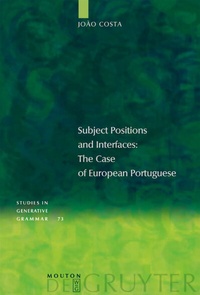
Subject Positions and Interfaces
Description

European Portuguese, like other Romance languages, display a great amount of word order variation. Out of the six logically possible permutations between Subject, Verb and Complement in a transitive sentence, five are possible: SVO, VSO, VOS, OVS and OSV.
The primary goal of this book is to provide an analysis of the several positions where the subject may surface in European Portuguese. Departing from an architecture of the clause as sketched in early minimalist work, containing two subject-related functional categories above VP (AgrP and TP), it is shown that the subject may surface in all potential landing sites: Spec,AgrP, Spec,TP and Spec,VP. Moreover, just like any other argument of the clause, it is claimed that subjects also have the possibility of surfacing in a left-dislocated position, arguably adjoining to the clause's left periphery.
It is shown that there is no free variation. Each of these positions may be occupied by the subject, only if two requirements are met:
i) The position is made available by syntax;
ii) The position does not violate any interface condition.
In other words, the following model is argued for: syntax generates legitimate outputs. At the interface levels, each output may be selected or filtred out, according to requirements of the interface.
The picture emerging from the proposal made in this book is the following: syntax proper does not need to refer to conditions best placed at the interface. All that is needed from syntax is that it generates an array of well-formed outputs. Such outputs may be evaluated a posteriori by each of the interfaces. If they meet requirements of the interface, they are selected as legitimate. If, on the contrary, some interface condition is violated, they are ruled out. Under this approach, three in-dependent results are derived: i) an explanation is found for the patterns of word order variation; ii) syntax proper may be reduced to its own tools, not having to manipulate semantic, discourse or prosodic variables; iii) the intuition that European Portuguese is an SVO language is derived: this word order corresponds to the one in which the subject occupies the only specifier position in which the other interfaces play no role.
Reviews / Votes
"In brief, this book makes an important contribution empirically in word order, and topic and focus in EP and theoretically on syntax and its interface with phonology and semantics, exploring Reinhart's proposal on the syntax-sematics interface."Michael Barrie in: Linguist List 17.2293 "Das lesenswerte Buch vermittelt dem theoretisch interessierten Romanisten anhand von reichem Beispielsmaterial tiefgehende Einsichten in die syntaktische Struktur des Europäischen Portugiesisch."Marc-Olivier Hinzelin in: Romanische Forschungen 1/2009More details
Other editions
Additional editions
Person
Content
2 - Contents [Seite 5]
3 - 1. Introduction [Seite 9]
4 - 2. Preverbal subjects: Spec,IP or left-dislocated? [Seite 19]
5 - 3. Postverbal subjects: syntax and discourse - VSO and VOS orders [Seite 31]
6 - 4. Inversion and information structure [Seite 79]
7 - 5. Optionality and left-dislocated subjects: semantic and discourse properties [Seite 115]
8 - 6. Subjects in Spec, TP and the interface with morphology [Seite 137]
9 - 7. Syntactic outputs and the interfaces [Seite 149]
10 - 8. Summary and conclusions [Seite 167]
11 - Backmatter [Seite 171]
