

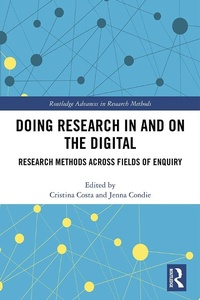
Doing Research In and On the Digital
Research Methods across Fields of Inquiry
1st Edition
Published on 23. May 2018
226 pages
978-1-317-20190-8 (ISBN)
Description

As a social space, the web provides researchers both with a tool and an environment to explore the intricacies of everyday life. As a site of mediated interactions and interrelationships, the 'digital' has evolved from being a space of information to a space of creation, thus providing new opportunities regarding how, where and, why to conduct social research.
Doing Research In and On the Digital aims to deliver on two fronts: first, by detailing how researchers are devising and applying innovative research methods for and within the digital sphere, and, secondly, by discussing the ethical challenges and issues implied and encountered in such approaches.
In two core Parts, this collection explores:
content collection: methods for harvesting digital data
engaging research informants: digital participatory methods and data stories .
With contributions from a diverse range of fields such as anthropology, sociology, education, healthcare and psychology, this volume will particularly appeal to post-graduate students and early career researchers who are navigating through new terrain in their digital-mediated research endeavours.
Doing Research In and On the Digital aims to deliver on two fronts: first, by detailing how researchers are devising and applying innovative research methods for and within the digital sphere, and, secondly, by discussing the ethical challenges and issues implied and encountered in such approaches.
In two core Parts, this collection explores:
content collection: methods for harvesting digital data
engaging research informants: digital participatory methods and data stories .
With contributions from a diverse range of fields such as anthropology, sociology, education, healthcare and psychology, this volume will particularly appeal to post-graduate students and early career researchers who are navigating through new terrain in their digital-mediated research endeavours.
More details
Series
Edition
1. Auflage
Language
English
Place of publication
London
United Kingdom
Publishing group
Taylor & Francis Ltd
Target group
College/higher education
Product notice
Reflowable
Illustrations
2 Tables, black and white; 11 Line drawings, black and white; 6 Halftones, black and white; 17 Illustrations, black and white
ISBN-13
978-1-317-20190-8 (9781317201908)
Copyright in bibliographic data and cover images is held by Nielsen Book Services Limited or by the publishers or by their respective licensors: all rights reserved.
Schweitzer Classification
Other editions
Additional editions
Cristina Costa | Jenna Condie
Doing Research In and On the Digital
Research Methods across Fields of Inquiry
Book
01/2020
1st Edition
Routledge
€68.90
Shipment within 15-20 days
Cristina Costa | Jenna Condie
Doing Research In and On the Digital
Research Methods across Fields of Inquiry
Book
06/2018
1st Edition
Routledge
€215.41
Shipment within 10-20 days
Persons
Cristina Costa is Associate Professor Digital Education and Society, University of the West of England, Bristol, UK.
Jenna Condie is a Lecturer in Digital Research and Online Social Analysis at Western Sydney University, Australia.
Jenna Condie is a Lecturer in Digital Research and Online Social Analysis at Western Sydney University, Australia.
Content
Chapter 1: Doing research in and on the digital
Cristina Costa, University of the West of England, UK & Jenna Condie, Western Sydney University, Australia
Part I: Collecting content: methods for harvesting digital data
Chapter 2: 'Feeling appy?': using app-based methodology to explore contextual effects on real-time cognitions, affect and behaviours
Linda K. Kaye, Rebecca L. Monk and Iain Hamlin, Edge Hill University, UK
Chapter 3: Adapting a method to use Facebook in education research: taking phenomenography online
Naomi Barnes, Griffith University, Australia
Chapter 4: An exploration of lived experience in a digital world: how technology is revolutionising substance misuse recovery
Stephanie Dugdale1, Sarah Elison-Davies1, Glyn Davies1, Jonathan Ward1, Michaela Jones2
1 Breaking Free Group, Manchester, UK
2 in2recovery, Manchester, UK
Chapter 5: Exploring breast cancer bloggers' lived experiences of 'survivorship': the ethics of gaining access, analysing discourse and fulfilling academic requirements
Cathy Ure, University of Salford, UK
Chapter 6: Text research on online platforms: heuristic steps and pitfalls
Tom Van Nuenen, Tilburg University, Holland
Chapter 7: Tinder matters: swiping right to unlock new research fields
Jenna Condie, Garth Lean, and Donna James, Western Sydney University, Australia
Chapter 8: Remote ethnography, virtual presence: exploring digital-visual methods for anthropological research on the web
Shireen Walton, University College London, UK
Part II: Engaging research informants: digital participatory methods and data stories
Chapter 9: The visualisation of data in a digital context
David A. Ellis, University of Lancaster and Hannah L. Merdian, University of Lincoln, UK
Chapter 10: Designing digital platforms for citizen data and public discourse on climate change
Lily Bui, Massachusetts Institute of Technology, USA
Chapter 11: In search of lost purpose: the dream life of digital
Erinma Ochu, University of Salford, UK
Chapter 12: Using digital stories in healthcare research: ethical and practical dilemmas
Carol Haigh, Manchester Metropolitan University, UK & Pip Hardy, Independent Researcher, UK
Chapter 13: Conclusion: (re-)exploring the practical and ethical contexts of digital research
Jenna Condie, Western Sydney University, Australia, & Cristina Costa, University of the West of England, UK
Cristina Costa, University of the West of England, UK & Jenna Condie, Western Sydney University, Australia
Part I: Collecting content: methods for harvesting digital data
Chapter 2: 'Feeling appy?': using app-based methodology to explore contextual effects on real-time cognitions, affect and behaviours
Linda K. Kaye, Rebecca L. Monk and Iain Hamlin, Edge Hill University, UK
Chapter 3: Adapting a method to use Facebook in education research: taking phenomenography online
Naomi Barnes, Griffith University, Australia
Chapter 4: An exploration of lived experience in a digital world: how technology is revolutionising substance misuse recovery
Stephanie Dugdale1, Sarah Elison-Davies1, Glyn Davies1, Jonathan Ward1, Michaela Jones2
1 Breaking Free Group, Manchester, UK
2 in2recovery, Manchester, UK
Chapter 5: Exploring breast cancer bloggers' lived experiences of 'survivorship': the ethics of gaining access, analysing discourse and fulfilling academic requirements
Cathy Ure, University of Salford, UK
Chapter 6: Text research on online platforms: heuristic steps and pitfalls
Tom Van Nuenen, Tilburg University, Holland
Chapter 7: Tinder matters: swiping right to unlock new research fields
Jenna Condie, Garth Lean, and Donna James, Western Sydney University, Australia
Chapter 8: Remote ethnography, virtual presence: exploring digital-visual methods for anthropological research on the web
Shireen Walton, University College London, UK
Part II: Engaging research informants: digital participatory methods and data stories
Chapter 9: The visualisation of data in a digital context
David A. Ellis, University of Lancaster and Hannah L. Merdian, University of Lincoln, UK
Chapter 10: Designing digital platforms for citizen data and public discourse on climate change
Lily Bui, Massachusetts Institute of Technology, USA
Chapter 11: In search of lost purpose: the dream life of digital
Erinma Ochu, University of Salford, UK
Chapter 12: Using digital stories in healthcare research: ethical and practical dilemmas
Carol Haigh, Manchester Metropolitan University, UK & Pip Hardy, Independent Researcher, UK
Chapter 13: Conclusion: (re-)exploring the practical and ethical contexts of digital research
Jenna Condie, Western Sydney University, Australia, & Cristina Costa, University of the West of England, UK
