

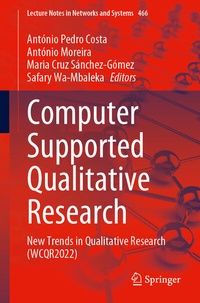
Computer Supported Qualitative Research
Description

This book includes selecting the articles accepted for presentation and discussion at WCQR2022, held on January 26 to 28, 2022 (Virtual Conference). The World Conference on Qualitative Research (WCQR) is an annual event that aims to bring together researchers, academics and professionals, promoting the sharing and discussion of knowledge, new perspectives, experiences and innovations on qualitative research. WCQR2022 featured four main application fields (education, health, social sciences, and engineering/technology) and seven main subjects: Rationale and paradigms of qualitative research; systematization of approaches with qualitative studies; qualitative and mixed methods research; data analysis types; innovative processes of qualitative data analysis; qualitative research in Web context; and qualitative analysis with software support. The book is a valuable resource for everyone interested in qualitative research, emphasizing computer-assisted qualitative data analysis software(CAQDAS).
More details
Other editions
Additional editions
Persons
Content
- Intro
- Preface
- Organisation
- Scientific Committee
- Contents
- Knowledge Transfer and the Challenges of the Virtual World
- 1 Introduction
- 2 Method
- 3 Results and Discussion
- 3.1 Does this Pandemic Crisis Influence the Knowledge Transfer and the Evidence-Based Practice?
- 3.2 Can the Issue of Knowledge Transfer and Implementation be Achieved Only Through Online Activities?
- 4 Final Considerations
- References
- Social Network Analysis and Its Applicability by Means of NVivo Software
- 1 Introduction
- 2 Background
- 3 Network Data
- 4 Vertex Metrics
- 5 Working with Sociograms in NVivo
- 6 Conclusions
- 7 Limitations
- References
- Analysis of the Use, Knowledge and Problems of E-learning in a Distance Learning Master's Programme
- 1 Introduction
- 1.1 ICT Resources and E-learning
- 1.2 Problems in Online Teaching and Learning
- 2 Methodology
- 2.1 Research Design
- 2.2 Participants
- 2.3 Preparation of the Structured Interview Script
- 3 Results
- 4 Discussion
- 5 Conclusions
- References
- Smart Speakers and Functional Diversity: A Scoping Review
- 1 Introduction
- 1.1 Rationale
- 1.2 Objectives
- 2 Methods
- 2.1 Protocol and Registration
- 2.2 Eligibility Criteria
- 2.3 Information Sources
- 2.4 Search
- 2.5 Selection of Sources of Evidence
- 2.6 Data Charting Process
- 2.7 Data Items
- 2.8 Synthesis of Results
- 3 Results
- 3.1 Selection of Evidence
- 3.2 Characteristics of Sources of Evidence
- 3.3 Results of Individual Sources of Evidence
- 3.4 Synthesis of Results
- 4 Discussion
- 4.1 Summary of Evidence
- 4.2 Limitations
- 4.3 Conclusions
- 5 Funding
- References
- Risk Communication During COVID-19: What Can We Learn from New Zealand?
- 1 Introduction
- 2 Methodology
- 3 Results and Discussion
- 4 Conclusions
- References
- Methodological Design and Application of NVIVO for a Perceptual Analysis of Green Infrastructure in the Periphery of Madrid
- 1 Perception and Subjectivity in the Study of Landscape
- 2 Objectives, Methodology and Research Stages
- 2.1 Fieldwork Design and Analysis Tools
- 2.2 Qualitative Analysis. The NVIVO Software
- 3 A Selection of Results from the Case Study Analysis
- 4 Discussion
- 4.1 Methodological Insights. Qualitative Research Assisted by NVIVO Software (Computer Supported Qualitative Research)
- 4.2 On Landscape Perception. Some Specific Topics Arising from the Analysis with NVIVO
- 5 Conclusions
- References
- Working During Covid-19 Lockdowns: Qualitative Study of the Psychological Adaptation of Nurses and Teleworkers During Pandemic Phases I and III
- 1 Introduction
- 1.1 Covid-19 Impact on Mental Health
- 1.2 Psychological Adaptation
- 2 Methods
- 2.1 Participants and Procedures
- 2.2 Analysis Strategy
- 3 Results
- 3.1 Qualitative Analysis
- 3.2 Lexical Analysis
- 4 Discussion
- 5 Conclusion
- References
- Using Socrative and Trello in Online Classes at the University of Brasília (UnB)
- 1 Introduction
- 2 Methodology
- 2.1 Virtual Room Planning
- 2.2 Research Characteristics
- 2.3 Method and Text Statistics
- 3 Results Presentation
- 4 Discussion
- 4.1 Theoretical and Practical Implications
- 4.2 Limitations and Future Research
- 5 Conclusions
- References
- Barriers Faced by Nurses Acting in Primary Health Care: Brazilian Case Study
- 1 Introduction
- 2 Methodology
- 3 Results and Discussion
- 4 Conclusions
- References
- Analysis of Governmental's Video Productions on COVID-19 for People with Disabilities from the Cognitive Multimedia Learning Theory Perspective
- 1 Introduction
- 2 Methods
- 3 Results
- 3.1 COVID-19 Protective Measures in PWD
- 3.2 COVID-19 Preventive Measures in PWD
- 4 Discussion
- 5 Conclusions
- References
- Perceptions of Primary School English Teachers Regarding Distance Education During the COVID-19 Pandemic: A Case Study in San Carlos, Costa Rica
- 1 Introduction
- 2 Literature Review
- 2.1 Distance Education
- 2.2 Pedagogical Framework for Distance Education
- 3 Research Context
- 3.1 Context of the Rural Schools
- 3.2 Purpose Statement
- 4 Data Collection
- 5 Data Analysis
- 6 Results
- 6.1 Feelings at the Beginning and During the Pandemic
- 6.2 Educational Management Processes
- 6.3 Self-efficacy Skills
- 6.4 Changes that Led to Normalized Processes During Distance Education
- 6.5 Characteristics of Distance Education
- 7 Discussion
- 8 Conclusions
- References
- Studying Inclusion in Music Education - An Integrative Literature Review as a Support in the Choice of Methodology, Using WebQDA
- 1 Introduction
- 2 Objectives
- 3 Theoretical Framework
- 4 Literature Review
- 5 Methodology
- 5.1 Phase 1
- 5.2 Phase 2
- 5.3 Phase 3
- 5.4 Phase 4
- 5.5 Phase 5
- 6 Final Reflections
- References
- How to Operate Literature Review Through Qualitative and Quantitative Analysis Integration?
- 1 Introduction
- 2 Bibliometric Analysis
- 3 The Proposed Approach to Bibliometric and Qualitative Analysis
- 3.1 Step 1: Research Design
- 3.2 Step 2: Data Collection for Bibliometric Analysis
- 3.3 Step 3: Search String Refinement
- 3.4 Step 4: The Bibliometric Analysis
- 3.5 Step 5: Qualitative Analysis
- 3.6 Step 6: Report and Dissemination of Research Results
- 4 Conclusions
- References
- Review of Scope on the Patient Safety in the Radiodiagnosis Area Supported by Software webQDA®
- 1 Introduction
- 2 Method
- 3 Results and Discussion
- 4 Conclusions
- References
- Analysis of Discrimination and Denial of the Rights of Women with Disabilities with the Help of the Nvivo Software
- 1 Introduction
- 2 Convergence of Negative Results
- 3 Methodology
- 3.1 Data Collection
- 3.2 Instrument
- 3.3 Data Analysis
- 4 Results
- 4.1 Results of the Quantitative Analysis
- 4.2 Descriptors for Impact on Quality of Life According to Setting They Live in
- 4.3 Discrimination
- 4.4 Impact on Quality of Life
- 4.5 Qualitative Analysis Results
- 5 Conclusions and Discussion
- 5.1 Circumstances Which Women with Disabilities Live in
- 5.2 View of Women with Disability Regarding Their Full and Inclusive Development
- 5.3 Differences in the Situation of Women with Disabilities in Rural or Urban Settings
- 5.4 Demands and Possible Improvements to the Dependency System
- 5.5 Study Limitations
- References
- A Qualitative Study and Analysis on the Use, Utility, and Emotions of Technology by the Elderly in Spain
- 1 Introduction
- 2 Methodology and Materials
- 2.1 Participants
- 2.2 Research Design
- 2.3 Preparation of the Script for the Semi-structured Interview and the Table of Categories
- 3 Results
- 4 Discussion
- 5 Conclusions
- References
- Giving Voice to Colorectal Cancer Patient About the Use of Communication Technology with Nurse Navigator
- 1 Introduction
- 2 Methods
- 3 Results
- 3.1 Giving Colorectal Cancer Patients a Voice on the Use of Technology for Communication with Professionals
- 3.2 Proposing Technological Tools that Optimize Communication Between the Nurse and the Patient
- 4 Discussion
- 5 Conclusions
- References
- The Reshuffle of the United Arab Emirates Government in 2020 and the New Context of Happiness as a Government Policy - Content Analysis with WebQDA
- 1 Introduction
- 2 Government Communication and Communication for Development
- 3 Happiness as a Government Policy and the UAE Ministry of Happiness
- 4 Methodology
- 5 Presentation, Data Analysis and Discussion of Results
- 6 Final Considerations
- References s
- Work Changes Due to COVID-19: Exploring Portuguese Workers' Expectations Using IRaMuTeQ
- 1 Introduction
- 1.1 The Impact of COVID-19 on Organizations and Work
- 1.2 Goal and Research Question
- 2 Method
- 2.1 Sample
- 2.2 Data Collection
- 2.3 Data Analysis
- 3 Results
- 3.1 Anticipated Changes Are Associated with Some Vulnerabilities
- 3.2 The Way People Connect to Each Other and with Organizations Will Change
- 3.3 Digitization Will Impact Work Processes
- 3.4 Concerns with Health and Safety Will Increase, and Working Conditions May Alter
- 4 Discussion
- 5 Conclusions
- References
- Network-Based Participatory Evaluation Methodology
- 1 Introduction
- 2 Background
- 2.1 Theoretical Background
- 2.2 Methodological Background
- 2.3 Context Background
- 3 Methodology
- 3.1 Network-Based Participatory Evaluation Methodology
- 3.2 ProfEPT Self-assessment Stages
- 3.3 ProfEPT Guidelines
- 3.4 Procedures
- 4 Results and Outputs
- 4.1 ProfEPT Online Platform
- 4.2 ProfEPT Self Evaluation Use
- 4.3 Contributions to the Development of Qualitative Research
- 4.4 Collaboration Impact
- 5 Conclusion
- References
- Online Problem-Based Learning During the Pandemic: SWOT Analysis of the Nursing Student's Opinion
- 1 Introduction
- 2 Methodology
- 3 Results
- 4 Discussion
- 5 Final Considerations
- References
- Methodological Reflections on Construction of Knowledge About Rural Women
- 1 Introduction
- 2 Introduction to the Study
- 3 Research Methodology
- 3.1 Methodological Framework
- 3.2 Research Procedure
- 4 Journey of the Researcher
- 5 Issues in Constructing Knowledge About Women
- 5.1 Women's Ways of Knowing and the Challenges
- 5.2 Construction of Knowledge About Women: Interaction Between Participants and the 'Self'
- 5.3 Speaking for Others
- 6 Conclusion
- References
- The Role and Potential of Information Communication Technology (ICT) in Early Childhood Education in South Africa: A Theoretical Perspective
- 1 Introduction
- 1.1 Overview
- 1.2 Problem Statement
- 1.3 Status of ICT in Early Childhood Development (ECD)
- 1.4 Objectives of the Study
- 1.5 Significance of the Study
- 2 Methods
- 3 Key Findings and Discussion
- 3.1 The Value of ICT in Early Childhood Education
- 3.2 ICT Financing in Schools as a Global Challenge
- 3.3 What is the Role of Technology in Teaching and Learning?
- 3.4 Recommendations for Best Practices and Critical Success Factors - The South African Context
- 4 Conclusion
- References
- Author Index
