

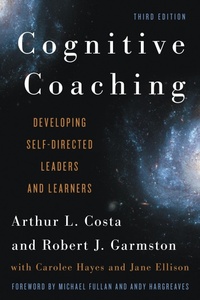
Cognitive Coaching
Developing Self-Directed Leaders and Learners
3rd Edition
Published on 1. August 2015
408 pages
979-8-8818-5172-9 (ISBN)
Description

In this greatly expanded and extensively updated edition of a widely popular resource you see how teachers' individual and collective capacities for continuing self-improvement are strengthened over time through Cognitive Coaching. You gain essential skills, protocols, guidance, research and resources to use when implementing Cognitive Coaching principles and values in your own school setting.
Working toward the goals of making school better places where more students succeed and satisfaction in learning and teaching prevail, Costa and Garmston let you know about their own learning, and how new research and practice can support individuals and schools in reaching higher, more satisfying, and more holistic performance. Organized into four sections, the book clearly and effectively presents these concepts: the meanings of cognitive coaching; the basics of teaching excellence; strategies and tactics for engaging in coaching; and how to integrate Cognitive Coaching throughout the system.
Working toward the goals of making school better places where more students succeed and satisfaction in learning and teaching prevail, Costa and Garmston let you know about their own learning, and how new research and practice can support individuals and schools in reaching higher, more satisfying, and more holistic performance. Organized into four sections, the book clearly and effectively presents these concepts: the meanings of cognitive coaching; the basics of teaching excellence; strategies and tactics for engaging in coaching; and how to integrate Cognitive Coaching throughout the system.
More details
Series
Edition
3rd edition
Language
English
Place of publication
United States
Publishing group
Bloomsbury Publishing Plc
ISBN-13
979-8-8818-5172-9 (9798881851729)
Copyright in bibliographic data and cover images is held by Nielsen Book Services Limited or by the publishers or by their respective licensors: all rights reserved.
Schweitzer Classification
Other editions
Additional editions
Arthur L. Costa | Robert J. Garmston | Carolee Hayes
Cognitive Coaching
Developing Self-Directed Leaders and Learners
Book
08/2015
3rd Edition
Rowman & Littlefield Publishers
€101.00
Shipment within 10-20 days
Persons
Art Costa is a Professor of Education, Emeritus, from California State University, Sacramento, where he taught graduate courses to teachers and administrators in curriculum, supervision, and the improvement of instruction. He is the author of The Enabling Behaviors, Teaching for Intelligent Behaviors and Supervision for Intelligent Teaching; and is co-author of Cognitive Coaching and Techniques for Teaching Thinking. He has written numerous other articles and publications on supervision, teaching strategies and thinking skills. Dr. Costa has made presentations and conducted workshops for educators throughout the United States and in Canada, Mexico, Europe, Africa, the Middle East, Asia and the South Pacific. He taught in the Bellflower School District, worked as a curriculum consultant in the Los Angeles County Superintendent of Schools Office, and was Assistant Superintendent of the Sacramento County Superintendent of Schools office. Active in many professional organizations, Dr. Costa has served as president of the California Association for Supervision and Curriculum Development and as president of the national A.S.C.D. from 1988 to 1989. Art can be reached by e-mail at artcosta@aol.com.
Robert J. Garmston, EdD, presents to educators and managers throughout the United States as well as in Canada, Africa, Asia, Australia, Europe, the Middle East and South America. Emeritus Professor of Educational Administration at California State University, Sacramento, Bob has previously been a classroom teacher, principal, director of instruction and acting superintendent. Co-Developer of Cognitive Coaching with Dr. Arthur Costa and co-founder of the Center for Adaptive Schools with Bruce Wellman, www.thinkingcollaborative.com, his work has been translated into Arabic, Hebrew, Italian and Spanish. He is director of Facilitation Associates, a consulting firm specializing in leadership, learning, personal and organizational development. Bob lives near Sacramento, California with his wife Sue and close to his five adult children, and grandchildren, who are, of course, cute and bright.
Robert J. Garmston, EdD, presents to educators and managers throughout the United States as well as in Canada, Africa, Asia, Australia, Europe, the Middle East and South America. Emeritus Professor of Educational Administration at California State University, Sacramento, Bob has previously been a classroom teacher, principal, director of instruction and acting superintendent. Co-Developer of Cognitive Coaching with Dr. Arthur Costa and co-founder of the Center for Adaptive Schools with Bruce Wellman, www.thinkingcollaborative.com, his work has been translated into Arabic, Hebrew, Italian and Spanish. He is director of Facilitation Associates, a consulting firm specializing in leadership, learning, personal and organizational development. Bob lives near Sacramento, California with his wife Sue and close to his five adult children, and grandchildren, who are, of course, cute and bright.
Content
Foreword
Preface
Acknowledgements
Cognitive Coaching Resources
PART I: EXPLORING THE MEANINGS OF COGNITIVE COACHING
Chapter 1: Discovering the Meanings of Cognitive Coaching
Chapter 2: Identity
Chapter 3: The Mediator's Skills
Chapter 4: Mediating for Self-Directed Learning
Chapter 5: Repertoire of Support Functions
PART II: SOURCES OF EXCELLENCE
Chapter 6: Developing and Maintaining Trust
Chapter 7: States of Mind
Chapter 8: Teacher Cognition
Chapter 9: Inquiring into the Knowledge Base of Teaching
PART III: ENGAGING IN COACHING
Chapter 10: Human Diversity In Meaning-Making
Chapter 11: The Maps of the Planning and Reflecting Conversations
Chapter 12: Resolving Problems: The Third Coaching Map
Chapter 13: Calibrating Conversations
PART IV: THE IMPACT OF COGNITIVE COACHING
Chapter 14: Cognitive Coaching: A Synthesis of the Research by Jenny Edwards
Chapter 15: How Leaders Support Learning in the Agile Organization
APPENDICES
APPENDIX A:Suggestions for Teachers Own Standards
APPENDIX B:Inner Coaching
APPENDIX C:Mediative Questioning
APPENDIX D:Calibrating Conversation Script
APPENDIX E:Sources of Standards of teacher & leader performance
APPENDIX F:Other Resources About Self-Directedness
APPEDIX G:List Of Videos, Topics And Length of Time In Minutes.
About the Authors
Glossary of Terms
References
Index
Preface
Acknowledgements
Cognitive Coaching Resources
PART I: EXPLORING THE MEANINGS OF COGNITIVE COACHING
Chapter 1: Discovering the Meanings of Cognitive Coaching
Chapter 2: Identity
Chapter 3: The Mediator's Skills
Chapter 4: Mediating for Self-Directed Learning
Chapter 5: Repertoire of Support Functions
PART II: SOURCES OF EXCELLENCE
Chapter 6: Developing and Maintaining Trust
Chapter 7: States of Mind
Chapter 8: Teacher Cognition
Chapter 9: Inquiring into the Knowledge Base of Teaching
PART III: ENGAGING IN COACHING
Chapter 10: Human Diversity In Meaning-Making
Chapter 11: The Maps of the Planning and Reflecting Conversations
Chapter 12: Resolving Problems: The Third Coaching Map
Chapter 13: Calibrating Conversations
PART IV: THE IMPACT OF COGNITIVE COACHING
Chapter 14: Cognitive Coaching: A Synthesis of the Research by Jenny Edwards
Chapter 15: How Leaders Support Learning in the Agile Organization
APPENDICES
APPENDIX A:Suggestions for Teachers Own Standards
APPENDIX B:Inner Coaching
APPENDIX C:Mediative Questioning
APPENDIX D:Calibrating Conversation Script
APPENDIX E:Sources of Standards of teacher & leader performance
APPENDIX F:Other Resources About Self-Directedness
APPEDIX G:List Of Videos, Topics And Length of Time In Minutes.
About the Authors
Glossary of Terms
References
Index
