

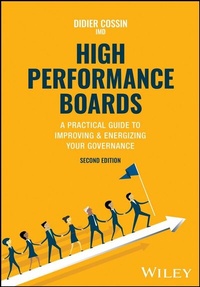
High Performance Boards
Description

"Didier Cossin's High Performance Boards covers aspects of culture and organisational design that are foundational to any successful institution. This comprehensive study captures real-world insights on quality governance and effective leadership. It connects his four- pillar methodology for gauging and improving board effectiveness, learning from both failure and success and boardroom best practice. It is a valuable tool for present and future directors." -Mark Tucker, Group Chairman of HSBC Holdings plc
"Recent developments in the financial services industry dramatically illustrate the intimate link between good governance and a company's success or failure, particularly in times of crisis. In his latest book, Didier Cossin sheds light on the design principles and practice that underpin good governance. A catchy and comprehensive textbook for those in charge!" -Sergio Ermotti, Group CEO and President of the Executive Board of UBS AG
The most up-to-date version of the gold standard in board governance
In the newly revised second edition of High Performance Boards: A Practical Guide to Improving & Energizing your Governance, author Didier Cossin delivers an incisive and practical roadmap to board governance best-practices. Accessible to professionals from a variety of backgrounds, the book lays out the foundational and advanced concepts you'll need to understand to effectively govern a for-profit firm, non-profit, or government entity.
You'll learn to manage risk, increase the impact of your board, consider and evaluate the importance of ESG metrics, take into account geopolitics, and supervise your organization's culture. You'll also discover:
- Extensive revisions to existing chapters, including new methods of cyber-risk management and stakeholder management
- Strategies for avoiding the common pitfall of 'greenwashing'
- Increasingly common new activism techniques undertaken by boards and investors to shape the behaviour of organizations
An indispensable resource for board members and directors serving on boards at organizations of all kinds, High Performance Boards will also earn a place on the bookshelves of corporate lawyers, board secretaries, and students of corporate governance. For additional materials to the book, please see didiercossin.com.
More details
Other editions
Additional editions
Person
Didier Cossin, Lausanne, Switzerland, is the founder and director of the IMD Global Board Center and the originator of the Four Pillars of Board Effectiveness methodology. In his work with boards, Professor Cossin helps them enhance organizational performance through strategy involvement, best-in-class decision making, enhancing board culture and general governance (including board restructurings). Professor Cossin is an advisor and/or executive teacher with the United Nations, the central banks of several countries, ministries as well as sovereign wealth funds and supranational organizations (including the European Central Bank, IFC, IOC), the boards or executive committees of corporations, financial institutions and funds in Europe, Asia, the Americas, Africa and the Middle East. He has worked extensively with the oil and gas industry (Schlumberger, Shell, Sinopec, Saudi Aramco, Qatar Petroleum, and others) and the banking industry (HSBC, Bank of America, Goldman Sachs, ICBC and others), but also with many other industries, including media, luxury goods, retail, shipping, and asset management. He also advises some leading non-profit organizations (UNICEF, the Red Cross) on governance issues. Didier is a member of the Risk Who's Who Society, the American Finance Association, the Eastern Finance Association, and the European Finance Association.
IMD, Lausanne, Switzerland, is an independent university institute with campuses in Lausanne and Singapore. For more than 75 years, IMD has been a pioneering force in developing leaders who transform organizations and contribute to society. IMD has been ranked in the top three of the FT's Executive Education Rankings (combined ranking for open & custom programs) since 2012. It has also been in the top four for 18 consecutive years.
Since 2004, IMD has sustained the premier "triple-crown" of AACSB, European Foundation for Management Development EQUIS, and AMBA accreditations, and, in 2022, IMD earned Swiss institutional accreditation, confirming IMD's commitment to delivering the highest quality teaching, research and services.
Content
About the Author xi
Acknowledgements xiii
Preface xv
Part I: The Four Pillars of Board Effectiveness 1
Joanne Marker and Board Service 3
Chapter 1 The Four Pillars of Board Effectiveness 9
The First Pillar: People Quality, Diversity, Focus, and Dedication 11
The Second Pillar: Information Architecture 13
The Third Pillar: Structures and Processes 14
The Fourth Pillar: Group Dynamics and Board Culture 16
Chapter 2 Governance Challenges around the World 19
Scientific Lessons from Natural Selection 21
What is Transformational Leadership? 22
Should We Trust Leaders? 23
The Governance DNA 24
Chapter 3 The Successful Director: Values and Character 27
Duty of Care 29
Duty of Loyalty 30
Duty of Compliance (or Obedience) 31
Integrity: A Key Characteristic of Board Directors 31
Chapter 4 The First Pillar: People Quality, Diversity, Focus, and Dedication 35
Quality and Diversity 35
Focus 38
Dedication 39
Chapter 5 The Second Pillar: Information Architecture 43
How Complete is Your Information? 44
Chapter 6 The Third Pillar: Board Structures and Processes 51
Processes 52
Committee Structure 53
Board Secretary 54
Lead Director or Vice Chair 54
Chapter 7 The Fourth Pillar: Group Dynamics and Board Culture 57
Understanding Group Dynamics 59
Coalitions Within a Board are Inevitable - and they Feed into Politics 62
Boards Fall into Traps 64
Drawing Strength from the Board's Potential 67
Developing Self- awareness 68
Board Culture 69
Summary Table to Part I: The Four Pillars of Board Effectiveness Toolkit 72
Checklist on People Quality, Diversity, Dedication, and Focus 72
Checklist on Information Architecture 73
Checklist on Structures and Processes 73
Checklist on Group Dynamics 75
Part II: Board Failures and Challenges 77
Chapter 8 Four Areas of Board Failure 79
Chapter 9 Risks and Ensuring the Right Board Risk Philosophy 83
Chapter 10 A Board Member's Practical Guide to Risk Thinking 87
The Physical Health Check: Technical Risks 87
The Mental Health Check: Behaviours 93
The Strategic Risk Check 96
The Governance Risk Check 98
Chapter 11 Elements of Advanced Risk Techniques for Board Members: From Quants to Cyber 101
The Why and How of Quantitative Risk Assessment for Boards 102
Integration of Risks 105
The Outcome of Risk Assessment 105
Cyber Risk 107
Chapter 12 Crisis Management 111
Crisis as a Turning Point 114
There is Work to be Done in Peaceful Times 114
Communication Principles 115
Another Powerful Weapon: Gathering Information 116
A Crisis Will Shed Light on Boardroom Fissures 118
Procedure vs Authenticity 119
Communicate Your Way to Rebuilding Trust 120
Chapter 13 The Four Tiers of Conflicts of Interest 123
Tier-I Conflicts: Individual Directors vs Company 124
Tier-II Conflicts: Directors vs Stakeholders 126
Tier-III Conflicts: Stakeholders vs Other Stakeholders 132
Conflicts of Interest within a Group of Stakeholders 136
Tier-IV Conflicts: Company vs Society 137
Chapter 14 High-level Fraud and Active Board Oversight 143
Why Does High-level Fraud Happen? 145
How to Create an Effective Oversight Environment 153
Tools for Anti-fraud Activities: Assessment, Prevention, Detection, and Investigation 159
Part III: Board Leadership 165
Joanne Marker and Board Values at Comfre 167
Chapter 15 Board Leadership and Values 169
Quality Boards Live and Breathe Integrity 169
Which and Whose Values? 171
Board Values vs Organisational Values 173
Family Values in Business 174
A New Board Arena for Joanne Marker: Chairing the Board 175
Chapter 16 Becoming the Chair 179
The Role of the Chair 179
Effective Chairs are Active 181
Transitioning into the Role of the Chair 182
Chairs as Transformational Leaders 185
Making the Right Decisions about Chairmanship Roles and Styles 187
Managing the Transition 190
Leaving a Lasting Organisational Impact as Board Chair 193
Appendix 16A - Checklist: Board Chairs as Stewards 194
Joanne Marker Enters the Chair Arena 195
Chapter 17 The Chair-CEO Relationship 197
Chair-CEO Dynamics - the Hallmarks of a Productive Relationship 198
Tests of the Chair-CEO Relationship 201
The Ideal Attributes of a Chair to be a Secure Base to the CEO 202
Joanne Marker Confronts Failing Board Culture 205
Chapter 18 The Board-Management Relationship 207
Supervision 207
Support 209
Blurring the Board-Management Relationship 209
Writing Governance Codes is Easier than Changing Behaviours 211
Chapter 19 Effective Diversity 213
Diversity is Good . . . But Why; and When? 213
Diversity as a Considered Choice 214
We Have Embraced Diversity . . . Now What? 221
The Chair's Role in Building and Nurturing Diversity 222
Chapter 20 Stewardship from the Board 225
Building Upon a Rich Cross-disciplinary Legacy of Thought 227
Psychological, Organisational, and Cultural Influences on Stewardship 227
Steward Leaders Build on their Unique Strengths to Drive Stewardship 227
Steward Leaders Deliver Long-lasting, Meaningful, and Inclusive Impact 228
Becoming a Steward Leader: What it Takes 231
Stewardship Risks 231
Boards are Key to Fostering Stewardship 232
Part IV: Board Best Practices 233
Chapter 21 The Board as a Strategic Asset 235
Five Definitions of Strategy 236
Clarifying the Board's Role 238
Taking Context into the Mapping Process 241
The Impact of Context on Strategic Views and Roles of the Board 241
The Board's Ultimate Strategic Significance 242
Chapter 22 Is the Board a Team? 245
Fundamentally, the Board is Not a Team 245
Boards Must Allow for Controlled Instability and Dissent 246
Convictions can be the Fuel in a Board's Teamwork 247
The Overarching Objective is to Make Boards Cohesive and Potent 249
Ways to Nudge a Board up the Maturity and Potency Curve 250
Effective Board Teams are Adept at Juggling Competing Priorities 254
Potent Boards Know When to Converge and When to Diverge - and Value Both 254
Appendix 22A: Characteristics of a potent board checklist 255
Appendix 22B: Board members' cultural and cross- cultural competences checklist 256
Chapter 23 A Primer on Finance Essentials for Directors 257
Reading Financial Reports 257
Understanding Ratios to Analyse Operating Strategies 259
Interpreting between the Lines of Financial Statements 261
How to Identify Red Flags in Financial Statements 262
Implementing Desired Capital Structure 263
Understanding Valuation Fundamentals 264
Making Better M&A Decisions 265
Overseeing Risk 267
Chapter 24 The Intricacies of Subsidiary/Holding Governance 271
Structures 273
Culture 275
Chapter 25 Fostering Entrepreneurship from the Board 277
'Best Practice' Governance vs Entrepreneurship 278
Boards Should Actively Encourage Entrepreneurship 278
Chapter 26 The Board's Oversight Framework for M&As 283
Creating a Deal-making Mindset 284
Seeing the Bigger Picture 285
Staging Deals with Maximum Precision 285
Integration 290
Confronting Litigation Involving M&As 291
Acknowledgement 293
Chapter 27 Boards and Oversight of KPIs 295
KPIs are a Language - and are Indispensable for Boards 295
KPIs Need to be Credible to be Useful 296
Zooming in on the KPIs that Matter - and that Tell a Story of How the Company Creates Value 297
KPIs Should Measure What is Critical 297
A Keen Focus on Value Creation 298
KPIs Help Diminish Substantial Business Risks Linked to ESG 299
KPIs and Human Capital 301
A Dynamic Approach to KPIs 301
Hi-tech Display and Review of KPIs 302
A Renaissance of the Balanced Scorecard 304
KPIs for Board Members 304
Appendix 27A 305
Chapter 28 The Talent Pipeline 309
The Board's Responsibility for Talent Management 309
The New Talent Dynamic: Culture, Values, Community 311
Chapter 29 Human Capital Evolution for Boards 315
Board Responsibility for Human Capital 316
Growing Stakeholder Demands for HCM Disclosure 318
Culture as the Safeguard of Long-term Value Creation 320
Staying Current with Emerging Expectations of the World of Work 321
Chapter 30 Boards and Social Media 323
JP Morgan's Failed Foray into Twitter Q&A 324
Why Boards Should Understand Social Media 324
What Boards Should Do 326
Acknowledgement 330
Chapter 31 Boards and Investors 331
The Move Toward Increasing Shareholder Engagement 332
The Surge in Shareholder Activism on Boards 334
Chapter 32 Managing Stakeholders 337
Shareholders vs Stakeholders: A Definition 337
How to Identify a Company's Key Stakeholders 339
The Board can be Instrumental in Shaping the CEO-Stakeholders Conversation 340
The Process of Stakeholder Engagement 340
Anticipating Stakeholders' Influence and Impact 343
Chapter 33 Board Oversight of Geopolitical Risks and Opportunities 347
Geopolitical and Geoeconomic Resilience has Moved to the Forefront of the Board's Agenda 347
Geopolitical Competence is Now a Muscle that Boards Must Develop 350
A Toolkit for Addressing Geopolitics 354
Overseeing Management's Action in Tackling Geopolitical Risk 358
Appendix 33A: Business dimensions affected by geopolitical risk 362
Appendix 33B: Evaluating the board's geopolitical competence 363
Appendix 33C: Gauging management's preparedness to handle geopolitical risks 363
Appendix 33D: Overseeing management's actions in dealing with geopolitical risks 364
Chapter 34 ESG Oversight in the Boardroom 365
Compliance with ESG Requirements 366
ESG Governance Oversight: Shifting from Compliance to Proactive Governance 367
ESG Metrics: Understanding which ESG Factors are Salient 370
Disclosure Oversight: Managing the ESG Narrative 373
Appendix 34A: ESG Questions for the board to reflect on 380
Chapter 35 Assessing and Benchmarking Governance Performance 383
HPB Director Survey 2012-2023 384
People Quality, Diversity, Focus, and Dedication 385
Information: Designing Board Intelligence 389
Structures and Processes: Architecting Governance Excellence 392
Group Dynamics and Culture 394
Conclusion: Orchestrating Governance Excellence 397
Conclusion 399
Index 401
Joanne Marker and Board Service
At age 62, Joanne Marker had been a senior independent director for over 20 years on the boards of many different companies and public organisations.
The previous year, Joanne had taken early retirement from her job as a senior leader at Connect, a major US telecommunications company, where she had worked for more than two decades. Hers had been a rewarding and challenging career, of which she was proud.
Joanne now derived a different kind of satisfaction from her board service at three very different companies: Connect, international pharmaceutical company Ziogen, and engineering multinational SNB. In recent months a few other organisations had extended invitations, and she was currently evaluating each of them.
One morning, an email from her nephew Thorsten popped up on her screen.
Dear Aunt Joanne,
Exciting news! I just received an invitation to be on the board of Kloetzel & Brothers! First board meeting is next month. I wanted to pick the brain of my favorite board member! Can I take you to lunch at Mario's when you're in town next week?
Yours,
Thorsten
Thorsten was an ambitious, capable, and educated young man working in investment banking on Wall Street. Joanne had no doubt that he would make a fine board director; his knowledge of the financial markets and banking regulation would certainly be helpful to Kloetzel, a global financial services company. He was bright, energetic, and hardworking - and from what she had heard, had earned a reputation in banking as a name to watch. Still, she found herself remembering a few incidents that made her wonder whether he had the maturity and self-possession needed for boardroom discussions. She checked her calendar and emailed Thorsten, confirming the lunch.
***
Joanne cast her mind back to a chilly March afternoon 19 years earlier. She had been in her office thinking about how to improve a distribution partnership for WeCare, the multinational consumer goods company she worked for at the time, when her phone rang.
It was her old friend from business school, Burt Goodman, who was now a mover and shaker at GCD, a major consulting firm. Goodman invited Joanne to join him for the Henry Street Settlement dinner in New York City. 'I'm just not cut out for big gala events, Burt', she had protested.
'Oh come on, it will be good for you', Goodman said. 'Sometimes even an MBA and over 20 years of experience in a major multinational can't match the magic of one lucky dinner conversation.' So Joanne decided to go.
At the dinner, she was seated next to Jordan Wise, the CEO of Amsterdam-based Virtuous Ventures, a major international conglomerate. Their conversation touched upon Joanne's family and career journey to date, and Wise asked her advice on the pros and cons of joint ventures in different emerging markets. Joanne shared her key learnings about each market, as well as the main strategic and industrial dimensions that needed to be considered.
'But doesn't it depend on your partners in the end?' Wise wanted to know. Joanne described the different partnerships that WeCare had developed locally, depending on the distribution channels in place (or not) in different markets.
Two days later, Wise called her with a proposal that took her by surprise. 'How would you like to be on the Virtuous board, Joanne?' he asked her. She had always aspired to board service at some point in her career - but she was only 43, surely far too young to be a director.
Wise explained: 'We're expanding internationally into a new retail business, and we need your international marketing expertise. You can bring in solid knowledge about distribution networks and consumer insight too.' Now Joanne's interest was piqued. She began to ask questions. Wise soon ran out of answers.
Her first meeting with Virtuous Ventures' Chairman Gerald Grossheim was over lunch at the famous Charlie Trotter's restaurant in Chicago's Lincoln Park. Over their first course, Grossheim explained how the company's 11-member board worked, how often it met (four times a year), and his relationship with Jordan Wise (almost daily contact, yet with a certain necessary distance). He also discussed other members of the top team.
Grossheim asked Joanne about the kinds of challenges she had encountered when negotiating with local distributors during international expansions, and about how she had developed an understanding of customers in different markets. Joanne happily described her extensive travels in India, Bangladesh, Thailand, China, and Egypt to talk to WeCare's local sales teams. She had accompanied them on visits, discussing their frustrations and where they saw opportunities, in order to get a sense of the reality on the ground.
Joanne had some questions of her own. While Grossheim sipped his coffee, she asked him:
- Who was on the Virtuous board? How dedicated were they? What did each bring - and what was his or her unique contribution?
- How did board directors ensure they had the information they needed to make decisions? What were the board briefing papers like? Were there other sources of information?
- What kind of processes and structures did the board have in place to ensure it was doing things efficiently and professionally? How did it ensure directors have a sufficient board-level view of risk? (Here, Joanne recalled the WeCare board's inability to understand how their growth strategy had exposed her own company to key vulnerabilities.)
- What was the Virtuous boardroom culture like? What kind of dynamics were at play? How would the other directors view the contribution of a much younger woman?
Together, they formulated questions for Grossheim to ask Virtuous Ventures' President of Marketing, including what additional information he could ask for that would be helpful in assessing the company's current global marketing plan.
Outside, they shook hands and agreed to speak again in the coming weeks. 'I hope to be seeing a lot more of you, Joanne', Grossheim said, smiling at her.
Three months later, after a series of discussions and a formal panel interview by the nominations committee, Joanne was appointed as an independent director and began eight years of board service with Virtuous.
***
The following Tuesday, Joanne walked into Mario's and kissed her nephew Thorsten on the cheek. It had been 18 months since she had last seen him. While Joanne sipped her iced tea, Thorsten told her how his favourite professor from business school, Sam Cragnolino, was on the board of Kloetzel and was approaching retirement.
As a member of the nominations committee, Cragnolino had seen the board's needs analysis, which had identified a gap in the area of finance - and investment in particular. The head of the committee had developed a skills and competency matrix, which specified that the candidate should also be young (between 30 and 40), and had then issued an invitation to executive search firms. He also asked the other board members if they had any candidates to nominate. Sam had recommended Thorsten.
James Caspar, Kloetzel's chair, had also screened the candidates proposed by the search firms, and invited Thorsten for a panel interview. The young man's expertise in securing and structuring deals with a series of major clients had attracted Caspar's attention as being something missing from the board's existing skillset - and something they very much needed. Thorsten had made the shortlist and passed the due diligence process, and then met the full board. He had been impressed by the ambition of its members to contribute to transforming Kloetzel.
'I really like what they're doing', Thorsten said to Joanne. 'James seems active and engaged, yet not overbearing. Everyone I talked to seems serious about really building something.' Joanne smiled at his enthusiasm.
'That's great, Thorsten', she said. 'Board service is one of the most rewarding experiences any professional can have during their career, and I think you stand to gain a lot. But tell me', Joanne said, putting down her fork and looking intently at the young man, 'what is it about your experience that leads you to think you could make a meaningful contribution to Kloetzel?'
'I know how companies are thinking about the costs and benefits of major transactions', Thorsten said. 'I could help Kloetzel think about whom they could approach and with what messaging to expand in major markets, which is part of their strategy.'
Joanne asked him about Kloetzel's current performance, and whether there were discrepancies across major markets. Thorsten shook his head. He didn't know the details. He dug in his pocket for a pen to make a note.
She pointed out the difference between board service and an executive director role. 'You're not there to tell management how to do their job', she said. 'You're there to challenge them on the strategy to make sure it's a good one, and to help them to get what they need to be able to do it, and then to check that they actually do...
