

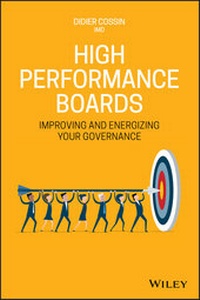
High Performance Boards
Improving and Energizing your Governance
1st Edition
Published on 9. April 2020
344 pages
978-1-119-61568-2 (ISBN)
Description

A comprehensive guide to transforming boards and achieving best-practice governance in any organisation.
When practising good governance, the board is the vital driver of organizational success, while fostering positive social impact and economic value creation. At all levels, executives around the world are faced with complexities rising from disruptive business models, new technologies, socio-economic changes, shifting political circumstances, and an array of other sources. High Performance Boards is the comprehensive manual for attaining best-in-class governance, offering pragmatic guidance on improving board quality, accountability, and performance.
This authoritative volume identifies the four dimensions, or pillars, which are crucial for establishing and maintaining best-practice boards: the people involved, the information architecture, the structures and processes, and the group dynamics and culture of governance. This methodology can be applied to any board in the world, corporate or non-profit organization, regardless of size, sector, industry, or context. Readers are introduced to a fictitious senior board member - an amalgamation of board members from well-known organisations - and follow her as she successfully handles real-life challenges with effective governance. Drawn from the author's 20 years of practice and confidential work with boards across the world, this book:
* Demonstrates how high-performance boards innovate and refine their practices
* Discusses examples of board failures and challenges, including case studies from both for-profit and non-profit organisations including international organizations and state-owned agencies or even ministries
* Provides a proven framework to create best-in-class governance
* Includes a companion website featuring tools for board assessment and board practice
High Performance Boards has inspired more than 3000 board members around the world. This book is essential reading for professionals and managers interested in governance and board members, senior managers, investors, lawyers, and students of governance.
When practising good governance, the board is the vital driver of organizational success, while fostering positive social impact and economic value creation. At all levels, executives around the world are faced with complexities rising from disruptive business models, new technologies, socio-economic changes, shifting political circumstances, and an array of other sources. High Performance Boards is the comprehensive manual for attaining best-in-class governance, offering pragmatic guidance on improving board quality, accountability, and performance.
This authoritative volume identifies the four dimensions, or pillars, which are crucial for establishing and maintaining best-practice boards: the people involved, the information architecture, the structures and processes, and the group dynamics and culture of governance. This methodology can be applied to any board in the world, corporate or non-profit organization, regardless of size, sector, industry, or context. Readers are introduced to a fictitious senior board member - an amalgamation of board members from well-known organisations - and follow her as she successfully handles real-life challenges with effective governance. Drawn from the author's 20 years of practice and confidential work with boards across the world, this book:
* Demonstrates how high-performance boards innovate and refine their practices
* Discusses examples of board failures and challenges, including case studies from both for-profit and non-profit organisations including international organizations and state-owned agencies or even ministries
* Provides a proven framework to create best-in-class governance
* Includes a companion website featuring tools for board assessment and board practice
High Performance Boards has inspired more than 3000 board members around the world. This book is essential reading for professionals and managers interested in governance and board members, senior managers, investors, lawyers, and students of governance.
More details
Other editions
New editions
E-Book
07/2024
2nd Edition
Wiley
€40.99
Available for download
Additional editions
Book
04/2020
1st Edition
Wiley
€38.90
Article exhausted; check for reprint
Person
DIDIER COSSIN is a professor at IMD, Switzerland and the founder and director of the IMD Global Board Center. He is the originator of the Four Pillars of Board Effectiveness methodology and an advocate of stewardship. He is the author and co-author of books such as Inspiring Stewardship, book chapters (such as Governance Risk: A Guide for Investors) and many articles in the fields of governance, investments, risks and stewardship, several of which have obtained citations of excellence or other awards.
Didier works with asset owners, government officials, central bankers, boards and senior leaders to provide the latest thinking on best-in-class governance, board effectiveness, the governance of investments, board dynamics and strategy design. He favors an adaptive and interactive approach to finding distinctive solutions for organisations on a wide range of governance topics. His latest research focuses on stewardship, how we can foster organisations to have long-term positive social impact while creating economic value for all. His past research has dealt with optimising governance in critical decision-making situations (large investments, key personnel changes, M&As, strategic turnarounds and organisational threats). Didier also supports some leading non-profit organisations at fine-tuning their governance for impact.
Didier works with asset owners, government officials, central bankers, boards and senior leaders to provide the latest thinking on best-in-class governance, board effectiveness, the governance of investments, board dynamics and strategy design. He favors an adaptive and interactive approach to finding distinctive solutions for organisations on a wide range of governance topics. His latest research focuses on stewardship, how we can foster organisations to have long-term positive social impact while creating economic value for all. His past research has dealt with optimising governance in critical decision-making situations (large investments, key personnel changes, M&As, strategic turnarounds and organisational threats). Didier also supports some leading non-profit organisations at fine-tuning their governance for impact.
Content
- Cover
- Title Page
- Copyright Page
- Contents
- About the Author
- Acknowledgements
- Preface
- Part I The Four Pillars of Board Effectiveness
- Joanne Marker and Board Service
- Chapter 1 The Four Pillars of Board Effectiveness
- The First Pillar: People Quality, Focus, and Dedication
- The Second Pillar: Information Architecture
- The Third Pillar: Structures and Processes
- The Fourth Pillar: Group Dynamics and Board Culture
- Chapter 2 Governance Challenges around the World
- Scientific Lessons from Natural Selection
- What is Transformational Leadership?
- Should We Trust Leaders?
- The Governance DNA
- Chapter 3 The Successful Director: Values and Character
- Duty of Care
- Duty of Loyalty
- Integrity: A Key Characteristic of Board Directors
- Chapter 4 The First Pillar: People Quality, Focus, and Dedication
- Quality
- Focus
- Dedication
- Chapter 5 The Second Pillar: Information Architecture
- How Complete is Your Information?
- Chapter 6 Board Structures and Processes
- Processes
- Committee Structure
- Board Secretary
- Lead Director or Vice Chair
- Chapter 7 Group Dynamics and Board Culture
- Understanding Group Dynamics
- Coalitions Within a Board Are Inevitable - and they Feed into Politics
- Boards Fall into Traps3
- Drawing Strength from the Board's Potential
- Developing Self-Awareness
- Board Culture
- Part II Board Failures and Challenges
- Chapter 8 Four Areas of Board Failure
- Chapter 9 Risks and Ensuring the Right Board Risk-Philosophy
- Chapter 10 A Board Member's Practical Guide to Risk Thinking
- The Physical Health Check: Technical Risks
- The Mental Health Check: Behaviours
- The Strategic Risk Check
- The Governance Risk Check
- Chapter 11 Elements of Advanced Risk Techniques for Board Members: From Quants to Cyber
- The Why and How of Quantitative Risk Assessment for Boards
- Integration of Risks
- The Outcome of Risk Assessment
- Cyber Risk
- Chapter 12 Crisis Management
- Crisis as a Turning Point
- There is Work to Be Done In Peaceful Times
- Communication Principles
- Another Powerful Weapon: Gathering Information
- A Crisis Will Shed Light On Boardroom Fissures
- Procedure vs. Authenticity
- Communicate Your Way to Rebuilding Trust
- Chapter 13 The Four Tiers of Conflicts of Interest1
- Tier-I Conflicts: Individual Directors vs. Company
- Tier-II Conflicts: Directors vs. Stakeholders
- Tier-III Conflicts: Stakeholders vs. Other Stakeholders
- Conflicts of Interest within a Group of Stakeholders
- Tier-IV Conflicts: Company vs. Society
- Chapter 14 High-Level Fraud and Active Board Oversight
- Why Does High-Level Fraud Happen?
- Injustice
- Lax Oversight
- Problematic Culture
- Financial Illiteracy
- How to Create an Effective Oversight Environment
- Preventing Injustice: Broaden the Notion of Conflict of Interest
- Preventing Lax Oversight: Build Appropriate Frameworks
- Preventing Toxic Behaviours: Create a Positive Culture
- Strengthen Board Oversight Expertise with Special Focus on Legal, Compliance, Risk, Fraud, and Financial Reporting
- Tools For Anti-Fraud Activities: Assessment, Prevention, Detection, and Investigation
- Assessment
- Prevention
- Detection
- Investigation
- Part III Board Best Practices
- Chapter 15 The Board as a Strategic Asset1
- Five Definitions of Strategy
- Clarifying the Board's Role
- Taking Context into the Mapping Process
- The Impact of Context on Strategic Views and Roles of the Board
- The Board's Ultimate Strategic Significance
- Chapter 16 A Primer on Finance Essentials for Directors
- Reading Financial Reports
- Understanding Ratios to Analyse Operating Strategies
- Interpreting Between the Lines of Financial Statements
- How to Identify Red Flags in Financial Statements
- Implementing Desired Capital Structure
- Understanding Valuation Fundamentals
- Making Better M&A Decisions1
- Overseeing Risk
- Joanne Marker and Board Values at Comfre
- Chapter 17 Board Leadership and Values
- Quality Boards Live and Breathe Integrity
- Which and Whose Values?
- Board Values vs. Organisational Values
- Family Values in Business
- Chapter 18 The Intricacies of Subsidiary/Holding Governance
- Structures
- Culture
- Chapter 19 Fostering Entrepreneurship from the Board1
- 'Best Practice' Governance vs. Entrepreneurship
- Boards Should Actively Encourage Entrepreneurship
- Chapter 20 The Board's Oversight Framework for M&As1
- Creating a Deal-Making Mindset
- Seeing the Bigger Picture
- Staging Deals with Maximum Precision
- Integration
- Confronting Litigation Involving M&As
- Joanne Marker Confronts Failing Board Culture
- Chapter 21 The Chair-CEO Relationship
- The Role of the Chair
- Chairs are Increasingly Active
- Chair-CEO Dynamics - the Hallmarks of a Productive Relationship
- Tests of the Chair-CEO Relationship
- The Ideal Attributes of a Chair
- Chapter 22 The Board-Management Relationship
- Supervision
- Support
- Blurring the Board-Management Relationship
- Writing Governance Codes Is Easier Than Changing Behaviours
- Chapter 23 Effective Diversity
- Diversity is Good . . . But Why
- and When?
- Diversity as a Considered Choice
- Gender
- Culture
- Personality
- Age
- Social Background
- We Have Embraced Diversity . . . Now What?
- The Chair's Role in Building and Nurturing Diversity
- Chapter 24 The Talent Pipeline
- The Board's Responsibility for Talent Management
- The New Talent Dynamic: Culture, Values, Community
- Chapter 25 Boards and Social Media1
- JP Morgan's Failed Foray into Twitter Q&A
- Why Boards Should Understand Social Media
- What Boards Should Do
- Chapter 26 Boards and Investors
- The Move toward Increasing Shareholder Engagement
- Chapter 27 Managing Stakeholders
- Shareholders vs. Stakeholders: A Definition
- How to Identify a Company's Key Stakeholders
- The Board Can Be Instrumental in Shaping the CEO-Stakeholders Conversation
- Anticipating Stakeholders' Influence and Impact
- Chapter 28 Stewardship from the Board
- Building Upon a Rich Cross-Disciplinary Legacy of Thought
- Psychological, Organisational, and Cultural Influences on Stewardship
- Steward Leaders Build on their Unique Strengths to Drive Stewardship
- Steward Leaders Deliver Long-Lasting, Meaningful, and Inclusive Impact
- Becoming a Steward Leader: What it Takes
- Stewardship Risks
- Boards Are Key to Fostering Stewardship
- Conclusion
- Index
- EULA
