

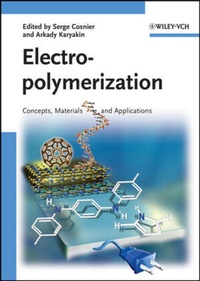
Electropolymerization
Concepts, Materials and Applications
1st Edition
Published on 5. August 2011
XVI, 280 pages
978-3-527-64204-5 (ISBN)
Description

Providing extensive coverage, including conducting, insulating and electroactive films, this handbook and ready reference deals with introductory topics and fundamentals as well as advanced insights. Clearly structured, in the first part of the book readers learn the fundamentals of electropolymerizatoin for all important types of polymers, mechanisms of film formation and functionalization, while the second part covers a wide range of applications in biochemistry, analytics, photovoltaics, energy and the environment as well as actuators.
More details
Other editions
Additional editions
Book
07/2010
1st Edition
Wiley-VCH
€145.00
Article exhausted; check different version
Software
07/2010
Wiley-VCH
€190.00
No shipping information available
Persons
Serge Cosnier is Research Director at CNRS and head of the Analytical and Electrochemical Biosystems Lab at Joseph Fourier University of Grenoble, France, where he began his research career in 1983. He received his Ph.D. in chemistry from Paul Sabatier University of Toulouse in 1982 and then was an Alexander von Humboldt postdoctoral fellow at Munich University. Since 2001, he is the President of the French Group of Bioelectrochemistry and was elected in 2007 President of the Rhône-Alpes section of the Chemical Society of France.
Dr. Cosnier has authored over 205 publications and was awarded two national prizes of the French Club of Chemical Microsensors. In 2009, he received the Katsumi Niki Prize for Bioelectrochemistry of the International Society of Electrochemistry.
Arkady A. Karyakin is professor of chemistry and head of the Electrochemical Methods Laboratory, Chemistry faculty of M.V. Lomonosov Moscow State University (MSU). He graduated from MSU in 1981, receiving his Ph.D. and D.Sc. in 1986 and 1996, respectively. Starting from 2010, A.A. Karyakin is Associate Editor of "Electroanalysis" (Wiley-VCH). He also serves as editorial board member on numerous journals. Professor Karyakin is author of more than 100 papers and contributor to the Encyclopedia of Sensors. He has received several awards in chemistry including the Russian Presidential Award.
Dr. Cosnier has authored over 205 publications and was awarded two national prizes of the French Club of Chemical Microsensors. In 2009, he received the Katsumi Niki Prize for Bioelectrochemistry of the International Society of Electrochemistry.
Arkady A. Karyakin is professor of chemistry and head of the Electrochemical Methods Laboratory, Chemistry faculty of M.V. Lomonosov Moscow State University (MSU). He graduated from MSU in 1981, receiving his Ph.D. and D.Sc. in 1986 and 1996, respectively. Starting from 2010, A.A. Karyakin is Associate Editor of "Electroanalysis" (Wiley-VCH). He also serves as editorial board member on numerous journals. Professor Karyakin is author of more than 100 papers and contributor to the Encyclopedia of Sensors. He has received several awards in chemistry including the Russian Presidential Award.
Content
Preface
ELECTROPOLYMERIZED FILMS OF PI-CONJUGATED POLYMERS. A TOOL FOR SURFACE FUNCTIONALIZATIONS: A BRIEF HISTORICAL EVOLUTION AND RECENT TRENDS
Introduction
Electropolymerization: Epistemological Analysis within the ICP Saga
Electropolymerization: From Pristine Heterocyclic to Sophisticated Functional and Conjugated Architectures
Conclusion
MECHANISMS OF ELECTROPOLYMERIZATION AND REDOX ACTIVITY: FUNDAMENTAL ASPECTS
Electropolymerization: General Aspects
Redox Activity of Polymer Films
Effect of Polymerization Parameters on Properties of Deposited Polymer Films
Conclusions
ELECTROCHEMICAL IMPEDANCE SPECTROSCOPY (EIS) FOR POLYMER CHARACTERIZATION
Introduction
Experimental Arrangements
Impedance Spectra of Polymer Films
Analysis of the Impedance Spectra
Models of Polymeric Layers
Summary
RECENT TRENDS IN POLYPYRROLE ELECTROCHEMISTRY, NANOSTRUCTURATION, AND APPLICATIONS
Introduction
Advances in Synthetic Procedures - New Polymers
Nanostructuration of Polypyrrole
Applications
Conclusion
ELECTROPOLYMERIZED AZINES: A NEW GROUP OF ELECTROACTIVE POLYMERS
Introduction
Electropolymerized Azines as a New Group of Electroactive Polymers
Polyazines in Electroanalysis
Electropolymerized Azines as Promoters for Bioelectrocatalysis
Conclusion
ELECTROPOLYMERIZATION OF PHTHALOCYANINES
Introduction
Immobilization of Transition-Metal Phthalocyanines on Conducting and Nonconducting Substrates
Electropolymerization of Phthalocyanines
Conclusion
IMPRINTED POLYMERS
Introduction
Molecular Imprinting in Conjugated Polymers
Solgel Imprinted Films Prepared by Electropolymerization
Integration of MIPs with the Surface of Transducers
Nanostructured Materials
Other MIP-Based Sensors
Conclusion
GAS SENSING WITH CONDUCTING POLYMERS
Introduction
Electronic Properties of Conducting Polymers
Preparation of Polymer Gas-Sensing Layers
Mechanism of Gas/Polymer Interactions
Types of Conducting Polymer-Based Gas Sensors
Conclusion
CHEMICAL SENSORS BASED ON CONDUCTING POLYMERS
Introduction
Electrochemical Signal Transduction
Optical Signal Transduction
Conclusions
BIOSENSORS BASED ON ELECTROPOLYMERIZED FILMS
Introduction
Chronological Evlution of the Concept of Biosensors Based on Electropolymerized Films: Principal Stages
Formation of Polymer Films by Direct Electropolymerization of the Biomolecule
Adsorption on Electrogenerated Polymers
Mechanical Entrapment within Electropolymerized Films
Covalent Binding at the Surface of Electropolymerized Films
Noncovalent Binding by Affinity Interactions with the Electropolymerized Films
Outlook
INHERENTLY CONDUCTING POLYMERS VIA ELECTROPOLYMERIZATION FOR ENERGY CONVERSION AND STORAGE
Introduction
Energy Conversion
Energy Storage
Electropolymerization to Form Electrodes for Energy Storage Applications
Nanostructured Conducting Polymers
Conducting Polymer Composites
Conclusions
ELECTROCHEMOMECHANICAL DEVICES: ARTIFICIAL MUSCLES
Introduction
Conducting Polymers as Reactive Materials: Electrochemical Reactions
Electrochemical Properties: Multifunctionality and Biomimetism
Macroscopic Dimensional Changes and Mechanical Properties
Anisotropy Obtained from Isotropic Changes: Macroscopic Devices
Electrochemical Characterization
Sensing Capabilities of Artificial Muscles
Tactile Sensitivity
Intelligent Devices
Muscles Working in Air
Advantages, Limitations, and Challenges
Artificial Muscles as Products
ELECTROPOLYMERIZED FILMS OF PI-CONJUGATED POLYMERS. A TOOL FOR SURFACE FUNCTIONALIZATIONS: A BRIEF HISTORICAL EVOLUTION AND RECENT TRENDS
Introduction
Electropolymerization: Epistemological Analysis within the ICP Saga
Electropolymerization: From Pristine Heterocyclic to Sophisticated Functional and Conjugated Architectures
Conclusion
MECHANISMS OF ELECTROPOLYMERIZATION AND REDOX ACTIVITY: FUNDAMENTAL ASPECTS
Electropolymerization: General Aspects
Redox Activity of Polymer Films
Effect of Polymerization Parameters on Properties of Deposited Polymer Films
Conclusions
ELECTROCHEMICAL IMPEDANCE SPECTROSCOPY (EIS) FOR POLYMER CHARACTERIZATION
Introduction
Experimental Arrangements
Impedance Spectra of Polymer Films
Analysis of the Impedance Spectra
Models of Polymeric Layers
Summary
RECENT TRENDS IN POLYPYRROLE ELECTROCHEMISTRY, NANOSTRUCTURATION, AND APPLICATIONS
Introduction
Advances in Synthetic Procedures - New Polymers
Nanostructuration of Polypyrrole
Applications
Conclusion
ELECTROPOLYMERIZED AZINES: A NEW GROUP OF ELECTROACTIVE POLYMERS
Introduction
Electropolymerized Azines as a New Group of Electroactive Polymers
Polyazines in Electroanalysis
Electropolymerized Azines as Promoters for Bioelectrocatalysis
Conclusion
ELECTROPOLYMERIZATION OF PHTHALOCYANINES
Introduction
Immobilization of Transition-Metal Phthalocyanines on Conducting and Nonconducting Substrates
Electropolymerization of Phthalocyanines
Conclusion
IMPRINTED POLYMERS
Introduction
Molecular Imprinting in Conjugated Polymers
Solgel Imprinted Films Prepared by Electropolymerization
Integration of MIPs with the Surface of Transducers
Nanostructured Materials
Other MIP-Based Sensors
Conclusion
GAS SENSING WITH CONDUCTING POLYMERS
Introduction
Electronic Properties of Conducting Polymers
Preparation of Polymer Gas-Sensing Layers
Mechanism of Gas/Polymer Interactions
Types of Conducting Polymer-Based Gas Sensors
Conclusion
CHEMICAL SENSORS BASED ON CONDUCTING POLYMERS
Introduction
Electrochemical Signal Transduction
Optical Signal Transduction
Conclusions
BIOSENSORS BASED ON ELECTROPOLYMERIZED FILMS
Introduction
Chronological Evlution of the Concept of Biosensors Based on Electropolymerized Films: Principal Stages
Formation of Polymer Films by Direct Electropolymerization of the Biomolecule
Adsorption on Electrogenerated Polymers
Mechanical Entrapment within Electropolymerized Films
Covalent Binding at the Surface of Electropolymerized Films
Noncovalent Binding by Affinity Interactions with the Electropolymerized Films
Outlook
INHERENTLY CONDUCTING POLYMERS VIA ELECTROPOLYMERIZATION FOR ENERGY CONVERSION AND STORAGE
Introduction
Energy Conversion
Energy Storage
Electropolymerization to Form Electrodes for Energy Storage Applications
Nanostructured Conducting Polymers
Conducting Polymer Composites
Conclusions
ELECTROCHEMOMECHANICAL DEVICES: ARTIFICIAL MUSCLES
Introduction
Conducting Polymers as Reactive Materials: Electrochemical Reactions
Electrochemical Properties: Multifunctionality and Biomimetism
Macroscopic Dimensional Changes and Mechanical Properties
Anisotropy Obtained from Isotropic Changes: Macroscopic Devices
Electrochemical Characterization
Sensing Capabilities of Artificial Muscles
Tactile Sensitivity
Intelligent Devices
Muscles Working in Air
Advantages, Limitations, and Challenges
Artificial Muscles as Products
