

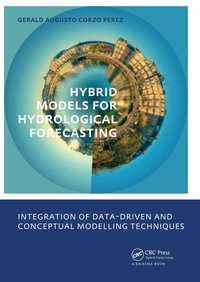
Hybrid models for Hydrological Forecasting: integration of data-driven and conceptual modelling techniques
Description

This book presents the investigation of possibilities and different architectures of integrating hydrological knowledge and conceptual models with data-driven models for the purpose of hydrological flow forecasting. Models resulting from such integration are referred to as hybrid models. The book addresses the following specific topics:
A classification of different hybrid modelling approaches in the context of flow forecasting.
The methodological development and application of modular models based on clustering and baseflow empirical formulations.
The integration of hydrological conceptual models with neural network error corrector models and the use of committee models for daily streamflow forecasting.
The application of modular modelling and fuzzy committee models to the problem of downscaling weather information for hydrological forecasting.
The results of this research show the increased forecasting accuracy when modular models, which integrate conceptual and data-driven models, are considered. Committee machine modelling show to be able to manage increased lead time with an acceptable accuracy.
More details
Other editions
Additional editions
Person
Gerald Corzo received his degree of civil engineering from the Escuela Colombian de Ingenieria, Faculty of Engineering (Bogotá, Colombia). He joined the Universidad Francisco de Paula Santander (UFPS), as a lecturer in Mathematics and Statistics (2000-2003). After graduating with the highest degree in his course he moved to Bogotá and served as lecturer in different universities. In October 2003 he moved to Delft in the Netherlands, there he joined the Hydroinformatics Master program at the UNESCO-IHE Institute for Water Education. He was awarded Master of Science in May 2005. His work explored the use of rule-based modelling and Committee of data-driven models in hydrological forecasting. In his thesis he showed a modular scheme approaching the incorporation of hydrological knowledge in a committee model. He continued with his work in the Phd, where he extended the analysis of artificial intelligence methods applied to hydrological phenomena.
