

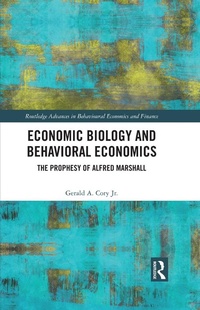
Economic Biology and Behavioral Economics
The Prophesy of Alfred Marshall
1st Edition
Published on 30. December 2022
198 pages
978-1-000-68309-7 (ISBN)
Description

Economic Biology and Behavioral Economics: The Prophesy of Alfred Marshall explores the prophesy of Alfred Marshall, the grand synthesizer of neoclassical economics, that the "Mecca of the economist lies in economic biology".
The book presents the proof of that prophesy through examination and establishment of the fundamental biological science necessary and then applying that science to the examination of current economic theory. In doing so, the book focuses primarily on the fundamentals of neoclassical economic theory- which is the reigning theory and the general framework of which is taught as "science" in first courses in college economics. These courses are at best an idealization, if not an ideology, of the discipline-presented to fresh minds misleadingly as confirmed science. The book examines the bases and the history of these idealizations, points to the sources of their error from the biological perspective and suggests a path forward for the discipline. Through this process, the book demonstrates the power of the biological perspective anticipated by Marshall.
This book provides invaluable reading for anyone interested in the future of economics and economic theory, and particularly those interested in behavioral economics and neuroeconomics.
The book presents the proof of that prophesy through examination and establishment of the fundamental biological science necessary and then applying that science to the examination of current economic theory. In doing so, the book focuses primarily on the fundamentals of neoclassical economic theory- which is the reigning theory and the general framework of which is taught as "science" in first courses in college economics. These courses are at best an idealization, if not an ideology, of the discipline-presented to fresh minds misleadingly as confirmed science. The book examines the bases and the history of these idealizations, points to the sources of their error from the biological perspective and suggests a path forward for the discipline. Through this process, the book demonstrates the power of the biological perspective anticipated by Marshall.
This book provides invaluable reading for anyone interested in the future of economics and economic theory, and particularly those interested in behavioral economics and neuroeconomics.
More details
Series
Edition
1. Auflage
Language
English
Place of publication
London
United Kingdom
Publishing group
Taylor & Francis Ltd
Target group
College/higher education
Professional and scholarly
Illustrations
10 Line drawings, black and white; 10 Illustrations, black and white
ISBN-13
978-1-000-68309-7 (9781000683097)
Copyright in bibliographic data and cover images is held by Nielsen Book Services Limited or by the publishers or by their respective licensors: all rights reserved.
Schweitzer Classification
Other editions
Additional editions
Book
10/2024
1st Edition
Routledge
€61.80
Shipment within 10-20 days
Book
12/2022
1st Edition
Routledge
€185.80
Shipment within 10-20 days
Person
Gerald A. Cory, Jr., Former Senior Fellow, Graduate Studies and Research, San Jose State University (Retired)
Content
Chapter 1: Introduction Part 1: The Biological Fundamentals Chapter 2: Foundations: Evolutionary Brain Science in the 21st Century Chapter 3: Our Mammalian Heritage: A Dual Motive Neurobehavioural Model Chapter 4: The Dynamic Algorithms of Social Behaviour Chapter 5: The Physiology of Social Behaviour
Chapter 6: The Organic, Homeostatic Equation of our Neural Architecture Chapter 7: Physics vs. Social Science: Some Differences Part 2: Biological Linkages to the Discipline of Economics Chapter 8: Family, Gift, and Market Chapter 9: Adam Smith and the Market Chapter 10: The Invisible Hand as a Neural Algorithm Chapter 11: General Equilibrium Theory: From Newtonian Physics to Organic Dynamics Chapter 12: The Social Brain and the Idealized Version of Price Theory Chapter 13: Calculus and Neural Algorithms in Price Theory Chapter 14: Further Application of the Basic Homeostatic Equation to Economics Chapter 15: Self-Interest and the Fallacy of Self-Reference Chapter 16: Hayek: Wishful Thinking and a not so Spontaneous Order Chapter 17: Nash: Modeling Equilibrium with Beautiful Mind, Beautiful Equations Part 3: The Wider Context Chapter 18: The Emergence and Promise of Neuroeconomics Chapter 19: The Larger Context: The Stiff Upper Lip, Original Sin, and Western Science Chapter 20: Evolutionary Neuroethology and Inclusive Fitness Chapter 21: Social Exchange and the Structure of Society Chapter 22: Conclusion
Chapter 6: The Organic, Homeostatic Equation of our Neural Architecture Chapter 7: Physics vs. Social Science: Some Differences Part 2: Biological Linkages to the Discipline of Economics Chapter 8: Family, Gift, and Market Chapter 9: Adam Smith and the Market Chapter 10: The Invisible Hand as a Neural Algorithm Chapter 11: General Equilibrium Theory: From Newtonian Physics to Organic Dynamics Chapter 12: The Social Brain and the Idealized Version of Price Theory Chapter 13: Calculus and Neural Algorithms in Price Theory Chapter 14: Further Application of the Basic Homeostatic Equation to Economics Chapter 15: Self-Interest and the Fallacy of Self-Reference Chapter 16: Hayek: Wishful Thinking and a not so Spontaneous Order Chapter 17: Nash: Modeling Equilibrium with Beautiful Mind, Beautiful Equations Part 3: The Wider Context Chapter 18: The Emergence and Promise of Neuroeconomics Chapter 19: The Larger Context: The Stiff Upper Lip, Original Sin, and Western Science Chapter 20: Evolutionary Neuroethology and Inclusive Fitness Chapter 21: Social Exchange and the Structure of Society Chapter 22: Conclusion
