

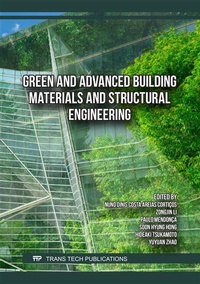
Green and Advanced Building Materials and Structural Engineering
Published on 15. December 2023
168 pages
978-3-0364-1485-0 (ISBN)
Description

The special issue contains articles that reflect the modern level of research and development in the area of materials and technologies in modern construction and will be useful to specialists in the construction industry.
More details
Series
Language
English
Place of publication
Zurich
Switzerland
Target group
Professional and scholarly
Illustrations
Illustrations
File size
24,98 MB
ISBN-13
978-3-0364-1485-0 (9783036414850)
DOI
10.4028/b-8NfqKF
Copyright in bibliographic data and cover images is held by Nielsen Book Services Limited or by the publishers or by their respective licensors: all rights reserved.
Schweitzer Classification
Other editions
Additional editions

Nuno Dinis Costa Areias Corticos | Zongjin Li | Paulo Mendonca
Green and Advanced Building Materials and Structural Engineering
Book
12/2023
Trans Tech Publications Ltd
€129.99
Shipment within 10-20 days
Content
Preface
Chapter 1: Green Building Materials
Evaluation of the Thermomechanical Response of Geopolymeric Mortars Manufactured from Peruvian Mining Residues and its Comparison with Portland Cement Mortars
X-Ray Diffraction Comparison Study of Binders Derived from Pure C3S and Portland Cement Paste
Performance of Metakaolin-Based Geopolymer Incorporating Recycled Plastic Aggregate
Mechanical Evaluation of Geopolymer Mortars Derived from Gold Mining Tailings under Differents Atmospheres
Development of Ultra-High Performance Geopolymer Concrete Containing Recycled Fine Aggregate Replacement
Effect of Ground Granulated Blast-Furnace Slag on the Bond Strength of Recycled Aggregate Concrete
Crumb Rubber in Alkaline Activated Clay Roof Tiles at Low Temperature
Tensile Strength Determination for Rice Husk Ash and Corn Cob Ash Blended Cement Concrete
Effectiveness of Carbide Lime Waste as CO2 Capturing Materials of Mortar at Early CO2 Curing Age
Chapter 2: Advanced Building Materials
Impacts of Abnormal Nanoindentation Points on Micromechanical Properties and Content of Phase in Hydrated Cement Paste
ETFE Characteristics in Architecture: The Case of Large-Scale Construction Project
Research on the Proportion and Strength of Joint Filler Materials for External Wall Tiles
Chapter 3: Applied and Structural Mechanics
Adaptational Response of Individual Trabeculae Morphology to Loading at Different Directions
Static and Fatigue Mechanical Properties of Polymer Matrix Composite Rods
Application of a Custom Fe Simulation Technique for the Analysis of Hybrid Double-Cover Butt Joints
Damage Localization in Plate Structures Based on Baseline-Free Method of Lamb Wave Using Mobile Transducer Set
Continuum Mechanics Models for Describing the Creep and Physical Aging Behaviors of Laminated Composites
Chapter 4: Materials and Structures in Geotechnical Engineering
Basic Study on Applicability to Artificial Barriers for Radioactive Waste Disposal Facility for Various Zeolites
Functionally Graded Concrete: Structural Design and Effect on Sustainability Parameters
Effect of Grain Size Distribution on Shear Strength Characteristic of Random Fill Material at Keureuto Dam, Indonesia
Chapter 1: Green Building Materials
Evaluation of the Thermomechanical Response of Geopolymeric Mortars Manufactured from Peruvian Mining Residues and its Comparison with Portland Cement Mortars
X-Ray Diffraction Comparison Study of Binders Derived from Pure C3S and Portland Cement Paste
Performance of Metakaolin-Based Geopolymer Incorporating Recycled Plastic Aggregate
Mechanical Evaluation of Geopolymer Mortars Derived from Gold Mining Tailings under Differents Atmospheres
Development of Ultra-High Performance Geopolymer Concrete Containing Recycled Fine Aggregate Replacement
Effect of Ground Granulated Blast-Furnace Slag on the Bond Strength of Recycled Aggregate Concrete
Crumb Rubber in Alkaline Activated Clay Roof Tiles at Low Temperature
Tensile Strength Determination for Rice Husk Ash and Corn Cob Ash Blended Cement Concrete
Effectiveness of Carbide Lime Waste as CO2 Capturing Materials of Mortar at Early CO2 Curing Age
Chapter 2: Advanced Building Materials
Impacts of Abnormal Nanoindentation Points on Micromechanical Properties and Content of Phase in Hydrated Cement Paste
ETFE Characteristics in Architecture: The Case of Large-Scale Construction Project
Research on the Proportion and Strength of Joint Filler Materials for External Wall Tiles
Chapter 3: Applied and Structural Mechanics
Adaptational Response of Individual Trabeculae Morphology to Loading at Different Directions
Static and Fatigue Mechanical Properties of Polymer Matrix Composite Rods
Application of a Custom Fe Simulation Technique for the Analysis of Hybrid Double-Cover Butt Joints
Damage Localization in Plate Structures Based on Baseline-Free Method of Lamb Wave Using Mobile Transducer Set
Continuum Mechanics Models for Describing the Creep and Physical Aging Behaviors of Laminated Composites
Chapter 4: Materials and Structures in Geotechnical Engineering
Basic Study on Applicability to Artificial Barriers for Radioactive Waste Disposal Facility for Various Zeolites
Functionally Graded Concrete: Structural Design and Effect on Sustainability Parameters
Effect of Grain Size Distribution on Shear Strength Characteristic of Random Fill Material at Keureuto Dam, Indonesia
