

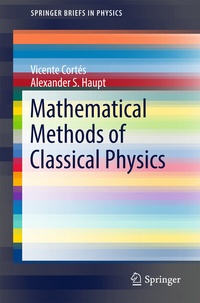
Mathematical Methods of Classical Physics
Published on 26. April 2017
XI, 99 pages
978-3-319-56463-0 (ISBN)
Description

This short primer, geared towards students with a strong interest in mathematically rigorous approaches, introduces the essentials of classical physics, briefly points out its place in the history of physics and its relation to modern physics, and explains what benefits can be gained from a mathematical perspective.
As a starting point, Newtonian mechanics is introduced and its limitations are discussed. This leads to and motivates the study of different formulations of classical mechanics, such as Lagrangian and Hamiltonian mechanics, which are the subjects of later chapters.
In the second part, a chapter on classical field theories introduces more advanced material. Numerous exercises are collected in the appendix.
As a starting point, Newtonian mechanics is introduced and its limitations are discussed. This leads to and motivates the study of different formulations of classical mechanics, such as Lagrangian and Hamiltonian mechanics, which are the subjects of later chapters.
In the second part, a chapter on classical field theories introduces more advanced material. Numerous exercises are collected in the appendix.
Reviews / Votes
"This book is mainly addressed to mathematicians. . with this book you learn how to (re)formulate physics in a new perspective, in terms of differential geometry, and in a more rigorous way. . this is a very good book for students in an advanced course in mathematical physics, but also a good reference book for researchers interested in the subject." (Giuseppe Nardelli, Mathematical Reviews, November, 2017)More details
Other editions
Additional editions
Vicente Cortés | Alexander S. Haupt
Mathematical Methods of Classical Physics
Book
05/2017
Springer
€58.84
Shipment within 10-15 days
Content
Introduction.- Lagrangian mechanics.- Hamiltonian mechanics.- Hamilton-Jacobi theory.- Classical field theory.- Exercises.- References.- Index.
