

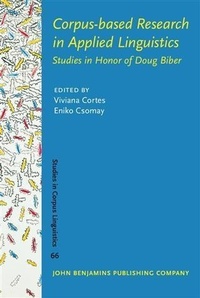
Corpus-based Research in Applied Linguistics
Studies in Honor of Doug Biber
1st Edition
Published on 14. January 2015
XIX, 219 pages
978-90-272-6905-8 (ISBN)
Description

This volume comprises nine contributions that were written by up-and-coming corpus-based researchers with varied areas of expertise, who were all disciples of Douglas Biber sometime in the past two decades. These papers cover a wide variety of linguistic analyses and describe the principles of the Flagstaff school: a careful procedure for language corpora collection with special consideration for corpus size, representativeness, sampling and systematic analysis; the use of computer programming abilities that allow the posing of corpus-based research questions never asked before; and a strong emphasis on the combination of quantitative methods based on sound and innovative statistical procedures complemented with comprehensive qualitative functional analyses of the language. This volume has been edited in honor of Douglas Biber, a pioneer of the American school of corpus-based research.
More details
Other editions
Additional editions
Viviana Cortes | Eniko Csomay
Corpus-based Research in Applied Linguistics
Studies in Honor of Doug Biber
Book
01/2015
John Benjamins Publishing Co
€95.40
Shipment within 10-15 days
Persons
Content
- Intro
- Table of content
- List of contributors
- Forword
- References
- Douglas Biber and the Flagstaff School of Corpus Research
- References
- A corpus-based analysis of linguistic variation in teacher and student presentations in university settings
- 1. Background
- 1.1 Previous corpus-based studies on student language in the academia
- 1.2 Situational characteristics of the academic presentations
- 1.3 Comprehensive descriptions of linguistic variation in texts
- 1.4 Outline of the present study
- 2. Methodology
- 2.1 Corpus
- 2.2 Definitions and unit of analysis
- 2.3 Linguistic features on four dimensions of academic language use
- 2.4 Analytical procedures
- 2.4.1 Counts and statistical procedures
- 3. Findings
- 3.1 General patterns
- 3.1.1 Oral vs. Literate Discourse
- 3.1.2 Procedural vs. Content-focused Discourse
- 3.1.3 Reconstructed account of events
- 3.1.4 Teacher-centered Stance
- 3.2 Summary
- 4. Conclusion and implications
- References
- Appendix A
- Appendix B
- Telephone interactions
- 1. Introduction
- 1.1 The focus of this chapter
- 1.2 Multi-feature, multidimensional analytical framework
- 1.3 Friginal's (2008) dimensions of call center interactions
- 2. Method
- 2.1 Corpora
- 2.2 Call center corpus
- 2.3 Call Home corpus
- 2.4 Switchboard corpus
- 2.5 American English (AmE) Conversation corpus
- 2.6 Computing dimension scores
- 3. Results
- 3.1 Dimension 1: Addressee-focused, polite, and elaborated information vs. Involved and simplified narrative
- 3.2 Dimension 2: Planned, procedural talk
- 3.3 Dimension 3: Managed information flow
- 4. Summary and discussion
- 5. Conclusion
- References
- On the complexity of academic writing
- 1. Introduction
- 1.1 Discourse complexity in written academic language
- 1.2 Purpose and overview of the current study
- 2. Notions of complexity: A framework of clausal elaboration versus phrasal compression
- 3. Disciplinary variation in academic writing
- 4. Methods
- 4.1 The corpus
- 4.2 Analytical tools and procedures
- 5. Elaboration and compression across disciplines
- 5.1 Clausal elaboration
- 5.2 Phrasal compression: Complex noun phrases
- 5.3 Clausal modifiers within the noun phrase
- 6. Summary: Overall patterns of elaboration and compression
- 7. Conclusion and future directions
- References
- Telling by omission
- 1. Introduction
- 2. Corpus, methodology, and data analysis
- 3. Results and discussion
- 3.1 Modal usage
- 3.2 Lexical markers of positive evaluation
- 3.3 Common frames in mitigating the negative
- 3.3.1 Frame I
- 3.3.2 Frame II
- 3.3.3 Frame III
- 3.3.4 Frame IV
- 3.3.5 Frame V
- 4. Conclusion
- References
- Corpora, context, and language teachers
- 1. Introduction
- 2. Background
- 2.1 Corpus data and context
- 2.2 Learner corpora and context
- 2.3 Corpora, teachers, and pedagogical applications
- 3. The ULCAE project: A case study
- 3.1 The local context
- 4. Rationale for the ULCAE project
- 5. Designing and building the corpus
- 6. Teacher involvement
- 6.1 Information and planning sessions for and with teachers
- 6.1.1 Information sessions
- 6.1.2 Planning sessions
- 6.1.3 Research-oriented sessions
- 6.2 Hands-on corpus-oriented workshops
- 6.2.1 Text processing
- 6.2.2 Concordance software
- 6.2.3 Formulating research questions
- 6.3 Project progress reports
- 7. Benefits of promoting teacher involvement
- 7.1 Teachers' roles and levels of involvement
- 7.2 Defining areas to explore
- 7.3 Interpreting corpus-based information
- 7.4 Evaluating the curriculum
- 8. Final remarks
- References
- The challenge of constructing a corpus-based analysis of introductory psychology textbooks
- 1. Introduction
- 2. Review of the literature
- 2.1 Corpus representativeness
- 2.1.1 Domain topic coverage
- 2.1.2 Domain text type/register coverage
- 2.1.3 Quality/relevance of texts sampled
- 2.1.4 Corpus size
- 2.1.5 Additional considerations
- 2.2 What evidence for representativeness is missing?
- 2.3 The current study
- 3. Methodology
- 3.1 The undergraduate introductory psychology textbook (PSYTB) corpus
- 3.2 Procedures
- 3.2.1 Vocabulary analysis program
- 3.2.2 The analyses
- 4. Results
- 5. Discussion of findings
- 5.1 Size may not be the whole story
- 5.2 Word list users must understand what word lists are and what they are not
- 6. Conclusion
- References
- Corpus linguistics and New Englishes
- 1. Introduction
- 1.1 Corpus linguistics and the study of New Englishes
- 1.2 English in India
- 1.3 Aims of the present study
- 2. Methodology
- 2.1 Corpus design: The corpus of contemporary Indian English
- 2.2 Combining CCIE with ICE-India
- 2.3 Features analyzed in current study
- 2.3.1 Absence of subject-auxiliary inversion in WH-question formation
- 2.3.2 Circumstance adverbials also and only
- 3. Results
- 3.1 Results on position of circumstance adverbials in initial, medial, final positions
- 3.1.1 Also
- 3.1.2 Only
- 3.2 Circumstance adverbials and focus
- 3.2.1 "Also" and focus
- 3.2.2 "Only" and Focus
- 3.3 WH-questions without subject-auxiliary inversion
- 4. Discussion
- 5. Conclusion and implications for future research
- References
- Investigating textual borrowing in academic discourse
- 1. Introduction
- 2. Student textual borrowing
- 3. A corpus-based approach to textual borrowing research
- 4. Developing a corpus-based methodology
- 5. Key findings
- 5.1 Assumption 1: L2 writers copy from source text more frequently than L1 writers
- 5.2 Assumption 2: Students copy from source texts because they do not understand what they are reading
- 5.3 Assumption 3: Students should be taught how to paraphrase so that they can avoid plagiarism
- 6. Directions for future research
- 6.1 Methodologies for the study of textual borrowing
- 6.2 Pedagogic concerns
- References
- Situating lexical bundles in the formulaic language spectrum
- 1. Introduction
- 2. Corpus-based and corpus-driven research methods and the study of formulaic language
- 3. From 2-word collocations to longer recurrent expressions
- 3.1 A brief account of collocations
- 3.2 Extending collocations: Recurrent word combinations
- 4. What lexical bundles are
- 5. What lexical bundles are not
- 6. Lexical bundles: Internal structure
- 7. From structure to function to communicative purposes
- 7.1 Functional taxonomy development
- 7.2 Other taxonomies
- 7.3 From functions to communicative purposes and rhetorical moves in academic prose
- 8. Conclusion
- References
- Index
