

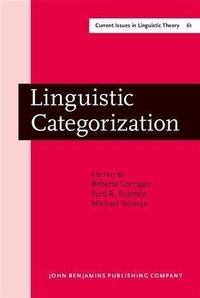
Linguistic Categorization
Proceedings of an International Symposium in Milwaukee, Wisconsin, April 10-11, 1987
1st Edition
Published on 1. January 1989
VIII, 348 pages
978-90-272-7852-4 (ISBN)
Description

This volume contains a selection of the papers presented at the 16th International Symposium at the University of Wisconsin/Milwaukee. Two central question were addressed: What is the nature of the categories that underlie the structure of human language? What is the nature of extralinguistic categories that are reflected in language? These questions are addressed from the perspective of a variety of disciplines, using many different methodologies and focusing on many different aspects of language including morphology, syntax, semantics, phonology and discourse. The volume is divided into 3 sections: prototype effects in language, categorization processes, and cross-linguistic categorization.
More details
Other editions
Additional editions
Roberta Corrigan | Fred Eckman | Michael Noonan
Linguistic Categorization
Proceedings of an International Symposium in Milwaukee, Wisconsin, April 10-11, 1987
Book
01/1989
John Benjamins Publishing Co
€132.50
Shipment within 10-15 days
Persons
Content
- LINGUISTIC CATEGORIZATION
- Editorial page
- Title page
- Copyright page
- Table of contents
- PREFACE
- INTRODUCTION LINGUISTIC AND NON-LINGUISTIC CATEGORIZATION: STRUCTURE AND PROCESS
- 1. The importance of categorization
- 2. Categorization as structure: The nature of cognitive and linguistic categories
- 2.1 Prototype effects in cognition
- 2.2 Prototype effects in language
- 3. Processes operating in categorization
- 3.1 Use of Production Systems
- 3.2 Parallel Distributed Processing
- 4. Language specific categorization
- 5. Summary and conclusions
- Note
- References
- I. PROTOTYPE EFFECTS IN LANGUAGE
- A LEXICAL MODEL OF COLOR SPACE
- 1. The testing
- 1.1 Four unlabelled categories
- 1.2 Red-green-yellow-blue
- 1.3 Red-purple-yellow-blue
- 1.4 Red-orange-yellow-blue
- 1.5 Three unlabelled categories
- 1.6 Red-yellow-blue
- 1.7 Red-green-blue (no yellow)
- 1.8 Red-yellow-green (no blue)
- 1.9 Green-Yellow-Blue (no Red)
- 1.10 Orange-yellow-blue
- 1.11 Red-orange-blue
- 1.12 Red-yellow-orange
- 1.13 Purple-yellow-blue
- 1.14 Red-yellow-purple
- 1.15 Red-purple-blue
- 2. A new model
- 3. Maximal perceptual distance
- Note
- References
- PRELIMINARIES TO A THEORY OF PHONOLOGICAL SUBSTANCE: THE SUBSTANCE OF SONORITY.
- 1. General introduction
- 1.1 Sonority, syllables and other notions
- 1.2 History
- 1.3 The difficulty in defining sonority
- 1.4 Sonority as a prototype category
- 2. Fundamental properties of sonority
- 2.1 Vocalicity/Svara
- 2.2 Voicing
- 2.3 Loudness
- 2.4 Prolongability
- 2.5 Openness
- 3. On the nature of margins - 'antisonority'
- 3.1 The sonority 'slope'
- 3.2 Consonantality
- 3.3 Closure
- 3.4 Silence and hiss
- 4. Sonority and prototypicality
- 5. Individual language analyses
- 5.1 The nature of Greek and Latin onsets
- 5.2 Vowel systems
- 6. Conclusions
- Notes
- References
- CATEGORIZING PHONOLOGICAL SEGMENTS: THE INADEQUACY OF THE SONORITY HIERARCHY
- Notes
- References
- EXPERIMENTALEVIDENCE FOR SYLLABLE-INTERNAL STRUCTURE
- Notes
- References
- PHONOLOGICAL CATEGORIES AND CONSTITUENTS
- References
- ARE THEMATIC RELATIONS DISCRETE?
- 1. Derived nominals
- 1.1 English two-argument nominals
- 1.2 Single argument transitive nominals
- 1.3 Polish derived nominals
- 2. Polish reflexive verbs
- 3. Polish impersonal constructions
- 4. Binding of anaphors in experiential constructions
- 5. Feature based thematic system
- 5.1 The choice of features
- 5.2 Action vs. emotion
- Notes
- References
- CATEGORY RESTRICTIONS IN MARKEDNESS RELATIONS
- Introduction
- 1. Markedness principles and categorial uniformity
- 1.1 Markedness-distribution principle
- 1.2 Hypothesis of differential communicative value
- 1.3 Markedness constraint
- 1.4 Markedness and language acquisition
- 2. Categorial minimality
- 3. Formal and functional minimality
- Notes
- References
- THE ACQUISITION OF THE PAST PARTICIPLE: DISCOURSE-BASED VS. FORM-BASED CATEGORIES
- 1. Methods
- 2. Results
- 3. Discussion
- Notes
- References
- II. CATEGORIZATION PROCESSES
- CATEGORY LEARNING IN A CONNECTIONIST MODEL: LEARNING TO DECLINE THEGERMAN DEFINITE ARTICLE
- 1. Cue learning and cue competition
- 2. Paradigm formation
- 3. Learning in a connectionist architecture
- 4. Simulation I
- 4.1 The training set
- 5. Results for training set items in Simulation I
- 5. Results for training set items in Simulation I
- 5.1 Generalizing the paradigm to old nouns in new contexts
- 5.2 Generalizing the paradigm to new nouns
- 5.3 Comparison to the developmental literature
- 6. Simulation II
- 6.1 Basic results
- 6.2 The impact of cue validity on internal representations
- 6.3 The impact of cue validity on new words
- 7. Discussion
- 7.1 Rules vs. networks
- 7.2 The model and the developmental data
- 7.3 The role of lexical items
- 7.4 Directions for future research
- Acknowledgement
- Notes
- References
- COMPETITION AND LEXICAL CATEGORIZATION
- 1. Word meaning
- 1.1 Competition between meanings
- 1.2 Competition and cooperation
- 1.3 Locative prepositions - an example
- 1.4 Semantic range and change
- 1.5 Non-semantic cues
- 2. The development of word meaning
- 2.1 Concept formation
- 2.2 Episodic encoding
- 2.3 Segmentation
- 2.4 Cue extraction
- 2.5 Acquiring superordinates
- 3. Polysemy and homonymy
- 3.1 Polysemic topography
- 3.2 Syntactic polysemy
- 3.3 Resolving non-syntactic polysemy
- 3.4 Anaphora as polysemy
- 4. Pushy polysemy
- 4.1 Pushing occurs over valence bridges
- 4.2 Reciprocality
- 4.3 Extension and conversion
- 4.4 Extensional pathways and PDP
- 5. Grammatical entanglement
- 5.1 An example from Hungarian
- 5.2 Extension and reinterpretation
- 6. Summary
- References
- III. CROSS-LINGUISTIC CATEGORIZATION
- A DISCOURSE APPROACH TO THE CROSS-LINGUISTIC CATEGORY 'ADJECTIVE
- 1. Introduction
- 2. Dixon's survey
- 3. Time stability
- 4. A discourse explanation
- 5. Conclusions
- Appendix Criteria for determining noun-like or verb-like tendencies for property concept words
- Notes
- References
- PRONOMINALITY: A NOUN-PRONOUN CONTINUUM
- 1. Introduction
- 2. Lexical entries
- 3. Morphological properties
- 4. Semantic properties
- 5. Implicational properties
- 6. Referential properties
- 6.1 Grammatical persons
- 6.2 Grammatical number
- 7. Syntactic properties
- 7.1 Case positions
- 7.2 Co-occurrence properties
- 8. Interpretive conditions
- 9. Summary
- Notes
- References
- ON HUMBOLDT ON THE DUAL
- 1. Humboldt's gift
- 2. Extensions
- 3. Notions
- 4. Conceptions
- 5. Dual motivation
- 6. Humboldts dilemma
- Notes
- References
- AUTHOR INDEX
- LANGUAGE INDEX
- SUBJECT INDEX
