

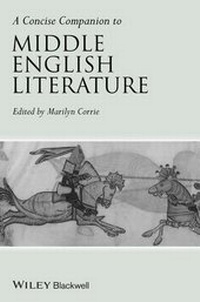
A Concise Companion to Middle English Literature
Description

Reviews / Votes
"This new concise companion engages with the difficulties of periodization but nonetheless asserts that there is a scholarly volue to considering 'Middle English Literature' as a discrete body of texts, written between c.1100 and c.1500. And indeed, this wonderfully erudite and readable volume proves this point." (Notes and Queries, 1 June 2011) "All of the essays examine canonical writers and texts but also discuss writers and works that are infrequently taught in traditional undergraduate (or even graduate) survey courses, and this is an encouraging move." (CHOICE, 2009)More details
Other editions
Additional editions
Person
Content
Chapter 1
Signs and Symbols
Barry Windeatt
Omnis mundi creatura
quasi liber et pictura
nobis est in speculum;
nostrae vitae, nostrae mortis,
nostri status, nostrae sortis
fidele signaculum.
(Alan of Lille, ed. Raby 1959: 369)
[All creation, like a book or a picture, is a mirror to us – a true figure of our life, our death, our condition, our lot.]
To the medieval mind symbolic significance might be read into almost anything, when all creation was a mirror, figure and script that pointed beyond itself, reminding of an otherworldly dimension that offered the only true and abiding perspective. In the variety of his works the fifteenth-century Scottish poet Robert Henryson can represent – by way of introduction to this chapter – the sheer range of uses of signs and symbols in medieval writings. His Garmont of Gud Ladeis reads moral conduct in terms of the symbolism of female attire, and in his Testament of Cresseid the disfiguring leprosy that punishes Cresseid for defiance of the gods draws on traditions that see sickness as an outward sign of inner moral condition. In his Orpheus and Eurydice Henryson plays his own variations on medieval traditions of moralizing classical mythology to expound a Christian moral. Here the hero and heroine symbolize intellect and desire respectively: when Eurydice flees through a May meadow from a would-be rapist shepherd, is stung by a venomous serpent and is summoned to hell, she flees from ‘good vertew’ (perhaps surprisingly to the modern reader) through the world’s vain delights, and so descends into hell through excess of care for worldly things. Henryson’s Fables include the grimly schematic symbolism of ‘The Paddock and the Mouse’, where a mouse (man’s soul), in seeking to cross a river (the world) to reach better things, has no option but to be tied to a frog (man’s body) that tries to drag her under and drown her, before both are seized by a kite (sudden death). Yet Henryson’s interpretations may also signify challengingly, as in ‘The Cock and the Jasp’, where a cock finds a jewel (which betokens perfect wisdom and knowledge) but hankers instead for something edible (sensibly enough, for a chicken?) – only to be roundly condemned as an ignoramus on the basis of the otherworldly perspective that unifies the medieval reading of signs.
Sign Systems
You can make a cross on the meal-table out of five bread-crumbs; but do not let anyone see this, except your wife….
(Instructions for a Devout and Literate Layman, trans. Pantin 1976: 398–422)
As St Augustine had remarked in De doctrina Christiana (‘On Christian Teaching’), ‘A sign is a thing which of itself makes some other thing come to mind, besides the impression it presents to the senses’ (trans. Green 1997: 31). In the Middle Ages, the natural world, the human body, or society and its constructions all had their symbolism and were full of signs to be interpreted. Most human experience could be read as symbolic: the successive ages of man; the powers or defects of the senses (vision or blindness, deafness, sweetness); the sleep of sin; illness, medicine and healing, which were seen as signs of moral failing and regeneration. Conduct was often evaluated symbolically in terms of conflicts between vices and virtues (personified in morality plays and innumerable allegories). As for the natural world, there was a long tradition of ‘bestiaries’, illustrated texts that expounded the moral symbolism discerned in the behaviour of animals and birds, as one preacher explains:
The Lord created different creatures with different natures not only for the sustenance of men, but also for their instruction, so that through the same creature we may contemplate not only what may be useful for the body, but also what may be useful in the soul … For there is no creature … in which we may not contemplate some property belonging to it which may lead us to imitate God or … to flee from the Devil. For the whole world is full of different creatures, like a manuscript full of different letters and sentences, in which we can read whatever we ought to imitate or flee from …
(Thomas of Chobham (d. 1236?), Summa de arte praedicandi (‘Manual of the Art of Preaching’) (ed. Morenzoni 1988: 275))
The symbolism in plants, flowers, herbs and trees (and by extension in gardens and springs, and the character of the seasons) was also the focus of moralizing interpretations, while a science of astrological signs decoded the stars, and, as in Henryson’s Orpheus and Eurydice, the ingenuity of medieval mythography read Christian symbolism into classical mythology. Analysed in texts called ‘lapidaries’, precious stones were credited with powers of healing and safeguarding, and gained symbolic meanings, as did both colours and also numbers, the subject of elaborate numerological symbolism (on all of which traditions the Gawain-poet draws). With their colours and gems, medieval clothes and jewellery, and above all ecclesiastical vestments, made symbolic statements, as did such accoutrements as armour and weapons. Heraldry developed a sophisticated lexicon of signs and signatures of kinship and descent. The regalia of kingship – crown, orb and sceptre – were replete with a symbolism of authority invested by coronation ritual, the most solemn amongst a system of symbolically charged ceremonies that included swearing of homage, and the dubbing and arming of knights, as also the observances and insignia of chivalric orders and the conduct of tournaments. In grander households some principal pastimes – hunting, jousting, feasting, dancing – were invested with symbolism, as were games and gift-giving, and all inform romance literature with its symbolic testings and questings. The quest draws meaning from a larger symbolism of movement and space: symbolic readings of journeys, and of the way taken, are especially resonant in the concept of the pilgrimage, as in romance, while architecture interprets built space in symbolic terms, in secular as well as ecclesiastical contexts.
Symbolism remained readable at different levels of understanding, education and literacy. Written explanations were provided even for medieval viewers of the ‘typological’ schemes of stained glass at Canterbury Cathedral, in which certain Old Testament episodes (‘types’) are read as prefigurations of New Testament episodes (‘anti-types’), and hence as signs that each episode in Christ’s life fulfils a divinely ordained pattern (Michael 2004: 13, 25; see also Henry, ed., 1987). Since Jonah’s three days in a whale’s belly were understood to prefigure Christ’s three days in the tomb (Matthew 12:40), Jonah’s being spewed up by the whale offered a memorable symbol of Christ’s resurrection, as did Samson’s carrying off the gates of Gaza where he was captured and imprisoned (while visiting a prostitute, but typology often seized on parallels regardless of context). In The Tale of Beryn – a fifteenth-century sequel to The Canterbury Tales in which the pilgrims reach Canterbury – lower-class pilgrims ‘counterfeting gentilmen’ try interpreting images in the cathedral windows and squabble ignorantly over their significance (ed. Bowers 1992: 64). However baffled they appear, these humble pilgrims’ conviction of symbolic meanings to be discovered reflects the wider typological awareness mirrored in the structure of mystery play cycles and throughout medieval visual culture.
Signs are for remembering: symbolism might prompt devout memorization by organizing knowledge, through pattern and tabulation, of core tenets of faith and cues for devotional observance, with no sign more central than Christ’s body. Analysis of sins and virtues might be set out in the form of diagrammatic trees or wheels or other visual mnemonics. Always there is the structure lent by numerical pattern: the seven sacraments, seven works of mercy, seven deadly sins; Mary’s joys and sorrows (variously, five, seven or fifteen); and Christ’s five wounds, object of a fragmenting devotional attention that disassembled Christ’s body into fetishized parts for veneration, focusing on separate images of wounded hands, feet and gaping side. Henry VI’s confessor records how the king
made a rule that a certain dish which represented the five wounds of Christ, as it were red with blood, should be set on his table by his almoner before any other course when he was to take refreshment; and contemplating these images with great fervour he thanked God marvellously devoutly.
(trans. James 1919: 35)
The wounds become the ‘Arma Christi’, or ‘Arms of Christ’, quasiheraldic badges of pain and shame ironically signifying glory, sacred insignia often conjoined with the ‘Instruments of the Passion’ – the emblematic objects and implements of torture that, by a kind of visual shorthand, prompt devout memories to recall man’s ingratitude to Christ. Blazoned on bench-ends, screens, roof-bosses, in wall-paintings and external decoration, images of the Wounds and Instruments might be displayed dispersedly throughout churches. ‘His body hanging on the cross is a book open for your perusal’, declares a fourteenth-century contemplative, the Monk of Farne, likening Christ’s body to a text, and for a...
