

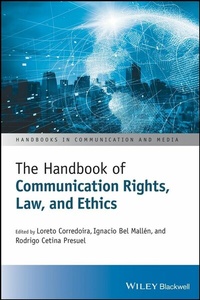
The Handbook of Communication Rights, Law, and Ethics
Description

The Handbook of Communication Rights, Law, and Ethics delivers an extensive review of the challenges facing modern communication rights. It offers readers an examination of the interplay between communication law and ethics and the role played by communication professionals in protecting individuals' rights to communication.
Distinguished authors Loreto Corredoira, Ignacio Bel Mallén and Rodrigo Cetina Presuel walk readers through the fundamental ideas and concepts that represent universal common ground regarding communication rights. They compare communication rights theories developed in Europe, the United States, Latin America, Australia, and East Asia to describe how communication-related freedoms and rights are formulated and applied around the world. Finally, the meaning of the phrases "freedom of expression" and "freedom of the press" are examined in the context of national constitutions and international human rights instruments.The Handbook of Communication Rights, Law, and Ethics provides readers with:
* A diverse, global perspective on how communication rights are protected and challenged around the world
* A universal vision of communication rights that encourages dialogue rather than confrontation
* A comparison of the American First Amendment of the Constitution with European communication rights theories and other legal traditions around the world
* An exploration of the frontiers of communication rights concepts, terminology, jurisdiction, and territoriality
Perfect for professors, graduate students, doctoral students, and postdoctoral researchers studying communication rights and freedom of expression around the world, The Handbook of Communication Rights, Law, and Ethics also belongs on the bookshelves of researchers studying issues surrounding freedom of the press in North America, Europe, and Latin America.
More details
Other editions
Additional editions
Persons
Loreto Corredoira is Professor of Communication Law at Complutense University in the School of Communication and Jean Monnet Chair in Audiovisual Media Heritage. She is co-Principal Investigator of the R&D Project Guarantees against disinformation in electoral processes. Cibersecurity and other information disorders in Social Network which has studied Cyberlaw in Spain since 1998.
Ignacio Bel is Professor of Communication Law at Complutense University and Professor of Communication Ethics at CEU-San Pablo and the IEB. He is the President of the International Forum of Communication Law and Ethics (FIEDI). He served for 25 years as Director of Communication at the IESE Business School at the University of Navarra in Madrid.
Rodrigo Cetina Presuel is a Researcher at the Institute for Global Law and Policy at Harvard law School where he conducts research about how private entities shape the digital public communication sphere. He is the United States East Coast Ambassador of IAMCR and co-Chair of the IAMCR Law section. He has taught Communication at Lasell University and Emerson College.
Content
Preface viii
Monroe E. Price
Introduction 1
Rodrigo Cetina Presuel and Loreto Corredoira
Part I Communication Rights: Principles 7
1. Freedom as the Essential Basis for Communication Rights 9
Ignacio Bel Mallén
2. Dignity, a Revolutionary Principle in a Cosmopolitan Society 20
Javier Gomá Lanzón
3. Communication Rights in an Internet-Based Society: Why Is the Principle of Universality So Important? 30
Loreto Corredoira
4. Communication Rights in the United Nations System: From Declarations to "Soft Law" 47
Leopoldo Abad Alcalá
5. Universality vs. Standardization: The Privatization of Communication Rights on Social Media 57
Rodrigo Cetina Presuel
6. United States and International Communication Rights Frameworks and the Pursuit of Global Consensus 75
Erik Ugland
Part II Communication Rights: A Study of Subjects and Messages 87
7. Communication Rights and Their Messages: News, Opinions, Ideas, and Advertising 89
Ignacio Bel Mallén
8. Subjects of Communication Rights: A Special Study of Minors 100
Isabel Serrano Maíllo
9. News: Objectivity and Truth 111
Justino Sinova
10. Journalists, Confidentiality, and Sources 121
Lorenzo Cotino Hueso
11. Addressing the Risks of Harms Caused by Disinformation: European vs. US Approaches to Testing the Limits of Dignity and Freedom of Expression Online 135
Divina Frau-Meigs
12. The Law and Ethics of Journalism in a Changing World: New Professional Realities and Challenges for Communication Professionals 147
Fernando Gutiérrez Atala
Part III Studies in Comparative Communication Law 157
13. Data Protection as a Limit to Communication Rights: A General Vision of Data Protection in Europe 159
José Martínez Soria
14. Regulation of Internet Intermediaries and Communication Rights 172
Joan Barata
15. Imperiling Community Memory: The European Right to be Forgotten's Tampering of Search Engine Results 185
Kristie Byrum
16. The Crime of Historical Denialism as a Limit to the Freedom of Expression 195
Germán M. Teruel Lozano
17. Hate Speech in the United States and Abroad: Finding Common Ground 205
Chris Demaske
18. Political Communication and Electoral Campaigns in Europe: The Search for International Standards 217
Rafael Rubio
19. One Servant Cannot Serve Two Masters: A Struggle for Divided Loyalties of Media Regulation in Hong Kong 228
Grace Leung and Richard Wu
20. Latin American Thinking in Communication and Advances in Communication Rights 241
Rolando Guevara-Martínez
21. Media Disorder and the Future of Journalism: International Developments and the Challenge of WikiLeaks 253
Jane Johnston and Anne Wallace
Part IV At the Intersection of Law and Ethics: Challenges in the Age of Algorithms, Disinformation, and Post-Truth 265
22. Public Communication and Sustainability in a Post-Truth Era 267
María José Canel
23. Freedom of Expression in Social Networks and Doxing 279
Pedro Anguita R
24. The Emerging Threat of Synthetic Media: A Consideration of Journalists' Responsibilities 292
Muira Nicollet McCammon
25. Journalism Routines Depend on Clicks: Best Practices for Using Metrics in Journalism 303
Mariza Zapata Vásquez
26. Epilogue 315
Ignacio Bel Mallén and Marisa Aguirre Nieto
Index 319
Preface
Monroe E. Price
I happily accepted the invitation of the editors - Profs. Loreto Corredoira, Ignacio Bel, and Rodrigo Cetina - to introduce this important work. The very occasion of our meeting resonates with the ambition of this book. I met the editors in 2019 at the annual conference of the International Association for Media and Communication Research (IAMCR), an organization long committed to exploring ways to enrich the flow of ideas of communication and society across cultures, across systems, across theoretical approaches. This book is emblematic of what might be called the exploratory spirit of the IAMCR. The collection is designed to underscore communication rights as that idea has flourished within the traditions of the editors and in conversation with competing and complementary ideas developed in other traditions.
The book is timely for many reasons. There is an imperative resulting from the massive transformations in media technology and in the tsunami of change that goes under the name of social media. The world is, and has been for recent decades, a jurisdictional and cultural experimental zone for testing or imposing policy, with the force of circumstances driving governments, civil society, political parties, nongovernmental organizations, and others in conflicting directions, confronting issues of power, impact, and conformity to norms.
Dramatic shifts - in geopolitics, in technology, and in institutions, create a demand for rethinking the relationship between media technologies and freedom. Recourse to first principles and review of historic traditions can, in such a context, lead to new insights. That is the significant effort of this book.
In my own work,1 I have tried to think about alternate ways of characterizing large-scale efforts to shape systems of information flow. "Communication rights" in this approach are nestled in and products of other expansive themes or tendencies. These overall themes are sometimes posed as foundational rights (prescribed, one could find, in the International Covenant of Civil and Political Rights) or constructed through observation of what societies actually do. Examples, from my work, include these actions of major forces in the information space: the shaping of strategic infrastructures for channeling, encouraging, or restricting media flows or the invention and uses of forceful narratives (call them strategic narratives) to affect public behaviors and institutional choices. All this occurs under an umbrella of complex operations that I have described under the term "Markets for Loyalties." How these ideas relate to communications rights or how communications rights flourish under technological and political pressures - this becomes the ongoing challenge.
Strategic Infrastructures
Everywhere about us, we see the material remnants of historic approaches to governing speech and society, and this volume - in its array of authorial backgrounds - manifests a variety of experiences with regulating freedom of expression and communication from different countries around the world. These distributed studies yield a catalogue of techniques used to mobilize, affect, or otherwise regulate and control societies. Technologies change: fax machines in dissident Eastern Europe, audiotapes in revolutionary Iran, flash drives in Cuba, smartphones in Egypt, sophisticated apps in Hong Kong. We aspire to explain how these technical interventions become effective tools for furthering freedoms but sometime become hijacked, melded with surveillance in ways subversive of an original goal. We recognize that it is not the technology alone, but the system design advanced by major communicators that is telling in these instances. Powerful communicators, and those who seek power, advance an infrastructure of information flow that will further their strategic objectives. We have paid too little attention to these broad efforts at global, regional, national, and community structures for information flow and too easily resort to familiar formulae of words to describe them.
Who, one might ask, are the architects of strategic infrastructures? Who sees themselves as empowered to articulate, demand, implement, or force the adoption of particular information infrastructures (or resist them)? These include those who seek a flow of images that reinforces sovereignty; those who wish to ration the import of potentially destabilizing advocacy; those who consider their state to be vulnerable to communal violence. But infrastructure design is also significant for those who advocate a full and free independent marketplace of ideas. Each of the authors in this volume brings to the table, at least, an implicit architecture, an implicit conception of infrastructure.
Those who design satellite systems or cable television systems, who recommend the loci of undersea cable, or transponder regulation are all engaged with strategic infrastructure. Just to reinforce the point, it is not the hardware alone that defines a strategic infrastructure and its freedom-related or control-related potential. Cell-phone towers, surveillance cameras, satellite dishes, and flickering television sets, do not fully tell the story. One needs to know the legal and policy setting. "Freedom" is the combination of the technologies, themselves and the institutions that surround them. And that is true of communications rights generally.
A few examples of information infrastructure that help explain the complex relation to freedom are: the satellite and cable system of Singapore, which permits large-scale access to information necessary for a modern business society, combined with an explicit set of norms and the machinery to enforce them; the now-obsolete Dutch system of allocation of broadcast time to ensure that pluralist values in the society are recognized and performed; and in more modern times, concerns with Internet shut-down capabilities (as in Ethiopia, Cameroon, and Kenya). Ithiel de Sola Pool wrote brilliantly about technologies of freedom,2 but the burden of this approach is that no technology is intrinsically an instrument of freedom. Indeed, some technologies of freedom have had Trojan-horse effects; by design, they have been engines of surveillance and betrayal.
Strategic Narratives
I turn now to what I call strategic narratives, which are increasingly in the tool kit of states and movements as strategic communicators. Strategic narratives include stories a society tells about itself or stories that those outside seek to impose. Strategic narratives are of the same family as propaganda and include how a society is made to think about itself, fully understanding that how a society perceives itself influences what policies it adopts. And "narratives" are a theater in which these positions are honed. Narratives of fear and destabilization, for example, lay the groundwork for more cautious and restrictive regulatory outcomes. Narratives of freedom generally embolden participation and encourage entry.
Who are the manufactures of strategic narratives? On what might be called the positive side, the Freedom Online Coalition is a consortium of states that recognizes the need for a narrative to foster adherence to a relatively strict regime of non intervention in the regulation of social media. They further a narrative of freedom that supports, as it were, a strategic infrastructure. Some powerful states insist on an open social media structure (the strategic infrastructure) and they advance a global narrative that reinforces it. The EU invests in a bedrock narrative that supports its internal strengthening and its capacity to advocate for freedom throughout the member-states and beyond. As is true both for the EU and the Freedom Online Coalition, the capacity to maintain a strategic narrative is itself a matter contested. A final example: Ukraine, in the information conflict with Russia, developed a strategic narrative for domestic and global, as did Russia. These strategic narratives were used to justify uses of law and uses of force to further some voices and restrict others.
The contributions in this volume imply an important point about the political economy of strategic narratives and their relationship to freedom that is worth examining. We must study not only the operation of a single strategic narrative (such as the narrative of the need for free and independent media) but the mix of narratives, their interaction and changing patterns in their production, what might be called, as these techniques become more potent, the cauldron of narratives.
For example, it has been a difficult time for narratives of freedom. In Europe, the idea of "illiberal democracy" has grown, often at the cost of institutions that were constructed precisely to advance pluralism, the rule of law, and independence - basic aspects of freedom. This is mirrored elsewhere, including for example Myanmar, where promising narratives have dimmed. We can see how, the impact of narratives turns, partly on geopolitical trends. China and its Belt and Road Initiative gains a significant narrative focal point, much like the Marshall Plan of the late 1940s and 1950s as it sought to further ideas of democracy and freedom in post war Europe
There has also been a concerted attack on the very engines of narrative that are most supportive of freedom. In the United States, the press - or major elements of it - are characterized as "enemies of the people." In Russia and elsewhere, non local NGOs, often the backbone of civil society and the instruments of freedom, are outlawed and harassed. Similarly, we are...
