

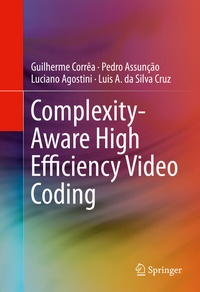
Complexity-Aware High Efficiency Video Coding
Description

More details
Other editions
Additional editions
Persons
Guilherme Corrêa received the B.Sc. degree in computer science from the Federal University of Pelotas (UFPel), Brazil, in 2009; the M.Sc. degree in computer science from the Federal University of Rio Grande do Sul (UFRGS), Brazil, in 2010; and the Ph.D. degree in electrical and computer engineering from the University of Coimbra, Portugal, in 2015. He is currently a postdoctoral researcher with the Group of Architectures and Integrated Circuits (GACI) at the Federal University of Pelotas, where he researches on video coding algorithms, complexity-aware video coding and digital systems design.
Pedro A. Amado Assunção received the Licenciado and M.Sc. degrees in electrical engineering from the University of Coimbra, Portugal, in 1988 and 1993, respectively, and Ph.D. in electronic systems engineering from the University of Essex, UK, in 1998. He is currently a professor of electrical and computerengineering, electronics and multimedia communication systems at the Polytechnic Institute of Leiria and senior researcher at the Instituto de Telecomunicações, Portugal. His current research interests include UHD, multiview and plenoptic video coding, communications and processing, video codec complexity control and adaptation based on user-driven approaches, error concealment and quality assessment.
Luciano Volcan Agostiniis a professor since 2002 at the Federal University of Pelotas (UFPel), Brazil. Since 2013, Prof. Agostini is the executive vice president for research and graduate studies at UFPel, and since 2006 he leads the Group of Architectures and Integrated Circuits (GACI) at the same University. Prof. Agostini received the B.Sc. degree in computer science from UFPel, Brazil, in 1998 and the M.Sc. and Ph.D. degrees from the Federal University of Rio Grande do Sul, Brazil, in 2002and 2007 respectively. Since 2013, he was distinguished with a Researcher Productivity Grant from the Brazilian National Research Council (CNPq). His research interests include 2D and 3D video coding, algorithmic optimisation, arithmetic circuits, FPGA-based design and microelectronics.
Luis A. da Silva Cruzis a professor of electrical and computer engineering at the University of Coimbra and researcher with the Instituto de Telecomunicações, Portugal. He received an M.Sc. in information systems from the University of Coimbra in 1993; an M.Sc. in mathematics from the Rensselaer Polytechnic Institute, USA, in 1997; and a Ph.D. in electrical, computer and systems engineering also from the Rensselaer Polytechnic Institute in 2000. He researches at the Instituto de Telecomunicações, focusing on video processing and encoding, video codecs optimization and medical image processing.
Content
Introduction.- Video Coding Background.- State of the Art on Computational Complexity of Video Encoders.- Performance and Computational Complexity Assessment of HEVC.- Complexity Scaling for HEVC Using Adaptive Partitioning Structures.- Complexity Reduction for HEVC Using Data Mining Techniques.- Complexity Reduction and Scaling Applied to HEVC Encoding Time Control.- Conclusions.
