

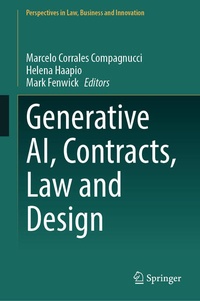
Generative AI, Contracts, Law and Design
Description

This book explores how generative AI and design are reshaping the law, legal communication, and contracting-moving beyond automation toward collaboration and meaningful outcomes. Combining theory and practice, it addresses challenges such as privacy, communication, financial well-being, responsible AI use, and the language of contracts.
This edited book breaks new ground in exploring how generative AI and design are acting as catalysts for change in law, legal communication, and contracting. Together, they are transforming the way we think and act-moving beyond automation toward collaboration, actionability, and achieving goals. Bringing together theoretical insights and practical experiments, the book features contributions from scholars and practitioners working at the intersection of law, business, technology, and design.
Chapters address topics such as AI-enhanced financial well-being and debt support; bridging the implementation gap in contracting; improving the usability of privacy communication and health data; and protecting artistic style in the age of AI. Threaded through these diverse contributions, common questions emerge: If the purpose of contracts is to establish and achieve common goals, why does their language so often seem arcane-like a magic spell-and how can AI help us change that? How can we responsibly integrate AI into legal, health, and commercial information to enhance usability and understanding? What does responsible AI use look like in practice, and how can design principles guide it?
This book provides legal professionals, technologists, designers, business leaders, and policymakers with the insight and tools necessary to shape the future of law and contracts creatively and critically.
More details
Other editions
Additional editions
Persons
Marcelo Corrales Compagnucci is an Associate Professor and Associate Director at the Center for Advanced Studies in Bioscience Innovation Law (CeBIL), Faculty of Law, University of Copenhagen in Denmark. He is also an Inter-CeBIL Research Affiliate at the Petrie-Flom Center for Health Law Policy, Biotechnology, and Bioethics at Harvard Law School. He specializes in information technology, privacy and data protection law. His research interests are the legal issues involved in disruptive innovation technologies and biomedicine. His past activities have included working as a consultant and lawyer for law firms and IT companies. He was also a research associate with the Institute for Legal Informatics (IRI) at Leibniz Universität Hannover in Germany and a visiting research fellow in various research centers around the world, including Harvard Law School, Cambridge University, the Max Planck Institute, University of Edinburgh, Turin University, and the Academia Sinica in Taiwan.
Helena Haapio is a Professor of Practice in Strategic Business Law at the University of Vaasa, Finland, Senior Researcher in the JARGONFREE Contract Language Research Group at Tampere University, Docent of Proactive Law and Contract Design at the University of Lapland and Contract Strategist at Lexpert Ltd. As a pioneer of Proactive Law and Legal Design, she has been promoting the use of simplification and visualization of legal information for many years. Her research and practice focus on operationalizing legal information design and using AI and design tools to transform contracts into strategic business tools that take into account the needs of different user groups, prevent misunderstandings, ease implementation, and drive better outcomes. Together with Stefania Passera, she created the WorldCC Contract Design Pattern Library.
Mark Fenwick is a Professor of International Business Law at the Faculty of Law, Kyushu University, Fukuoka, Japan. His primary research interests are in the fields of business regulation in a networked age, and white-collar and corporate crime. Recent publications include New Technology, Big Data & the Law (Springer, 2017: co-edited with M Corrales Compagnucci and N Forgó), Robotics, AI and the Future of Law (Springer, 2018: co-edited with M Corrales Compagnucci and N Forgó), Smart Contracts: Business, Legal & Technological Perspectives (Hart, 2021: co-edited with M Corrales Compagnucci and S Wrbka), Organizing-for-Innovation: Corporate Governance in a Digital Age (Springer, 2023: co-authored with EPM Vermeulen and T Kono), and The Law & Ethics of Data-Sharing (Springer, 2024; co-edited with M Corrales Compagnucci, T Minssen, M Aboy, and K Liddell).
Content
Chapter 1 Generative AI and the Future of Contracts, Law and Design.- Chapter 2 No More Legal Writing in Contracts - Time to Break the Magic Spell!.- Chapter 3 Contracting: Is Generative AI Really Making a Difference?.- Chapter 4 AI as a Financial Coach - Promoting Sustainable Financial Management with Generative AI.- Chapter 5 Generative AI, Can You Help Us Bridge the Implementation Gap in Contracting?.- Chapter 6 Generative AI: Can Rule of Law Be Bargained for the Sake of Legal Tech Efficiency?.- Chapter 7 Proactive Privacy Communication Design for Emotional Robots.
