

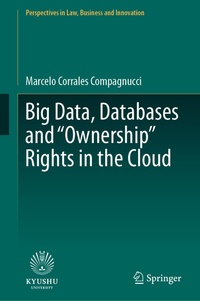
Big Data, Databases and "Ownership" Rights in the Cloud
Description

Two of the most important developments of this new century are the emergence of cloud computing and big data. However, the uncertainties surrounding the failure of cloud service providers to clearly assert ownership rights over data and databases during cloud computing transactions and big data services have been perceived as imposing legal risks and transaction costs. This lack of clear ownership rights is also seen as slowing down the capacity of the Internet market to thrive. Click-through agreements drafted on a take-it-or-leave-it basis govern the current state of the art, and they do not allow much room for negotiation. The novel contribution of this book proffers a new contractual model advocating the extension of the negotiation capabilities of cloud customers, thus enabling an automated and machine-readable framework, orchestrated by a cloud broker.
Cloud computing and big data are constantly evolving and transforming into new paradigms where cloud brokers are predicted to play a vital role as innovation intermediaries adding extra value to the entire life cycle. This evolution will alleviate the legal uncertainties in society by means of embedding legal requirements in the user interface and related computer systems or its code. This book situates the theories of law and economics and behavioral law and economics in the context of cloud computing and takes database rights and ownership rights of data as prime examples to represent the problem of collecting, outsourcing, and sharing data and databases on a global scale. It does this by highlighting the legal constraints concerning ownership rights of data and databases and proposes finding a solution outside the boundaries and limitations of the law.
By allowing cloud brokers to establish themselves in the market as entities coordinating and actively engaging in the negotiation of service-level agreements (SLAs), individual customers as well as small and medium-sized enterprises could efficiently and effortlessly choose a cloud provider that best suits their needs. This approach, which the author calls "plan-like architectures," endeavors to create a more trustworthy cloud computing environment and to yield radical new results for the development of the cloud computing and big data markets.
More details
Other editions
Additional editions
Person
Dr. Marcelo Corrales Compagnucci is Attorney-at-Law specializing in intellectual property (IP), information technology (IT) and corporate law. His research interests are the legal issues involved in disruptive innovation technologies. He is currently a Postdoctoral Researcher at the Centre for Advanced Studies in Biomedical Innovation Law (CeBIL), Faculty of Law, University of Copenhagen in Denmark. His past activities have included working as a consultant and lawyer for law firms and IT companies. He was also a research associate with the Institute for Legal Informatics (IRI) at Leibniz Unvirsität Hannover in Germany, and a visiting research fellow in various research centers around the world, including the Max Planck Institute for Comparative and International Private Law (Hamburg), the Max Planck Institute for Innovation and Competition (Munich), the Shepherd and Wedderburn Centre for Research in Intellectual Property and Technology (SCRIPT) within the University of Edinburgh in Scotland, and the Academia Sinica in Taiwan. He has a Doctor of Laws (LL.D.) degree from Kyushu University in Japan. He also holds a Master of Laws (LL.M.) in international economics and business law from Kyushu University, and an LL.M. in law and information technology and an LL.M. in European intellectual property law, both from the University of Stockholm in Sweden. He has several publications in the field of IT & IP Law. His most recent publications include New Technology, Big Data and the Law (Springer, 2017); Robotics, AI and the Future of Law (Springer, 2018); and Legal Tech, Smart Contracts and Blockchain (Springer, 2019).
Content
PART I - Fundamental Legal, Theoretical and Technical Issues.-Chapter 1 Database Rights in Big Data and the Cloud - Main Legal Considerations.Chapter 2 Brokers, Clouds and Databases - The Good, the Bad and the Ugly.- Chapter 3 Law and Economics - Five Core Principles in the Cloud.- PART II - A New Theoretical Framework.- Chapter 4 Plan-like Architectures.- Chapter 5 Plans, Brokers and Trust.- Chapter 6 Framing Choice Architectures.- PART III - A New Contractual Model.- Chapter 7 Improved Template for SLAs.- Chapter 8 Towards a Legal Risk Assessment.- Chapter 9 Conclusion - Main Findings and Contributions to the Current Knowledge.- Index.
